
Inflation Remains a Top Concern—2025 Survey Shows Evolution in Sentiment
Cambodians continue to grapple with economic pressures as inflation remains a significant concern. However, our latest 2025 Cambodian consumer research reveals a shifting landscape in how Cambodians view their economic challenges and purchasing power.

Inflation, described as the rise in the general level of prices of goods and services in an economy over time, is a major concern for many people worldwide. And it’s not hard to see why—when prices go up, our purchasing power goes down. This can make it difficult to make ends meet, especially for those on a fixed income.
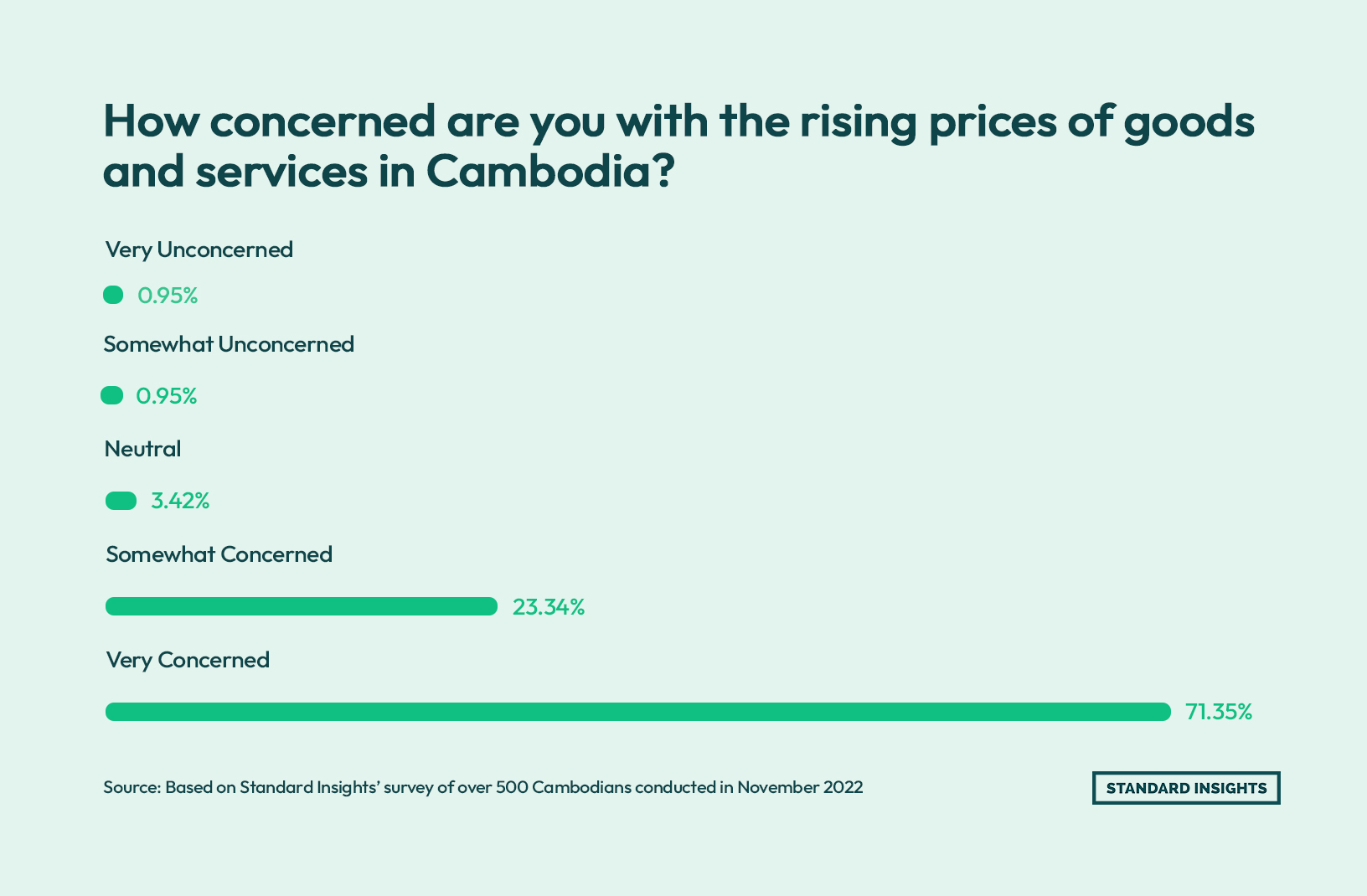
Inflation in Cambodia has been a big problem in recent years. Our market research study of over 500 Cambodians has even found that 71.35% of Cambodians are very concerned about inflation in 2022.
The Current State of Inflation in SEA and Cambodia
According to the International Monetary Fund, world inflation is expected to reach 8.8% in 2022 (compared with 2021 prices). It also anticipates a convergence of advanced and developing economies as geopolitical tensions drive up energy prices and supply-side disruptions distort consumer prices. As a result, nearly half of the world’s countries are experiencing double-digit inflation or greater.
Zooming in on Southeast Asia (SEA), inflation is also regarded as a pressing issue, with the region’s rapid economic growth and a volatile political climate driving up prices for goods and services. It is a persistent problem in the region, and as of 2019, the inflation rate averaged 3.9%.
In Cambodia, inflation has been on the rise since 2017 due to soaring fuel prices and the depreciation of the Riel. The consumer price index (CPI) increased from 1.9% in 2017 to 3% in 2019, with food being the most affected product category, increasing by an average of 6%.
Incidentally, the National Bank of Cambodia reported that inflation in Cambodia decreased to 4.40% in September from 4.90% in August of 2022. According to their report, although Cambodia’s inflation rate fluctuated substantially in recent months, it tended to increase through periods from October 2021 to September 2022, ending at 4.4 % in September 2022.

This rise in inflation in Cambodia has caused prices to increase across all sectors, including housing, healthcare, and transportation services. In addition, income inequality is higher than the regional average due to poor economic conditions, leading to a widening gap between rich and poor households. As a result, poorer families are more affected by rising living costs as they have less money to spend on essential items such as food or medical supplies.
The government has taken steps to alleviate some of these financial pressures through tax breaks and minimum wage increases, but more needs to be done if Cambodia is going to tackle its growing inflation problem.
How Cambodians Feel About the Economy in 2025
As of 2025, Cambodia’s economic outlook shows signs of both resilience and continued challenges. Our recent survey of 500 Cambodians reveals nuanced perspectives on the country’s economic trajectory—a marked evolution from the near-universal inflation concerns documented in our 2022 research.
How Confident Are Cambodians About Cambodia’s Economy?
Unlike the nearly universal concern about inflation observed in our 2022 study, sentiment in 2025 shows greater variation. When asked about their confidence level in Cambodia’s economy:
- 37.6% express being “somewhat confident”
- 29.0% remain “neutral”
- 15.0% are “very confident”
- 14.8% are “not confident”
- Only 3.6% report being “not confident at all”
This distribution suggests a cautiously optimistic outlook, with over half of respondents (52.6%) expressing some level of confidence in the economy, a notable shift from the pervasive concern documented in 2022.
Is Purchasing Power Increasing or Decreasing in Cambodia?
When comparing their purchasing power for consumer goods to the previous year, Cambodians present a divided perspective:
- 27.8% report it’s “about the same”
- 24.4% say it’s “somewhat lower”
- 23.8% indicate it’s “somewhat higher”
- 17.2% feel it’s “much higher”
- 6.8% report it’s “much lower”
Interestingly, 41% of respondents report improved purchasing power (combining “somewhat higher” and “much higher”), suggesting that while challenges persist, many Cambodians are experiencing economic gains compared to previous years.
What Do Cambodians Expect for Their Purchasing Power in 2025?
Cambodian consumers show measured optimism about their purchasing power evolution in 2025:
- 31.8% expect it to “increase slightly”
- 22.4% anticipate it will “decrease slightly”
- 22.4% believe it will “remain the same as it is today”
- 12.0% expect it to “increase significantly”
- 11.4% predict it will “decrease significantly”
Notably, 43.8% of respondents expect their purchasing power to increase in some capacity, outweighing the 33.8% who anticipate a decrease. This forward-looking optimism, combined with current experiences of improved purchasing power, paints a picture of an economy in transition—moving from crisis management to cautious growth.
3 Factors Causing The Inflation in Cambodia
1. Rising Dollarization in Cambodia
According to our recent market research study in Cambodia, although the Cambodian Riel is the main currency in Cambodia, over half of the surveyed respondents (56.17%) also frequently use the US dollar.

Described as the process whereby locals prefer to save or spend American dollars instead of their country’s domestic currency, this dollarization has become a major issue in Cambodia due to its severe inflationary pressures.
For Cambodia, the dollarization of its currency has resulted in excessive reliance on the US dollar, resulting in the Cambodian Riel’s inability to operate as a reliable store of value, worsening the country’s already high rate of inflation exponentially.
As dollarization continues in Cambodia, with the local population turning more frequently to dollar-denominated goods, it will become increasingly difficult for the nation’s fragile monetary system to cope with rising inflation.
2. Rising Food Prices and Rising Fuel Prices
Rising food and fuel prices in Cambodia drove consumer price inflation to 7.8% in June before dropping to 5.4% in July, according to the World Bank.
Prices for food in the country have been increasing steadily over the past few years. A combination of factors is responsible, including increased demand from tourists, poor management of water resources, and agricultural production constraints caused by climate change.

Additionally, the rising fuel cost in the country is another major factor behind inflation in Cambodia. Since most goods and services depend on transportation costs for their delivery, these costs have been driven up as fuel prices have risen. The increase in oil and gas prices is largely due to global trends, such as increased demand for oil and gas worldwide, coupled with geopolitical tensions that have resulted in artificial supply constraints.
3. Rising Costs of Housing and Utilities
The Khmer Times has reported that property prices in Cambodia are expected to rise more than 7% in 2022 as developers look to increase prices while the country’s economy reopens and measures and restrictions continue to ease. Aside from the aforementioned factors, real estate experts attribute the expected price increase to the fact that Cambodia, particularly the capital Phnom Penh, is a rapidly developing area that is appealing to foreign investors, with some developers even planning to adjust prices back to pre-pandemic levels.
However, CBRE Cambodia Associate Director Kim Kin Kesa predicts that the growth in demand in Cambodia’s real estate sector will be limited in 2023. She cites the worldwide economic recession, Cambodia’s slow recovery, the global geopolitical crises, high inflation, and rising energy, construction, and transportation prices as reasons impacting this restricted growth.
Cambodian Economic Priorities in 2025
Evolving Economic Priorities
While poverty and inequality remain significant concerns, our 2025 research reveals a broader spectrum of challenges facing Cambodia:
Biggest Challenges Faced by Cambodia in 2024 (from respondents’ perspectives):
- Poverty and inequality: 28.3%
- Quality education: 16.4%
- Decent work and economic growth: 14.1%
- Good health and well-being: 11.7%
- Peace, justice, and strong institutions: 11.1%
- Climate action: 7.1%
- Industry, innovation, and infrastructure: 4.5%
This data shows that while poverty remains the top concern, education, employment, and institutional strength have emerged as critical priorities for Cambodians.
5. Shifting Financial Priorities:
Cambodian financial goals for 2025 reflect a balance between managing current obligations and planning for the future:
- Pay off debt, including student loans and credit cards: 30.4%
- Save for a major purchase like a house or car: 28.4%
- Plan and save for future travel or vacation goals: 18.2%
- Fund education or skill development: 7.4%
- Invest for retirement: 6.0%
- Start a business or invest in entrepreneurial ventures: 4.6%
The emphasis on debt repayment and major purchases suggests consumers are working to stabilize their financial situations while also investing in tangible assets.
Economic Growth in Cambodia
The World Bank forecasts Cambodia’s GDP to grow 4.8% in 2022, and rise for the next two years while remaining below pre-pandemic levels. Further, inflation in Cambodia may hit 6%, more than double the rates of the last two years, as food and fuel prices rise.
The country’s economy, meanwhile, is expected to rise at a 5.2% annual rate next year and 6.3% by 2024. This anticipated growth shows further signs of recovery after the country saw its first negative growth since 1994 in 2020, during the first year of the COVID-19 outbreak and global economic slowdown.
Are Cambodians concerned about inflation? (2022)
Although inflation does create more economic opportunities for citizens and businesses, it also drives up costs for everyday goods and services, putting pressure on Cambodian citizens from all walks of life. While some can absorb the cost increases and maintain their current spending levels, many Cambodians are feeling the pinch.
With wages unable to keep up with inflation levels, many people are struggling to make ends meet and provide for their families. As a result, concerns about inflation problems are widespread among Cambodians.
In November 2022, we surveyed over 500 Cambodians and found out that almost 95% of respondents are concerned about inflation in their country.
Specifically, more Cambodians are concerned about resolving poverty issues (29.41%), inclusive security & justice (24.86%), as well as health issues (22.96%).

How are Cambodians anticipating inflation?
In the same study, 43.64% of Cambodians are anticipating spending less money on food and other household items, and 32.07% of them are planning to decrease their spending on housing, due to rising concerns caused by inflation.
The same goes for all age groups and genders when it comes to the rise in prices and their impact. A tighter budget would be implemented by families to purchase less amount of food and other household items, as well as housing.

To keep up with inflation in Cambodia, many people have begun to look toward sustainability as an effective and economical solution. Sustainability includes methods such as preserving energy by switching off lights and electronics when not in use.
In our study, 56.36% of Cambodians avoided food wastage to promote sustainability, besides other popular activities like walking, biking, or using public transit (32.83%), and buying local items (32.64%).

On the other hand, NBC Governor Chanto, while speaking at a conference in July 2022, remarked that the prolonged Russia-Ukraine conflict and the sanctions against Russia had increased food and oil prices, causing inflation hikes in Cambodia.
Taking that into account, NBC is considering implementing a monetary policy to control inflation in Cambodia and support economic recovery by stabilizing the exchange rate and maintaining the purchasing power of the local currency and the income of vulnerable groups.
Furthermore, to promote economic growth, the monetary easing policy will continue to be implemented by ensuring that the required reserve ratio is kept at 7%, thus helping financial institutions and banks to have more cash.
Discover our findings about Cambodia in 2023 or explore our interactive Consumer Report Cambodia 2025.
Conclusion
Cambodia’s strong growth performance in the last decade relied heavily on exports to world markets, particularly the United States and Europe, and inflows of foreign direct investment and official development assistance under the newly liberalized economic regime. Cambodia, therefore, is not immune to storms.
The country’s inflation crisis is a timely wake-up call, highlighting challenges and opportunities for Cambodia’s continued economic stability, growth, and future prosperity.
Ready to empower your brand with Cambodian consumer insights? Gain the knowledge to tailor your products, messaging, and marketing to resonate deeply with your target audience. Navigate the market with confidence and achieve your business goals with our Market Research in Cambodia.