
You know your customer.
Can you prove it?
Audience profiling built from real consumer data — who they are, what they value, where you sit in their world, and what actually drives the choice.
Usually ordered when: entering a market, launching into a new segment, or briefing an agency who's about to ask who the audience is - and the only answer in the building is a persona someone invented in a workshop. Audience profiling replaces it with 300 real people.
Audience profiling on one screen.
Who qualified into your category, what they look like, and which brand they actually prefer. Four figures at the top, four sections underneath, and an analyst's read of what it means at the bottom.
Who they actually are
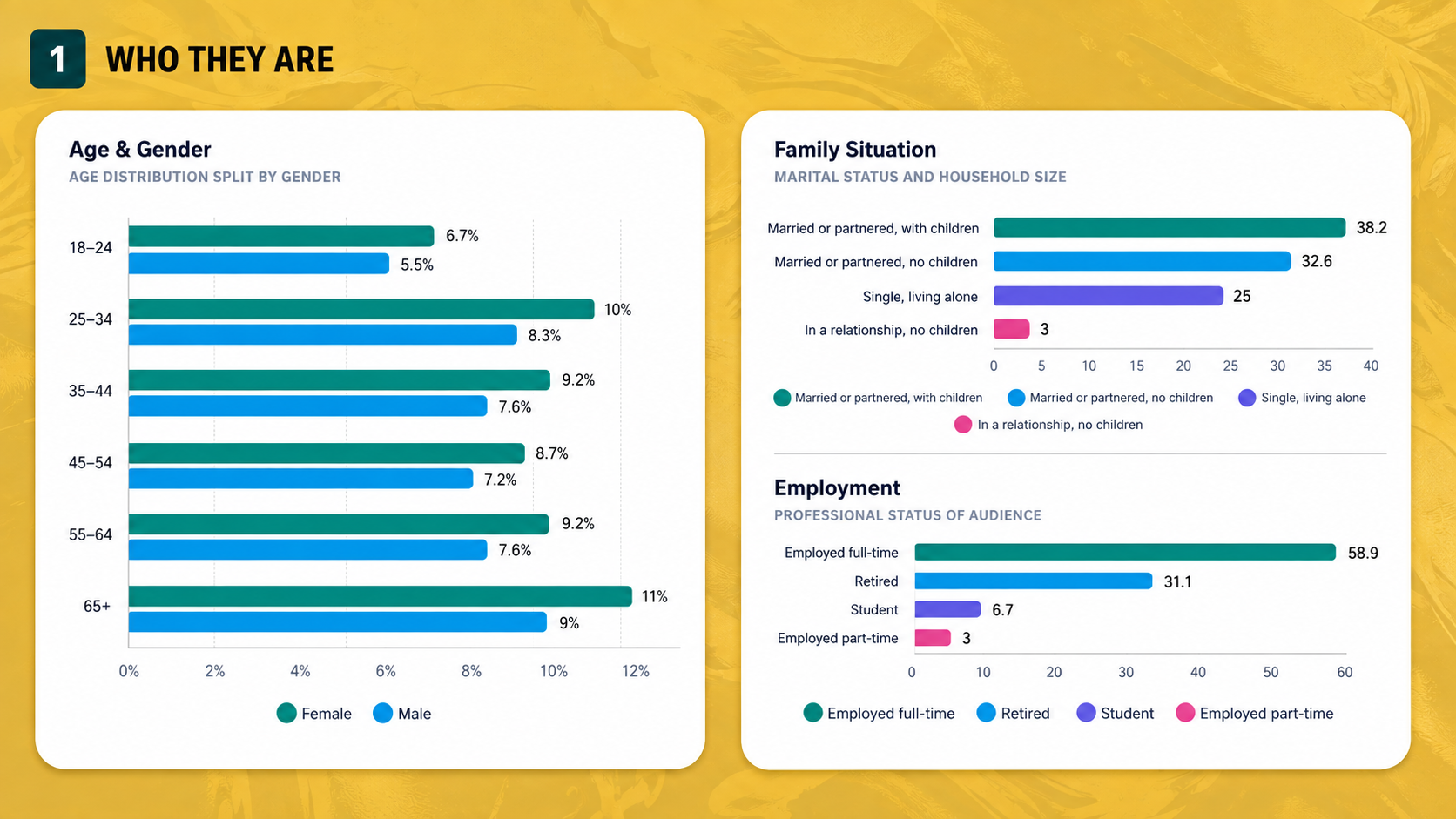
Age, gender, household, work - and what they spend their time and attention on. The demographic reality, not the target you wrote down.
Where you sit with them
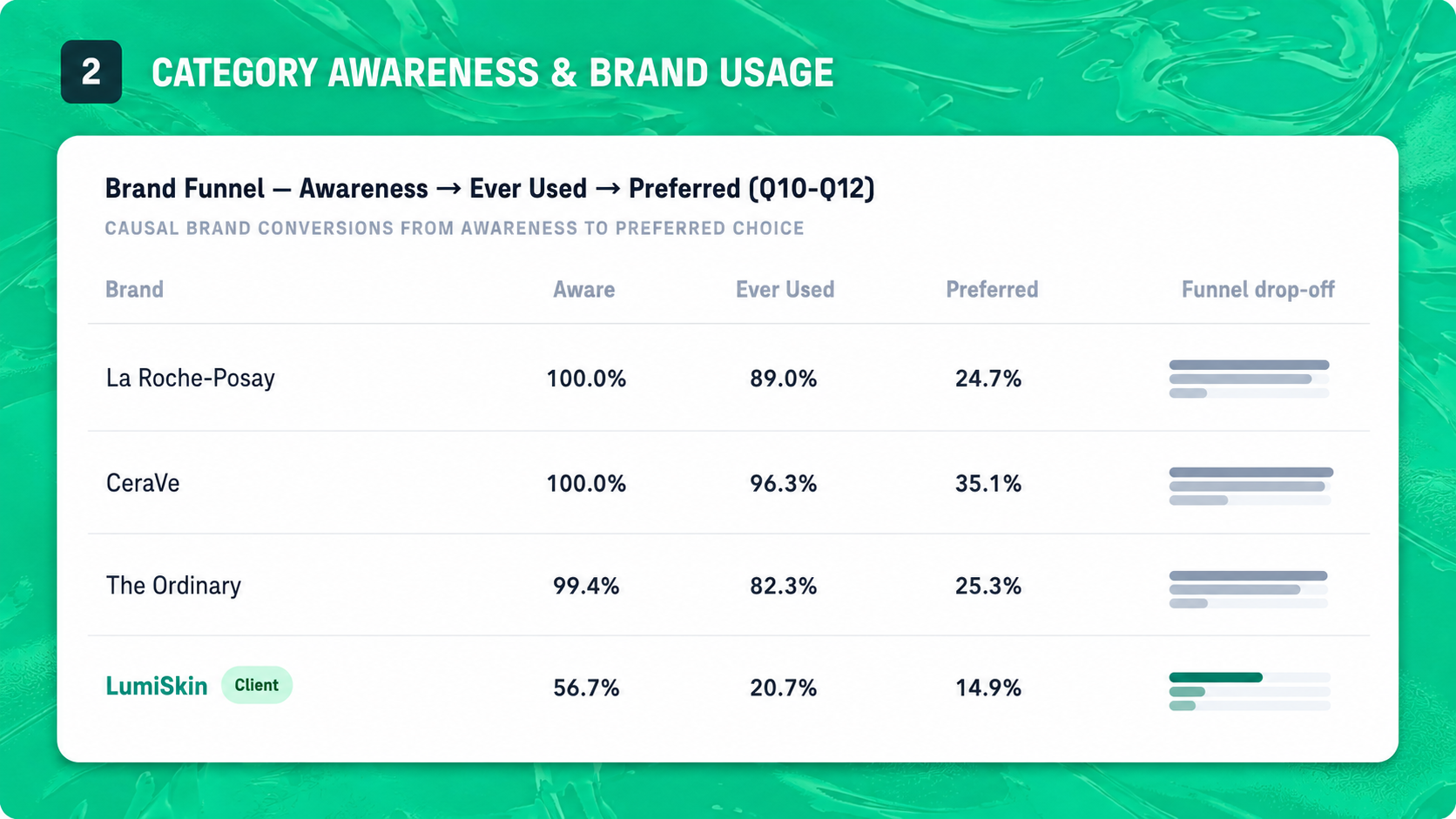
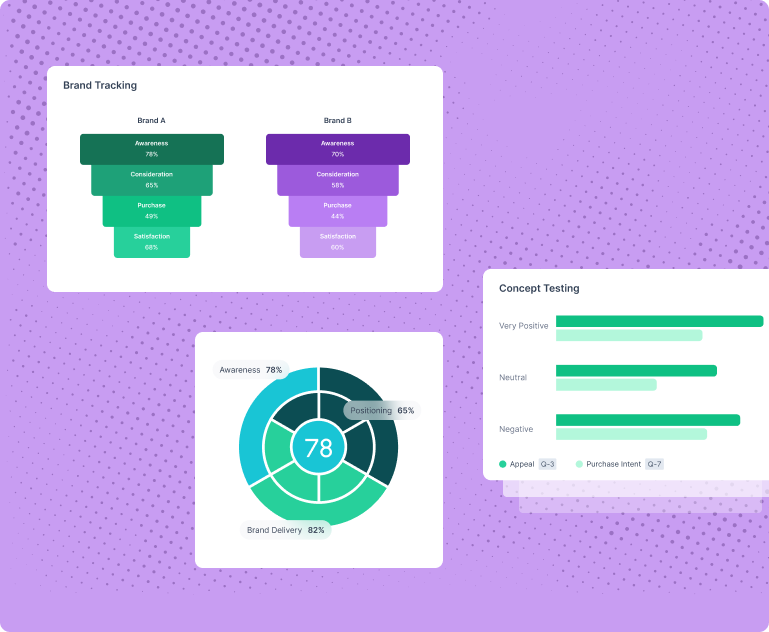
Your funnel against every competitor, from the same respondents. Aware, tried, preferred - and where you leak between the three.
What decides it
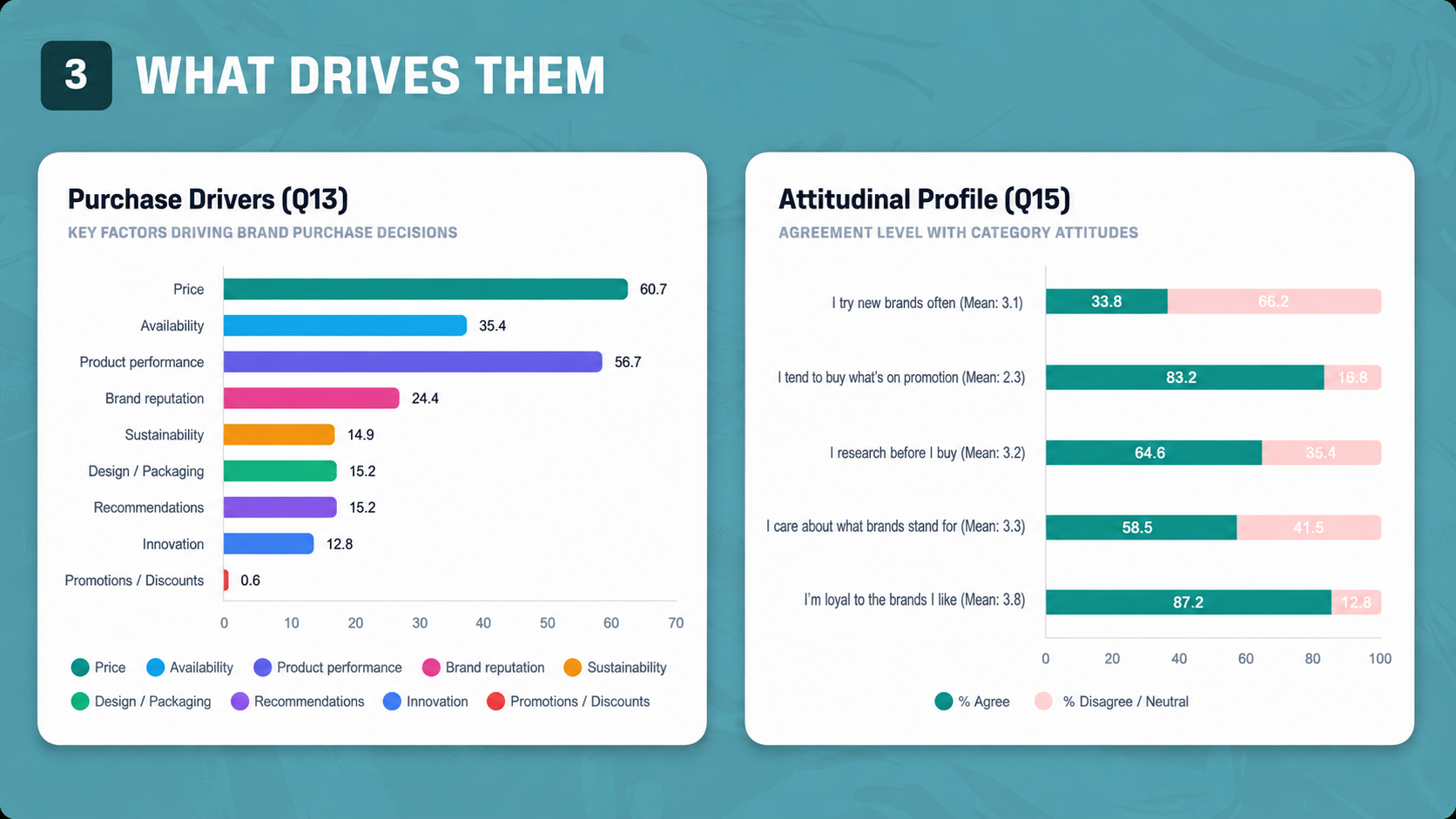
The factors driving the choice, and the reasons underneath them in consumers' own words. The route in, named rather than implied.
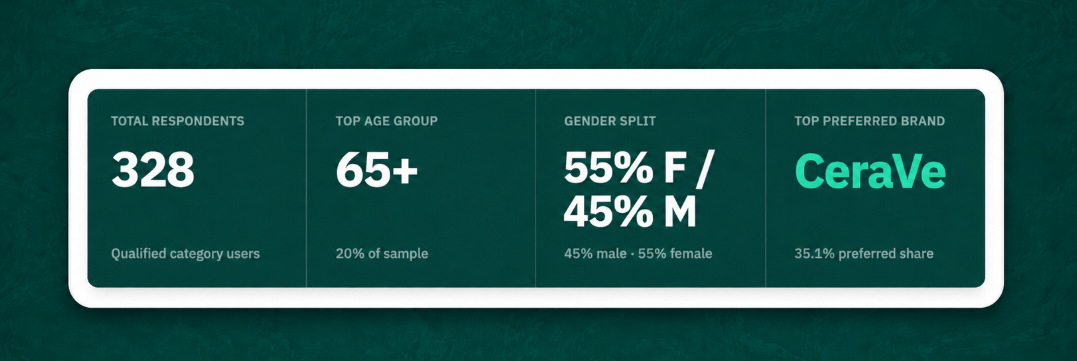
No go/no-go here. Audience profiling doesn't produce a verdict — it produces a picture specific enough to target against, and a stated recommendation on where to start.
Three reads, and the reasoning behind them.
Enough to brief an agency without opening anything else — and if someone wants to dig, the full audience profiling report is underneath.
Who they actually are.
- Age split by gender & household composition
- Employment, status & lifestyle interests
- Personal life priorities vs category claims
Where you stand.
- Aware, ever used & preferred funnel table
- Direct client brand vs competitor comparison
- Conversion shape & leakage diagnostic
What moves them.
- Ranked purchase decision factors
- Attitudinal profile agreement vs disagreement
- Motivation themes & analyst recommendation
01 - Who they are
Demographics, lifestyle & priorities.
Age split by gender, not separately. A category can be 55% female overall and skew entirely differently at the ends. Family situation and employment - household composition and professional status, because a plan built for one and a plan built for the other are different plans. Lifestyle interests - what they do with their time, ranked. This is where media planning starts. Personal priorities - what they say matters most in their life, which is a different question from what matters in your category. The gap between them is usually where messaging goes wrong.
02 - Where you stand
Brand funnel & conversion shape.
A brand funnel table - aware, ever used, preferred, for you and every competitor, with the drop-off shown at each step. Your client brand marked, so the comparison is immediate rather than something you have to work out. The shape matters more than the numbers. Low awareness with strong conversion is a completely different problem from high awareness with weak preference - and the funnel tells you which one you have.
03 - What drives them, and the route in
Motivations, barriers & recommended focus.
Purchase drivers - what decides the brand, ranked. Price, availability, performance, reputation, sustainability. Attitudinal profile with agreement and disagreement shown together, so a mid-range mean doesn't hide a split audience. Motivation themes, clustered from open-text answers. Why those factors matter, in their words, before anyone offered them a list. Usage frequency, channels and occasions - how often, where they buy, and when they use it. Plus usage context themes from the verbatims. Analyst notes ending on a recommended focus. Not a summary of the charts - a read of what the funnel shape means, what the route in is, and what to do first.
Full Report Underneath
And the full report, if the answer raises another question.
Behind the dashboard sits the complete report - personas built from these respondents, segment cross-tabs, verbatim responses, market context, and every question exactly as it was answered.
See what's in a full report →Audience profiling in three steps.
You define who counts as your consumer. We find them, ask nineteen questions about their lives, their category and your brand, and hand back the picture.
In just a few minutes.
- Name your category and qualifying behaviour - for example, bought in the last three months. Everyone who answers has to clear it
- Name your brand and up to five competitors. Leave them blank and we build the set from your category
- Pick your market. One per study - run several in parallel if you need more
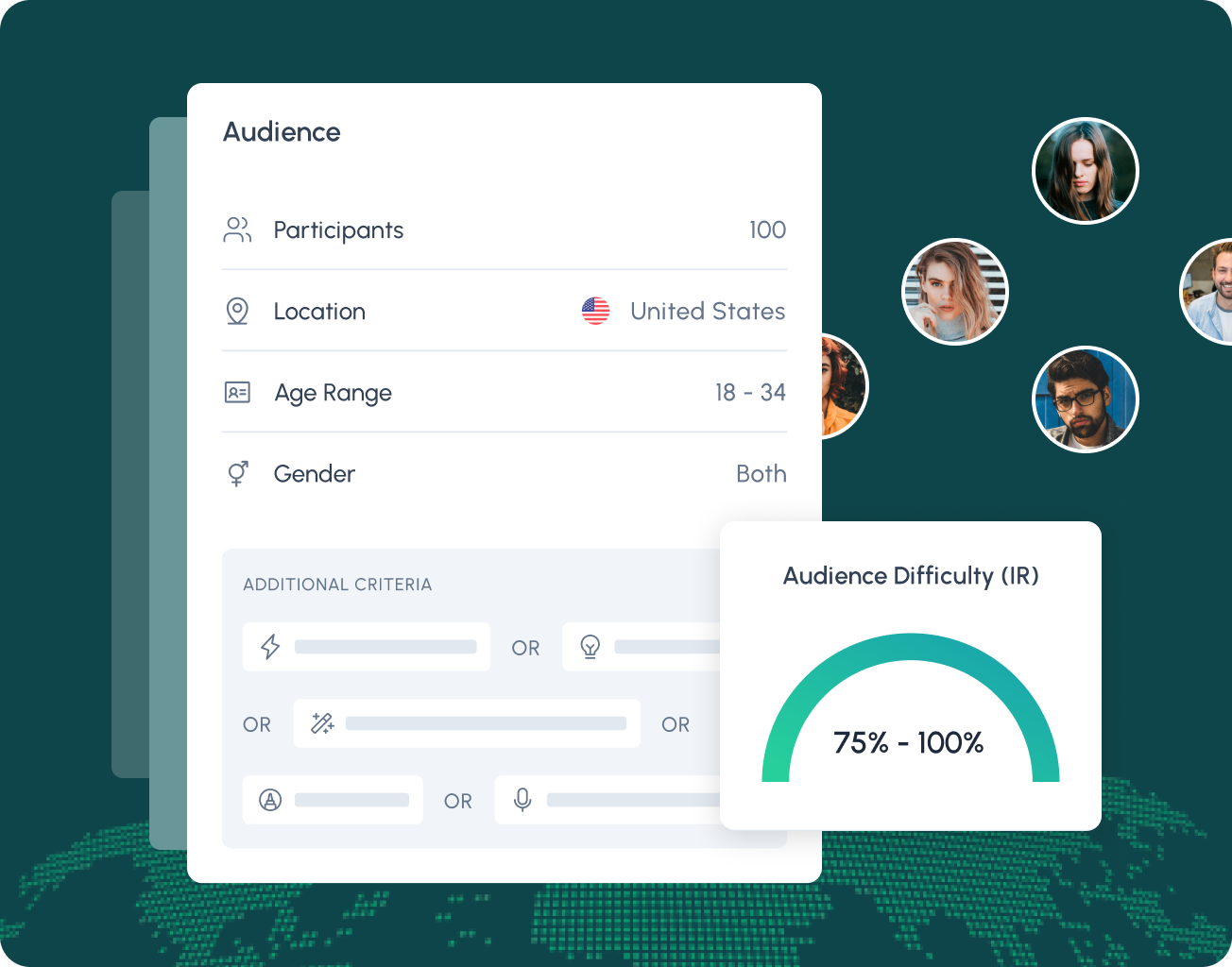
- You set it up yourself, in your own workspace - audience, criteria, add-ons - with the price updating as you go. No quote to wait for, no procurement step.


Why the answer holds up.
Personas have a bad reputation and they've earned it. Most are assembled in a workshop, given a stock photo and a first name, and quietly ignored. Audience profiling personas come out of what 300 qualified people actually said.
Who answers
- Screened into your category, every one of them. A general population sample would dilute exactly what you're trying to see
- 170M+ verified consumers across 130+ markets, from Kantar Profiles, Cint and Dynata
- Never synthetic. Every response comes from a verified human, not a model
- 300 respondents minimum, so each persona rests on a real group rather than a handful of people
How it's asked
- Qualification runs first. The screener happens before anything else, and non-users are out
- Every brand measured from the same respondents, so the funnel comparison is like for like
- Open questions before prompts. Motivations and usage context are captured in their words, then clustered - the themes come from consumers, not from a list we wrote
- You get the sample you ordered. Order 300, receive 300 clean responses - removals are on us
How it's read
- Personas clustered from the data, not written to a brief. If the audience splits three ways you get three, not the five somebody expected
- A person writes the recommended focus. Audience profiling doesn't reduce to a threshold, so an analyst reads the funnel shape and names what to do first
- Base sizes on every cut, and where a finding rests on a subgroup, that's stated
- Where the sample skews, the notes say so - so you know which breakouts are solid and which are directional
Run it yourself, or have us run it.
Same nineteen questions. Same 300 screened consumers. Same 24 hours.
Run it yourself
Name your category, your qualifying behaviour and your competitive set. The price updates as you go, and you pay online.
Have us run it
Tell us who you're trying to reach and what you're deciding. We define the qualifying criteria with you, run the study, and deliver the picture — with an analyst to translate the personas into a targeting brief.
You're a good fit if
You're not a good fit if
Audience profiling questions, answered.
What is audience profiling?
Audience profiling builds a picture of who actually buys in your category, from 300 screened category consumers rather than a general population sample. It covers demographics and lifestyle, your brand funnel against up to five named competitors, ranked purchase drivers, and the reasons underneath them in consumers' own words. You get three to five personas clustered from the data, plus an analyst's recommended focus. 24 hours, $2,990.
How much does audience profiling cost?
$2,990 per study, covering 300 screened respondents in one of 130+ markets, nineteen questions, up to five competitors, personas and analyst notes. Categories with an incidence rate under 30% need a custom quote.
How are the personas actually built?
By clustering the 300 responses - grouping people who answered similarly across demographics, values, brand relationship and buying behaviour. The groups come out of the data. Nobody decides in advance that there'll be a "Busy Mum" and a "Young Professional."
How many personas will I get?
Three to five, depending on how the audience genuinely splits. A category with one dominant behaviour pattern gets three. A fragmented one gets five. We don't pad it to hit a number.
Do I get a verdict like the other Standard Studies?
No, and that's deliberate. A concept test can say deploy or don't; audience profiling can't. What you get instead is a picture specific enough to target against, plus a recommended focus from the analyst on where to start.
Can I use them for media targeting?
That's what they're built for. Each persona carries the demographic, behavioural and channel detail a planner needs, so it can go into a targeting brief without a translation step.
Can you run the study for us?
Yes. Tell us who you're trying to reach and what you're deciding — we define the qualifying criteria with you, run the study and deliver the picture, with an analyst to translate the personas into something a planner can target against. Same study, same 24 hours.
How is this different from Understand Your Market?
This tells you who they are. Understand Your Market tells you how the category works - the full journey, switching triggers, loyalty drivers and where the unmet needs sit. If you're deciding who to talk to, start here. If you're deciding how to compete, start there. Entering a new category, plenty of accounts run both.
This shows my brand funnel. How is that different from a brand health study?
Audience profiling shows the funnel as one part of a picture built around the people — who they are, what they value, what decides the choice. A brand health study is built around the brand: the full funnel, perception attributes, advertising and touchpoints, buyer profile, all against your named competitors, from $3,990. Start here if the question is who you're talking to. Start there if the question is where you stand.
Why can't I run this on a nationally representative sample?
Because a general population sample would be mostly people who don't use your category, and the personas would describe the country rather than your audience. Audience profiling needs a qualifying criterion every time — it's what makes the output specific enough to act on.
What counts as a qualifying criterion?
Usually a category and a timeframe: bought running shoes in the last six months, used a meal delivery service in the last three. You can layer on demographics or behaviour if you need to narrow it further.
Can I profile an audience in more than one market?
One market per audience profiling study. Run them in parallel if you need several - they'll use the same questionnaire, so the results stay comparable, and each is priced and sized for its own market.
Need the full buying journey too? See Understand Your Market →
Ready to launch.
The fastest way to an answer.
Whatever you're deciding, there's a study designed for it.
Test concepts, messages, and creative before you commit budget.
See Concept Testing →Test the finished creative against a control group, before the media spend.
See Brand Lift →Measure what your campaign actually changed.
See Campaign Recall →Measure your funnel, perception and position against your competitors.
See Brand Health →Build real audience segments from real consumer data.
You're here - Audience ProfilingSee how your category behaves before you plan.
See Usage & Attitudes →Find out who you're actually talking to.
Name your category and your consumer. Audience profiling runs from $2,990, and the picture is back in 24 hours.