
A fraction of the time.
A fraction of the price.
Here's how
it adds up.
This is how consumer research works when the overhead is removed.
Traditional research is slow and expensive because of what surrounds it, not because of what it is. Here's what we removed, what we kept, and what runs the rest.
How consumer research works here: what we removed, what we kept.
Every minute saved has to come from somewhere.
Here is exactly where - line by line, so you can check it against your
own experience of how research usually goes.
Removed
- Scoping calls and discovery workshops
- Written proposals, and the rounds of revision after them
- Procurement and PO cycles before anything can start
- A questionnaire drafted from a blank page every time
- Fieldwork coordinated by email between three parties
- Data cleaned by hand in spreadsheets
- Cross-tabs built one at a time
- Charts produced manually, then re-produced when a number changes
- Deck assembly, formatting, and template wrangling
- Internal review rounds before anything reaches you
Kept
- Frameworks designed by research analysts, one per study type - question wording, scales and analysis structure fixed in advance
- A human review of the questionnaire before it goes into field
- A human review of the sample and audience definition before fieldwork starts
- Quality removal and replenishment on every study, until the order is filled with responses that pass
- An analyst review of the finished report before it is released to you
- And one thing added: a report built to be used by the people who have to act on it, not filed by the people who commissioned it.
Nothing on the left is thinking. That's the whole trick.
What actually happens, in order.
Five steps, the same every time — this is how consumer research works whether you pick a ready-made study or write your own questions.
Pick a ready-made scenario, or build your own.
Either way: set your criteria, see the price, pay online - all in your own workspace, no call required to start. Ready-made scenarios and custom briefs both let you set audience size, targeting criteria, and add-ons, with the price updating as you go. Payment happens online, and there's no procurement step.
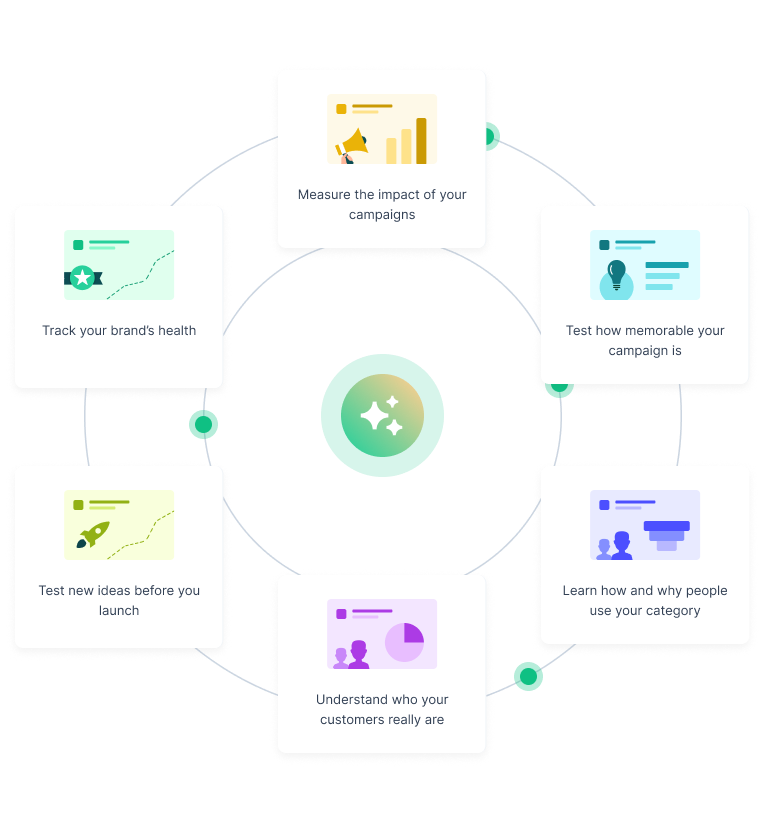
Real consumers, not simulated ones.
Your audience is matched to your criteria and sourced across 130+ markets through Kantar Profiles, Cint and Dynata — real people answering real questions, never synthetic or AI-generated responses. Broad audiences deliver in 24 hours; niche or low-incidence audiences can take up to 5 days, because sourcing the right real consumers takes longer, not because anything is cut short.
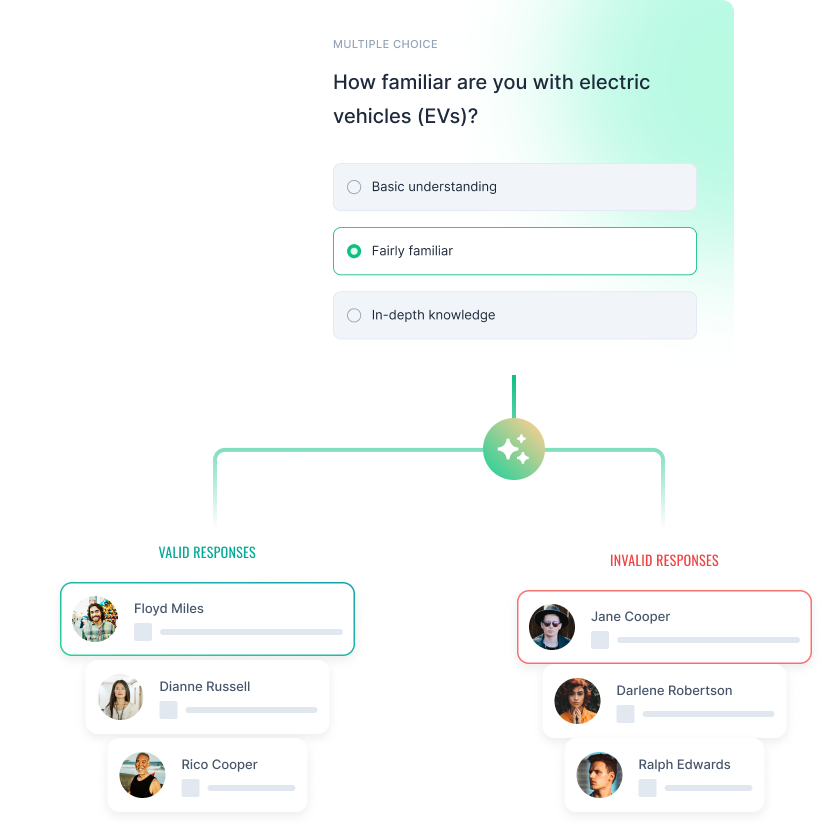
Every respondent, verified before they count.
Panel access gets you respondents. It doesn't guarantee they're the right ones, or that they were paying attention.
Geolocation
Confirms respondents are really where they say they are.
Speed detection
Flags anyone rushing through without reading.
AI consistency check
Catches answers that contradict each other or don't hold together.
Manual review
A human pass before anything ships.
Order 300 respondents, receive 300 quality respondents - even if we remove far more than that to get there.
Structured analysis, reviewed before it reaches you.
Cleaned data runs through structured AI analysis - built to answer your original question, not to improvise. Each study type follows an analysis framework built by research analysts, not a generic prompt, before a human review pass.
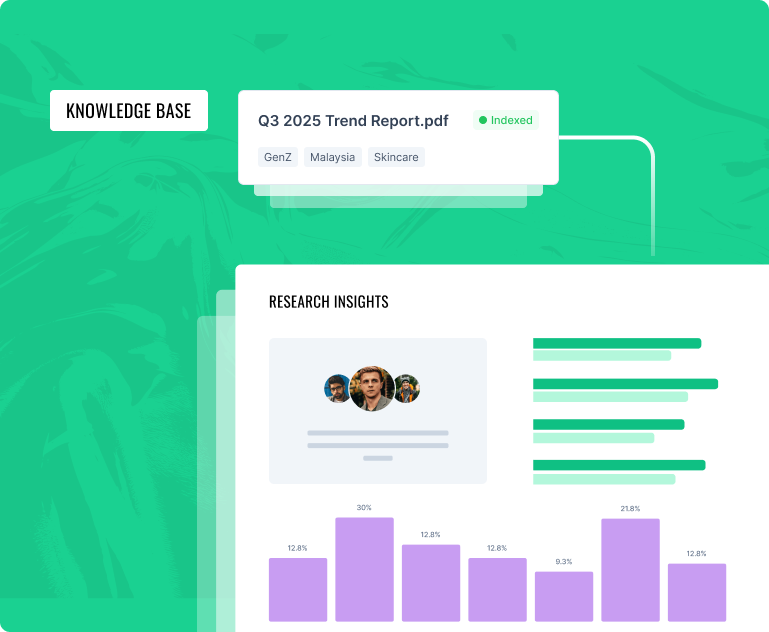
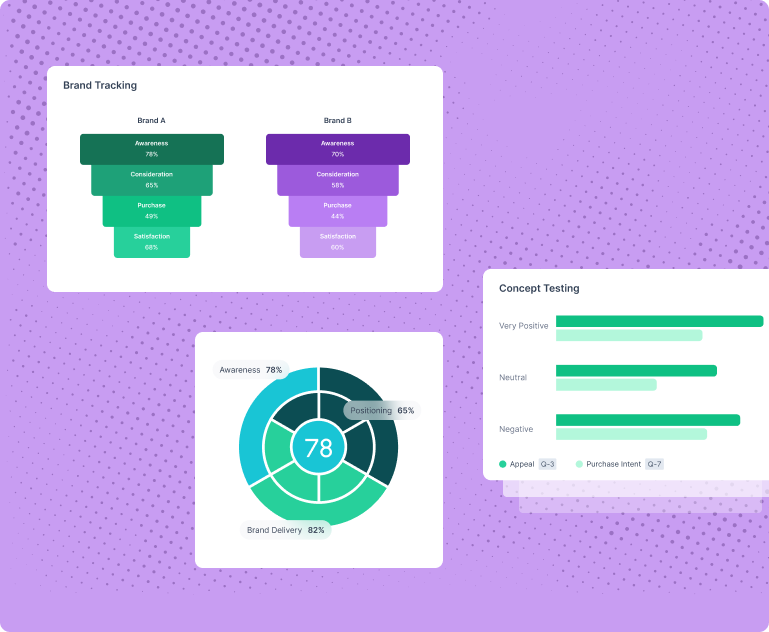
Curious what the report actually looks like? See What You Get →
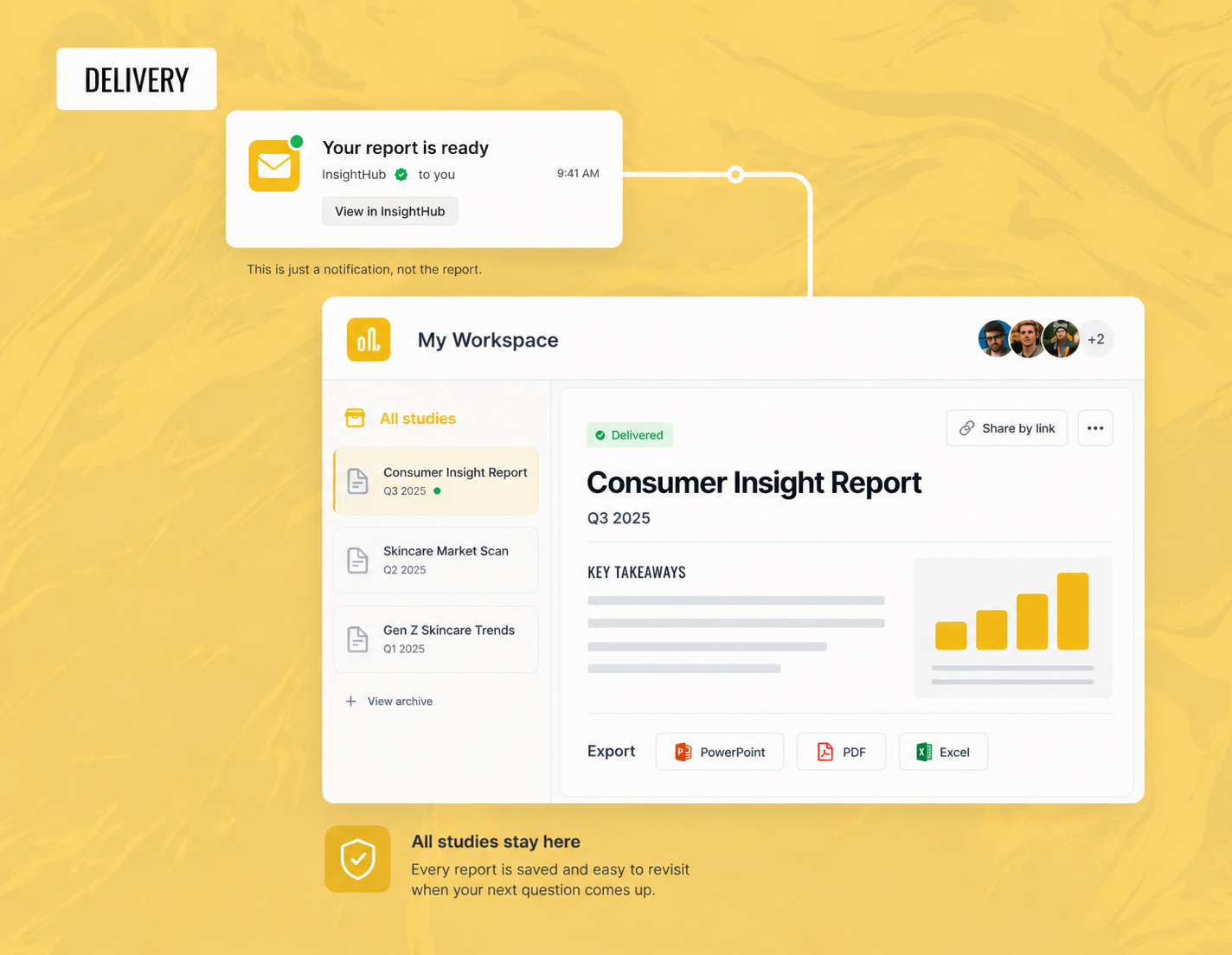
It lands in your workspace, not your inbox.
You get an email when it's ready, and the report opens in your own space - not as an attachment somebody has to forward. Share it by link with whoever needs it, export to PowerPoint, PDF or Excel, and come back to it whenever the next question comes up. Every study you run stays there.
You set it up, or we do.
The five steps above run the same either way. The only question is who does the first one.
You set it up
Pick a study, set your audience and criteria, watch the price update, pay online. No scoping call, no proposal, no procurement step. Most people who know what they want to ask start here.
We set it up
Tell us what you're deciding. We build the questionnaire, define the audience with you, run the study and deliver the report — with an analyst to walk you through what it says.
Available on every study, including custom questions. Scoped with you, because what it takes depends on what you're measuring.
Same fieldwork. Same quality control. Same report. Same 24 hours.
Where AI is used. Where it never is.
"AI analysis" is a phrase worth interrogating before you trust an answer that came out of one. Here is exactly how consumer research works with AI in it — including the things it isn't allowed to do.
AI does
- Removes low-quality responses, speeders and contradictory answers
- Builds cross-tabs and charts from the cleaned dataset
- Clusters respondents into personas from how they actually answered
- Drafts the written analysis against the study's framework
- Transcribes and translates open-ended and video responses
A person does
- Designs the framework each study type follows
- Reviews the questionnaire before it goes into field
- Reviews the sample and the audience definition
- Signs off the finished report before it is released
AI never does
- Generate a respondent. Every answer comes from a verified human, always
- Replace a human check. Nothing reaches you on automation alone
- Invent a finding. Analysis only runs on data that actually came back
- Decide the recommendation. It drafts; a person approves or rewrites it
How your sample size gets decided.
The honest answer is that it depends. How consumer research works on sample size is a function of your market, your category, and how many people in it match what you've asked for. So rather than publishing a number that would be wrong most of the time, the sizing is worked out for your specific study, and shown to you before you commit to anything.
Standard Studies come pre-sized
Each one ships with a sample size already set for the margin of error its conclusions need - chosen for what makes the findings hold, not for what is cheapest to field. You don't have to work it out, and you can't accidentally under-order.
Custom studies are sized as you build them
As you set market, audience and criteria, the order works out the real incidence rate for that audience in that market and shows you what sample size is achievable, what it costs, and how long it will take. Including when what you've asked for isn't feasible as specified.
The same audience isn't the same everywhere
An audience that's easy to reach in one market can be low-incidence in another, which changes both price and timing. That difference is shown at the point of ordering rather than discovered once fieldwork has started.
Trackers are sized per wave, and never scaled down
Always-on brand tracking runs 300 respondents every wave, all twelve. Reducing a wave to save money doesn't produce a cheaper tracker — it produces a series with a hole in it, and the trend line stops meaning anything.
When this isn't the right method.
How consumer research works here answers a lot of questions well. It doesn't answer all of them, and pretending otherwise would cost you more than it costs us.
Deep emotional exploration
Why somebody feels the way they do, uncovered over an hour of conversation rather than a questionnaire. That's qualitative work and it needs a moderator.
Observing rather than asking
Watching what people actually do in a store or in their home. Survey research captures what people report, which is not always the same thing.
Very low incidence audiences
Reachable, but not on standard pricing or timing. Worth a conversation first so nobody is surprised by the quote or the timeline.
Tracking the same individuals over time
Following one person's actual purchases across months is a different discipline. We can track a market's movement wave over wave; we don't follow individuals.
A method built around a novel hypothesis
If the question needs a study design that doesn't exist yet, it needs designing - which is a scoped project rather than an order.
If your question is on this list, say so and we'll tell you straight. Sometimes the honest answer is that we're not the right people, and you'll hear that from us rather than find out afterwards.
How consumer research works: your questions, answered.
How does consumer research work?
Five steps. You order online, setting your audience criteria and seeing the price before you commit. Real consumers matched to those criteria are sourced across 130+ markets. Every response passes geolocation, speed detection, an AI consistency check and a manual review before it counts. Cleaned data runs through an analysis framework built by research analysts for that study type, then an analyst reviews the report. It's delivered as a link in 24 to 72 hours. What's been removed is the overhead — scoping calls, proposals, procurement, manual data cleaning and deck assembly. What's kept is every human judgement step.
Why is it faster than traditional consumer research?
Because the eight-week timeline was never fieldwork. It was scoping calls, proposal rounds, procurement cycles, questionnaires drafted from scratch, fieldwork coordinated by email, data cleaned by hand, cross-tabs built one at a time, and deck assembly. None of that is thinking, and all of it is automated here. The analyst-designed frameworks, the questionnaire review, the sample review and the final sign-off all stay.
What if my incidence rate is very low?
We'll flag it upfront and quote a realistic timeline.
Can you run the whole study for us?
Yes, on every study. We build the questionnaire, define the audience with you, field it and deliver the report, with an analyst to walk you through the findings. It's scoped with you rather than listed, because what it takes depends on what you're measuring. Same fieldwork, same quality control, same report.
Can I run the same study repeatedly over time?
For brand measurement, yes — always-on brand tracking runs twelve monthly waves across a year, with the questions and audience fixed so the movement is real. Monthly is the only cadence, because longer gaps produce isolated readings rather than a series. For a single measurement of where your brand stands, a brand health study is a one-off, from $3,990. Other studies are ordered when you need them; nothing runs on a schedule unless you've bought a tracker.
What happens if the quality checks remove too many respondents?
We keep sourcing until your order is met in full - you're never short.
Do you ever miss the 24-72 hour window?
Rarely, and only for very low-incidence audiences - we'll always tell you upfront if that's the case.
What if something looks off with my order?
Every project gets a human review before fieldwork starts - if something's unclear, we'll reach out before running it.
Can this run across multiple time zones or markets at once?
Yes - fieldwork runs in parallel across markets, it doesn't add to your timeline.
Who writes the analysis - a person or the AI?
The draft is generated against the study's analysis framework, then an analyst reviews it before it's released. Nothing reaches you without a person having read it. That's the part of how consumer research works that automation doesn't touch.
Are respondents ever synthetic or AI-generated?
Never. Every response comes from a verified human, sourced through established consumer panels. It's the one thing we won't do to make a study faster or cheaper.
What if my study is too complex to set up myself?
Then have us set it up. Complexity in the design isn't a reason to buy something different — it's a reason not to build the questionnaire yourself. What genuinely falls outside this is on the limits list above, and we'll tell you if you're on it.
Still think it's too good to be true?
Order one and find out how consumer research works when nothing gets in the way. From $990, and you'll have it this week.