
Your brand health.
Measured. Not debated.
A brand health study measures your full funnel, perception and buyer profile against up to five competitors you name. Your category. Your audience. Your subgroup cuts.
One market, ordered online. A complete study in its own right — nothing to renew, nothing that expires.
Usually ordered when: brand health gets reported upwards and currently rests on opinion, sales proxies, or a competitor's press release. A brand health study replaces the opinion with a measurement.
One study. Your whole brand, held against your whole category.
Every other Standard Study answers a single question. This one holds the picture — and holds it against up to five competitors, measured on the same questions, in the same study, from the same people.
A free brand index gives you a public read built on someone else's competitive set. This is built on yours.
Scroll through what the study gives you. Not a summary of it: the actual sections, as they arrive.
Get StartedFunnel & performance.
- Full brand funnel comparison
- Reach gap vs market leaders
- Overall category benchmarks
Perception & channels.
- Attribute mapping & positioning
- Ad recall by brand & touchpoint
- Unclaimed positioning territory
Buyer profile & habits.
- Demographics vs competitor buyers
- Shopping occasions & rotation
- Loyalty & word of mouth
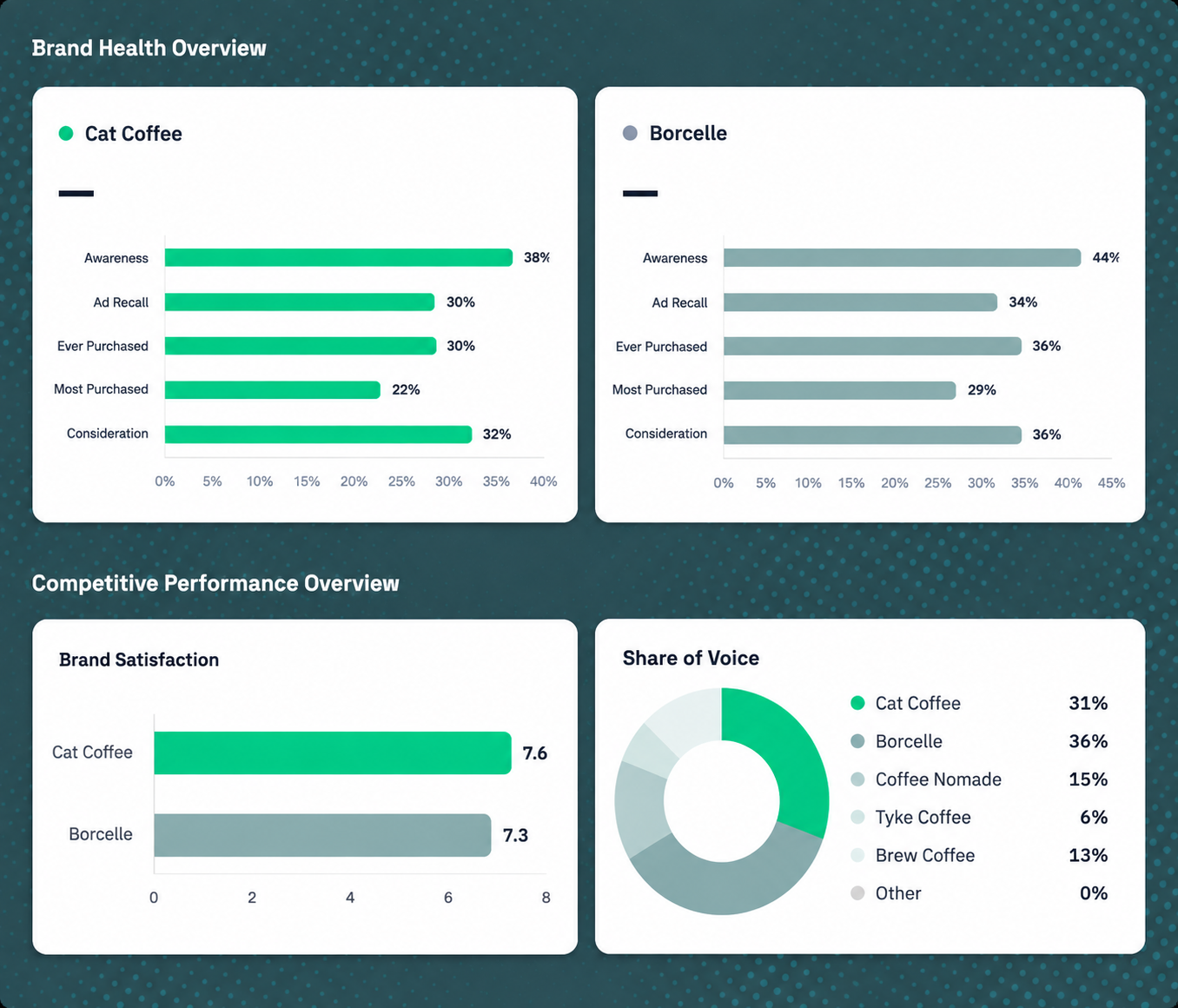
01 - Overall performance
Your reach gap, stated.
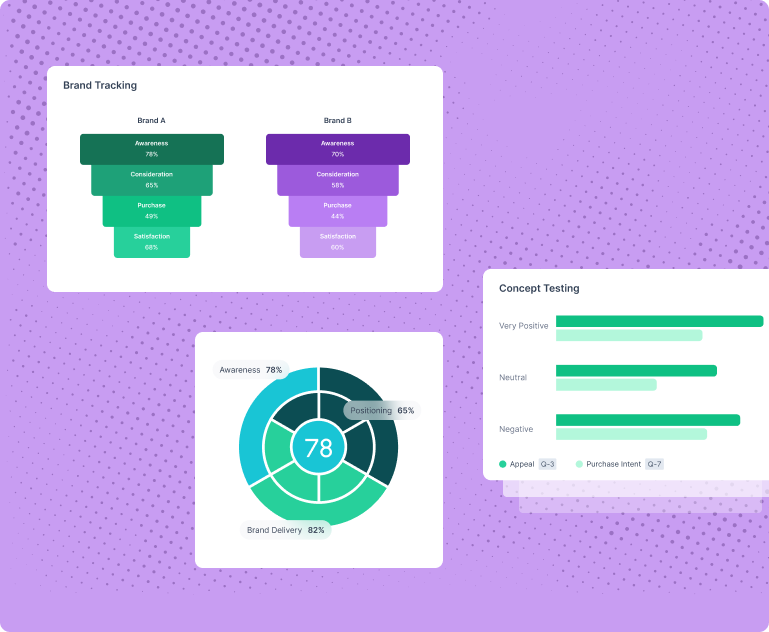
Brand health across every funnel metric, satisfaction and share of voice, with your competitive set on the same chart. If you're losing on reach and winning on loyalty, that shows up in the first screen.
02 - Brand funnel
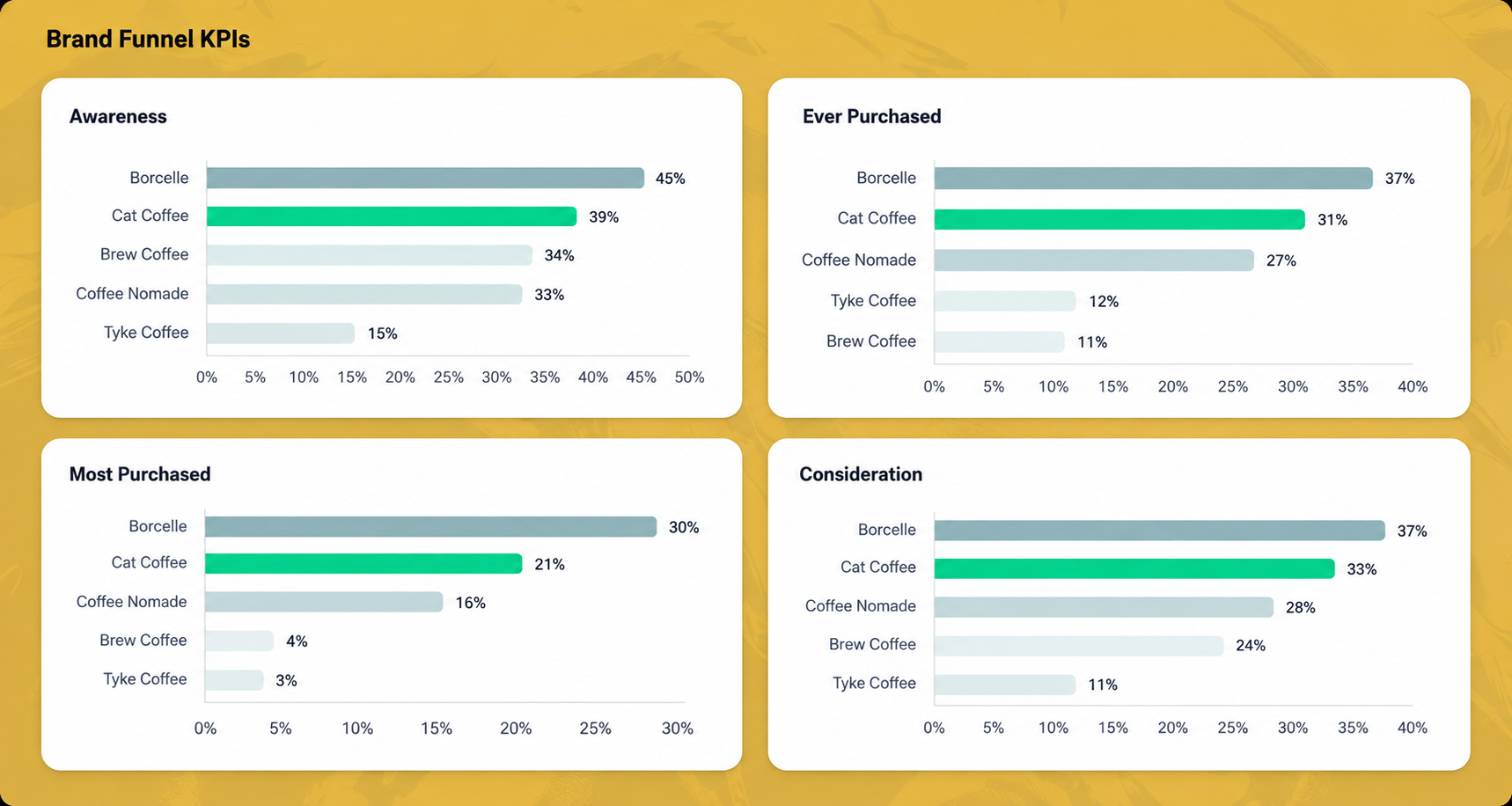
Where you leak, and whether they do too.
Awareness, ad recall, ever purchased, most purchased, consideration — plus advocacy, satisfaction and differentiation. The drop between two steps is the finding, not the top number.
03 - Brand attributes
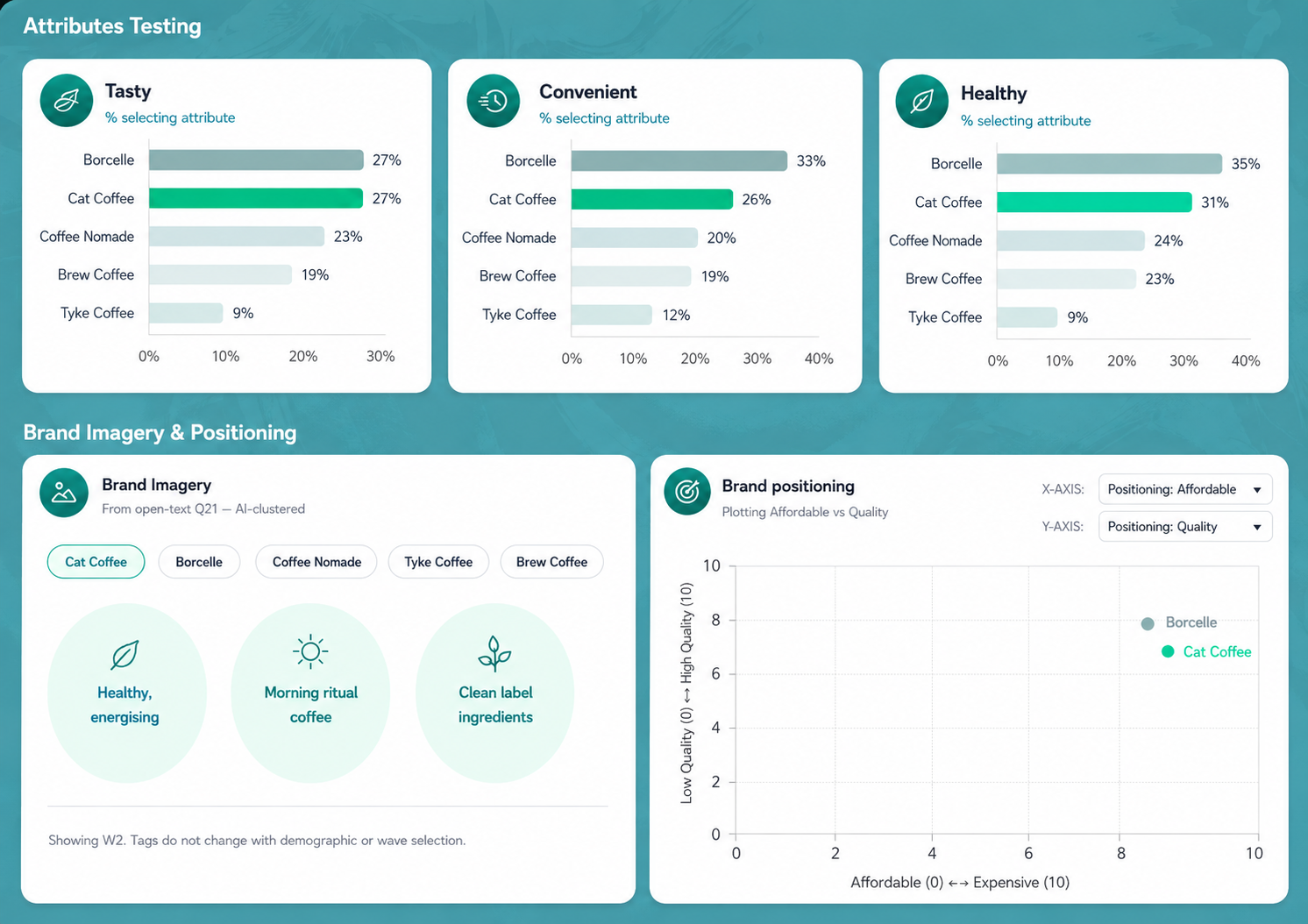
What you're understood to be.
Which attributes attach to which brand, and positioning plotted on two axes you pick. Including the case where nobody owns the space yet, which is an opportunity rather than a result.
04 - Advertising and touchpoints
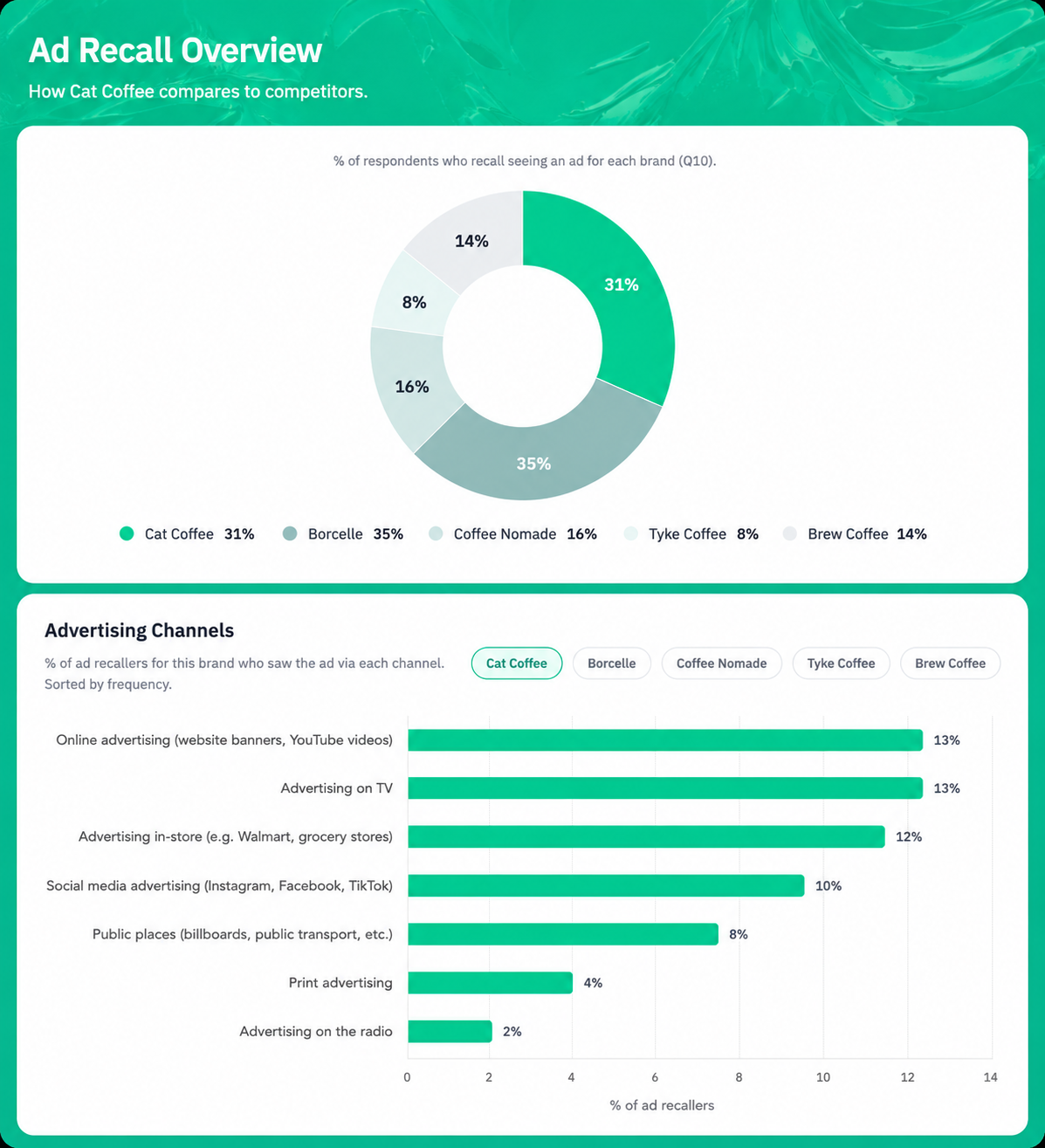
Which channels are actually working.
Ad recall by brand, and the channels people who recall you say they saw you on. Where your spend is landing, for which audience, and where the reach stops.
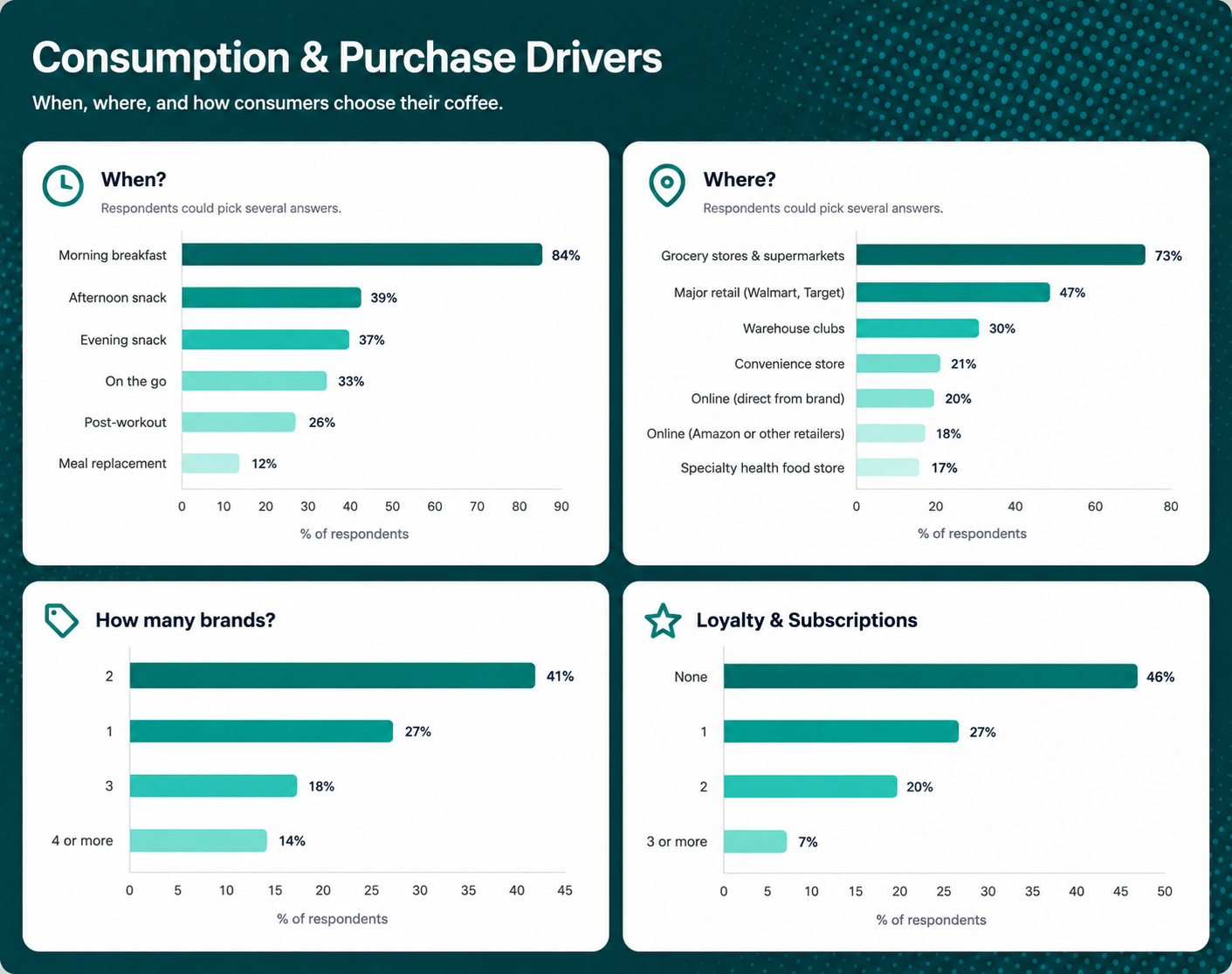
05 - Shopping and usage habits
The behaviour underneath the numbers.
When and where the category is bought, how many brands people rotate between, loyalty programmes and word of mouth. A loyal-looking share can sit on top of a completely promiscuous category.
06 - Brand profile
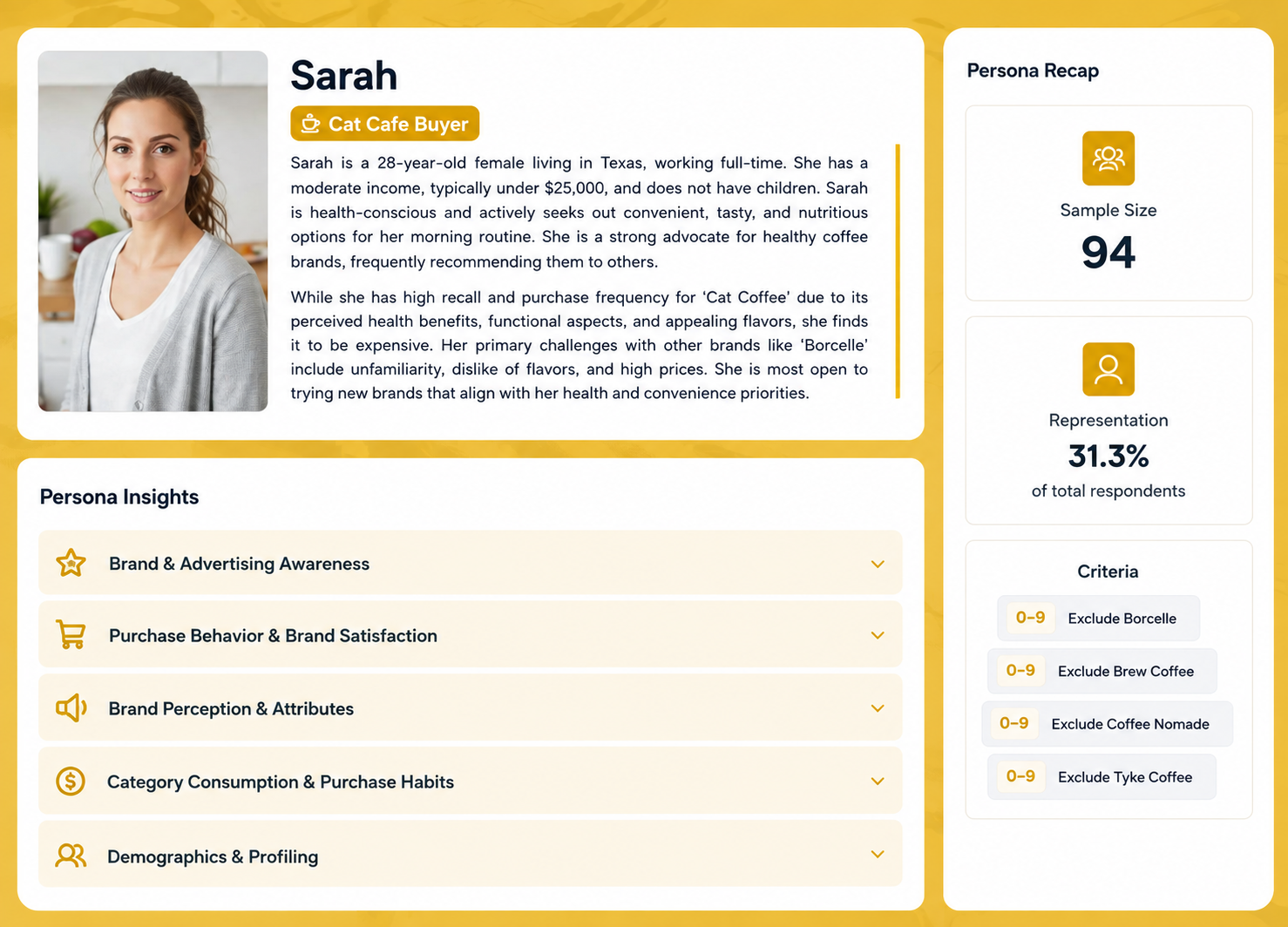
Who your buyers actually are.
Demographic and behavioural detail on the people choosing you, against the people choosing your competitors. Usually the section that most contradicts the target audience in the deck.
Plus analyst notes on every single section.
Not one summary at the end. Every section carries its own written read of what those numbers mean — where the pattern is, what it implies, and what it doesn't prove. Alongside market context, key takeaways, the full survey, and a demographic filter that re-runs any section for the segment you actually care about.
And the people who aren't in the category at all.
A brand health study measures category consumers. This add-on goes and asks the people who don't consume your category. Not your non-buyers — those are already in the sample — but the market that doesn't exist for you yet, with a set of questions written for them.
Why they're not in the category
What keeps them out, in their terms. Never appealed, tried it and stopped, a health or budget reason, or a substitute doing the job instead. Four different barriers, and only some of them are yours to solve.
What would bring them in
The conditions under which someone outside the category would enter it. Product, occasion, format, price — asked of people who have no reason to flatter you.
Whether it's worth trying
How big the addressable group actually is, and how far away. Category growth and share growth are different strategies with different budgets, and this is the section that tells you which one is available.
Everything else in the study measures the fight you're already in. This measures whether the pitch is bigger than it looks.
A snapshot is a position.
A tracker is a direction.
38% awareness. Is that good? Nobody can answer that from one number, including us. It's good if it was 31% before and bad if it was 45%. So here is the honest split, before you order.
What a brand health study gives you:
Where you stand right now, properly measured. Your funnel, your perception, your buyer profile, and up to five competitors on every one of them — measured in the same study, from the same people, so the comparison between brands is real. That is a complete finding. It's the read most brands have never had.
What it doesn't:
Whether the gap is opening or closing. Movement needs two points measured the same way, and a single study has one. If what you need is whether something worked, that's Brand Tracking — twelve monthly waves, from $19,990/year.
Measuring movement rather than position? See Brand Tracking →
Run it yourself, or have us run it.
Same study. Same report. Same 24 hours.
Run it yourself
From $4,990 · order online- Name your brand, your competitive set and your audience
- Price updates as you set it, before you commit to anything
- Pay online. No quote to wait for, no procurement step
- The report comes back in 24 hours
Have us run it
Scoped with you- We build the competitive set and the audience definition with you
- We design the screening, field the study, and deliver the report
- An analyst walks you through the findings
- Same study, same report, same 24 hours
Add-ons available either way: unaided awareness, additional competitors, extra attitude statements, and prospective consumers — a dedicated read on non-users of your category, with their own question set.
A brand health study in three steps.
The value of the study is that everything is measured the same way at the same moment — your brand and your competitors, one audience, one field period.
A few minutes.
- Name your brand and up to five competitors. Add more if your category needs it
- Choose the attributes you want perception measured on, or leave them blank and we build them from your category
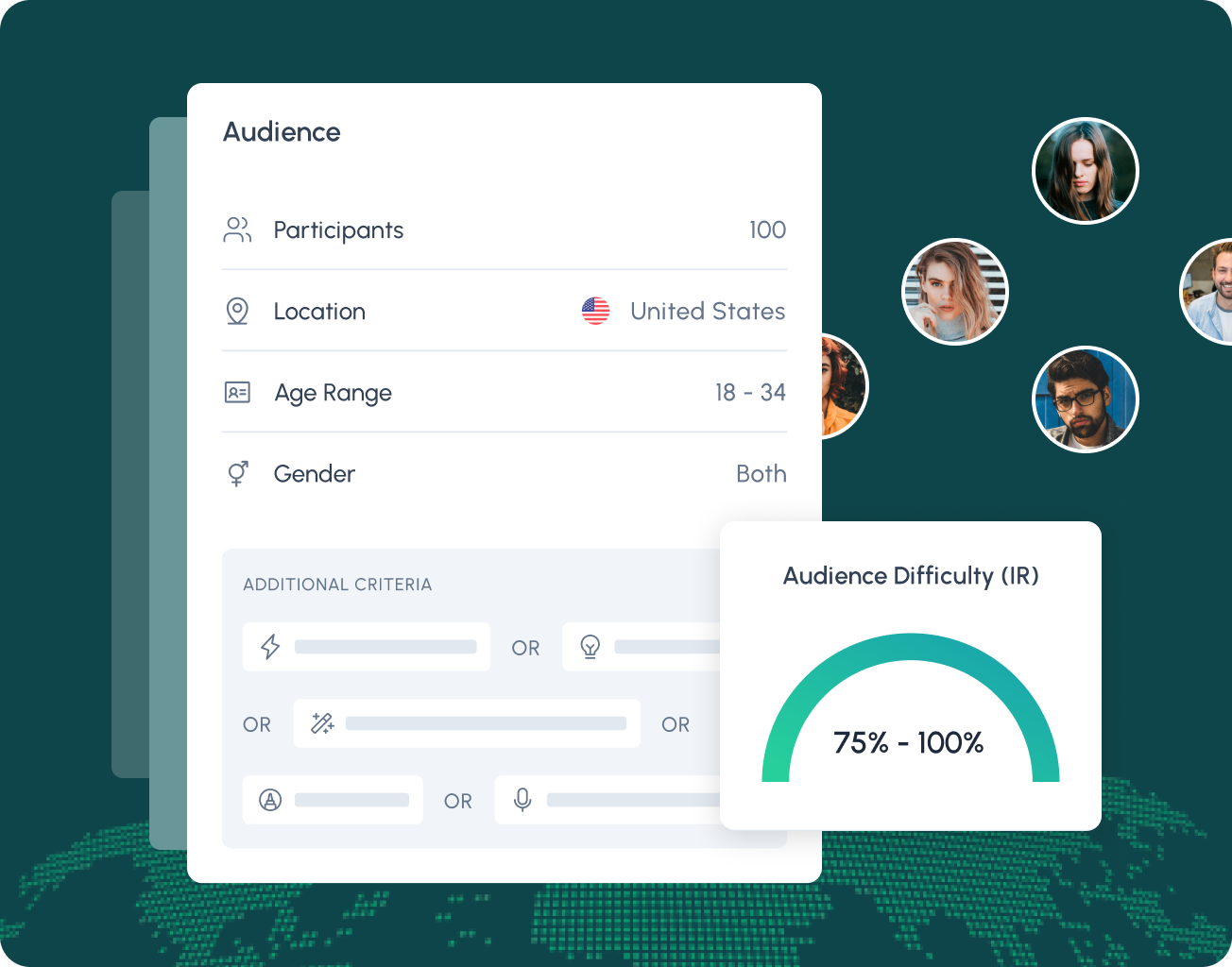
- Define your audience — nationally representative, or a custom profile you specify
- Pick your market. One per study; run several in parallel if you need more
- Set your subgroup cuts, so the report arrives already split the way you report it
You set it up and see the price move as you go. Or hand it over and we set it up with you.


Why the numbers hold up.
A brand health study lives or dies on one thing: whether your brand and your competitors were measured under identical conditions. Compare your own figures against someone else's published benchmark and you're reading two methods, not two brands.
Who answers
- 170M+ verified consumers across 130+ markets, from Kantar Profiles, Cint and Dynata
- Never synthetic. Every response comes from a verified human, not a model
- 300 minimum, never fewer. Reducing the sample doesn't reduce the price, because it would ruin the comparison
- Your audience definition, screened before anyone sees a question
How it stays comparable
- Every competitor measured in the same study, on the same questions, by the same people
- One field period, so nothing shifts underneath the comparison
- Geolocation, speed detection and consistency screening before anything reaches analysis
- You get the sample you ordered. Order 300, receive 300 clean responses — removals are on us
How it's read
- Analyst notes on every section, written by a person. Not a single score, because brand health doesn't reduce to one
- Including what the data doesn't prove. Where a finding is directional, the notes say so
- Base sizes on every cut, so you can see what a segment reading rests on
- Presentable as it arrives, not a dataset your team has to build a deck from
You're a good fit if
You're not a good fit if
Brand health, answered.
What is a brand health study?
A brand health study is a single measurement of how a brand is performing among the people who buy its category — funnel, perception, advertising and touchpoints, shopping habits and buyer profile — with up to five named competitors measured on the same questions, in the same study, from the same people. 300 respondents minimum, one market, from $4,990, delivered in 24 hours.
How much does a brand health study cost?
From $4,990, ordered online. That covers 300 respondents in one market, up to five competitors, your own audience definition, your subgroup cuts, and the full report with analyst notes on every section. The price updates as you set the scope, and you see it before you commit. Categories with an incidence rate under 30% need a custom quote.
How is this different from brand tracking?
A snapshot is a position. A tracker is a direction. A brand health study measures where you stand right now, in full. Brand Tracking runs twelve monthly waves across a year so you can read movement — whether what you did worked. One is a complete measurement; the other is a continuous series. Neither substitutes for the other.
Is this just brand tracking with one wave?
No. They answer different questions. A brand health study is a point-in-time diagnostic: your funnel, your perception, your competitive position, measured properly. It isn't a trial, and there's nothing to graduate to — plenty of brands need a position and never need a series.
How is this different from the free Brand Index?
The Brand Index is a public read, built on a standard competitive set and a general population. A brand health study is built on yours: the competitors you name, the audience you define, the attributes you choose, and the subgroups you report against. That's the difference between seeing a number and being able to act on one.
Can I define my own audience?
Yes, and it's the point. Nationally representative, or a specific profile — category behaviour, purchase recency, demographics, region. Everyone who answers has to clear it before they see a question.
Can I cut the results by subgroup?
Yes. Any section re-runs for the segments you set, with base sizes shown so you can see what each reading rests on.
Why 300 respondents, and why can't I run fewer to save money?
Because the study lives on comparison — between you and five competitors, and between segments. Below 300 those cuts stop being reliable. Reducing the sample doesn't reduce the price.
How many competitors can I measure?
Five as standard, which covers most categories, and every one is measured on the same questions in the same study. More can be added if your set is wider.
Is unaided awareness included?
It's an add-on rather than part of the standard set. Aided awareness is included and is what most funnel comparisons run on. If unaided recall matters to how you report brand health, add it at setup.
What are prospective consumers, exactly?
People who don't use your category at all — not your non-buyers, who are already in the standard sample. If your study measures coffee drinkers, this measures non-coffee drinkers, with questions written for them: why they're out, what would bring them in, and how large the group is. It answers whether the category can grow, rather than whether your share can.
How is this different from Understand Your Market?
Usage & Attitudes maps the category — how people buy, what drives loyalty, where the unmet needs are. This measures your brand inside it, against named competitors. One tells you what you're competing in. This tells you where you stand in it.
Can I run more than one market?
One market per study. Run them in parallel if you need several — same questionnaire throughout, so the reads stay comparable, and each is priced and sized for its own market.
How fast is it?
24 hours. Very low-incidence audiences take longer, and we tell you before you order rather than after.
Can you run it for me?
Yes. We build the competitive set and audience definition with you, design the screening, field the study and deliver the report, with an analyst to walk you through it. Same study, same report, same 24 hours.
The others answer a question.
This one holds the picture.
If what you need is a decision rather than a position, one of these will get you there faster and cheaper.
Test concepts, messages, and creative before you commit budget.
See Concept Testing →Test the finished creative against a control group, before the media spend.
See Brand Lift →Measure what your campaign actually changed.
See Campaign Recall →Measure your funnel, perception and position against your competitors.
You're here - Brand HealthBuild real audience segments from real consumer data.
See Audience Profiling →See how your category behaves before you plan.
See Usage & Attitudes →Stop reporting an opinion.
Name your brand, your competitive set and your audience. A brand health study starts at $4,990, and it's back in 24 hours.