
The campaign ran.
Did anyone notice?
Campaign recall measured with real consumers. Who remembers it, what stuck, and whether it moved anyone closer to buying.
Usually ordered when: the campaign is live or just wrapped, the next budget cycle is being planned, and impressions and click-through don't answer what anyone in the room is actually asking. Campaign recall answers it while the memory is still there.
Campaign recall on one screen.
Four numbers at the top: how many people recall category advertising at all, how many recall your brand's, how many recall this campaign, and what the people who remember it intend to do.
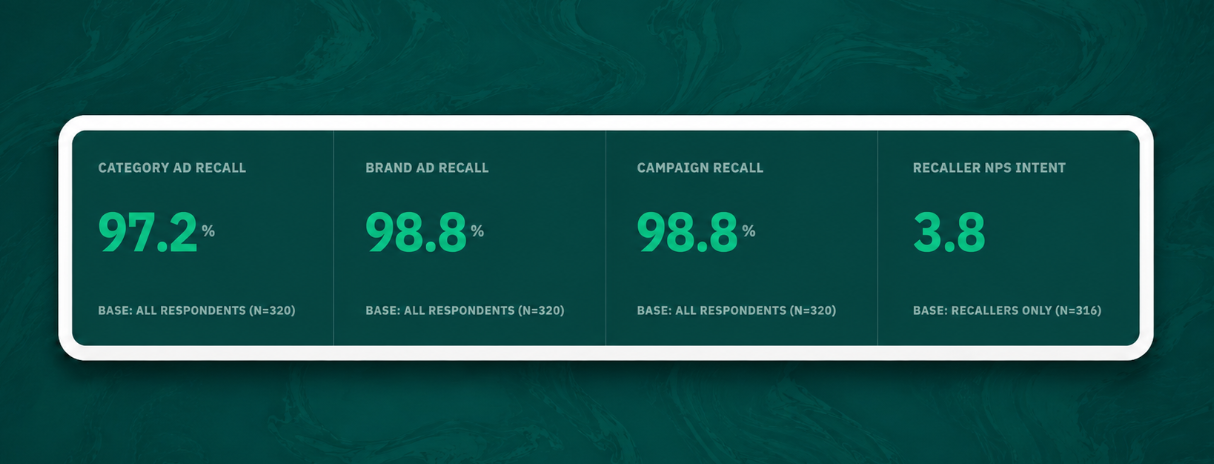
Every figure states its base. Recall questions run against everyone; message and intent questions run only against the people who genuinely remember the campaign - so the numbers describe who they say they do.
Three reads, and the reasoning behind them.
Enough to answer "did it work" in a meeting without opening anything else — and if someone wants to dig, the full campaign recall report is underneath.
Recall & Memory.
- Category, brand & campaign recall funnel
- Competitor recall comparison
- Channel attribution & unprompted memories
What Stuck.
- Verbatim takeaway quotes & key themes
- Emotion map & indifference rating
- Relevance, brand fit & gap analysis
Intent & Call.
- Consideration & purchase intent side-by-side
- Barriers to action breakdown
- Analyst verdict with caution flags
01 - The breakthrough
Recall, channels & memory.
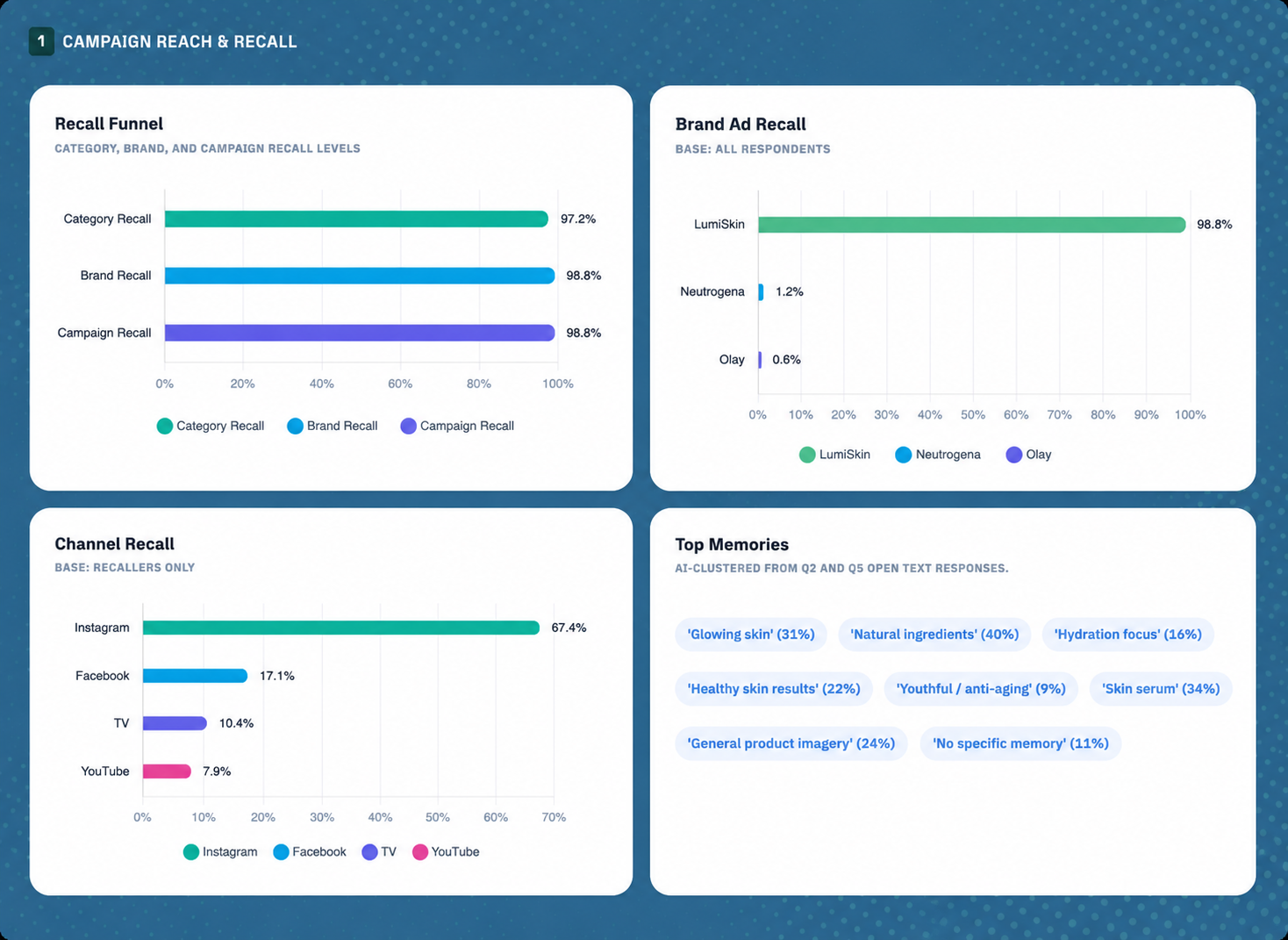
A recall funnel — who remembers category advertising, who remembers a brand's, who remembers yours. The drop between the steps is the story, not the top number.
Brand ad recall against your competitors', from the same respondents, so you can see whether the category is noisy or you're the only one in it.
Channel recall — where people say they saw you, ranked. Including channels you never bought, which tells you something either way. Top memories, clustered from what people wrote unprompted, and "no specific memory" is one of the options that shows up.
Category context — how much advertising people are seeing at all, and how relevant they find it. A campaign recall figure means something different in a crowded category than a quiet one.
02 - The message
What stuck & how it landed.
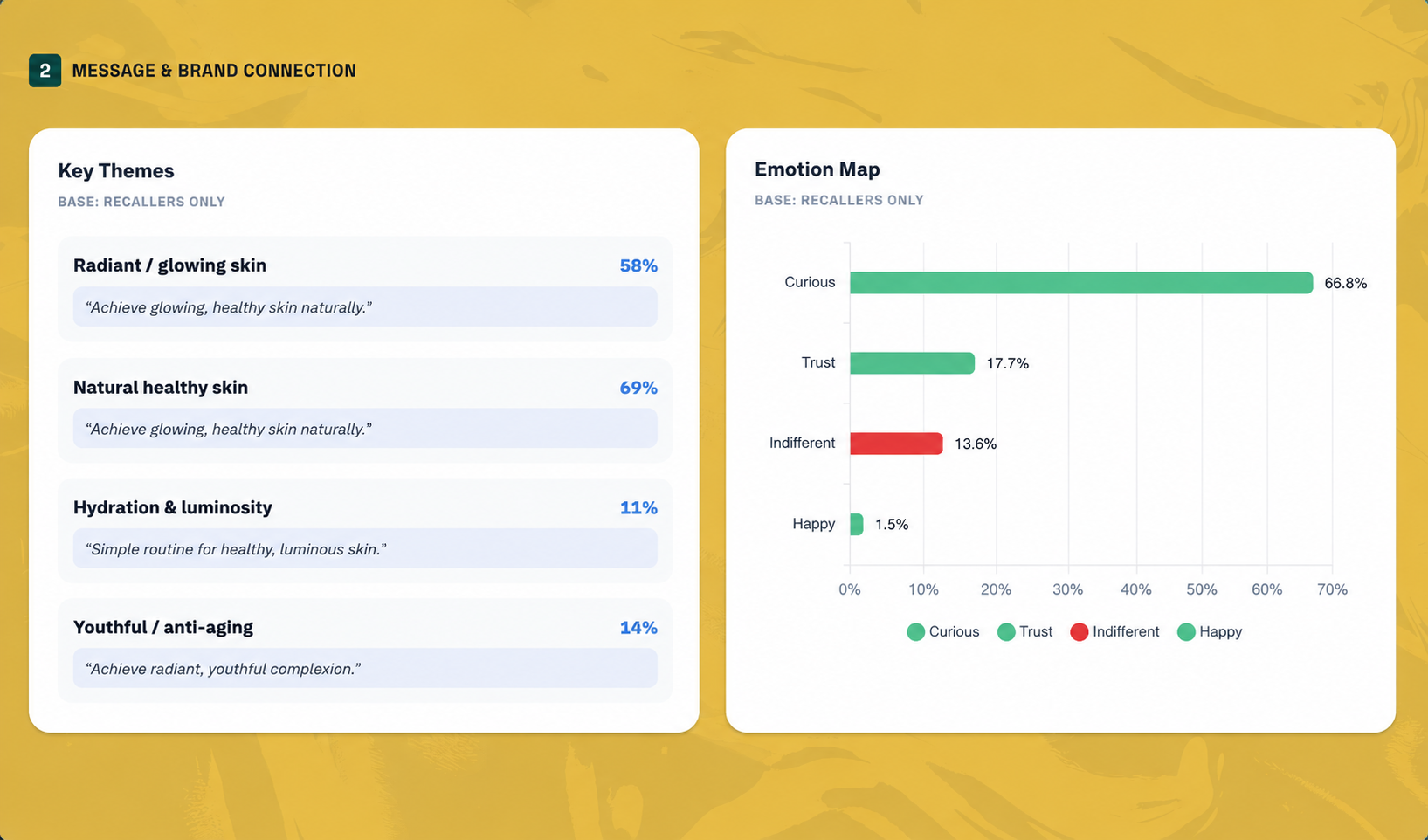
Key themes with the actual quotes underneath - what people took away, in their words, before anyone offered them options.
An emotion map - curious, indifferent, or somewhere else. Indifference is the expensive one and it gets its own bar.
Message relevance and brand fit, scored by people who remember the campaign. Whether what landed was the thing you paid to land.
The gap you're looking for: high recall with low relevance means the campaign is memorable and not persuasive, which is a creative brief rather than a media one.
03 - Conversion & call
Intent, barriers & analyst verdict.
Consideration and intent side by side, so you can see whether people who remember it moved from "might" to "will".
Barriers to action - among people who didn't move, exactly what stopped them. Preferring another brand and finding it too expensive are different problems with different fixes.
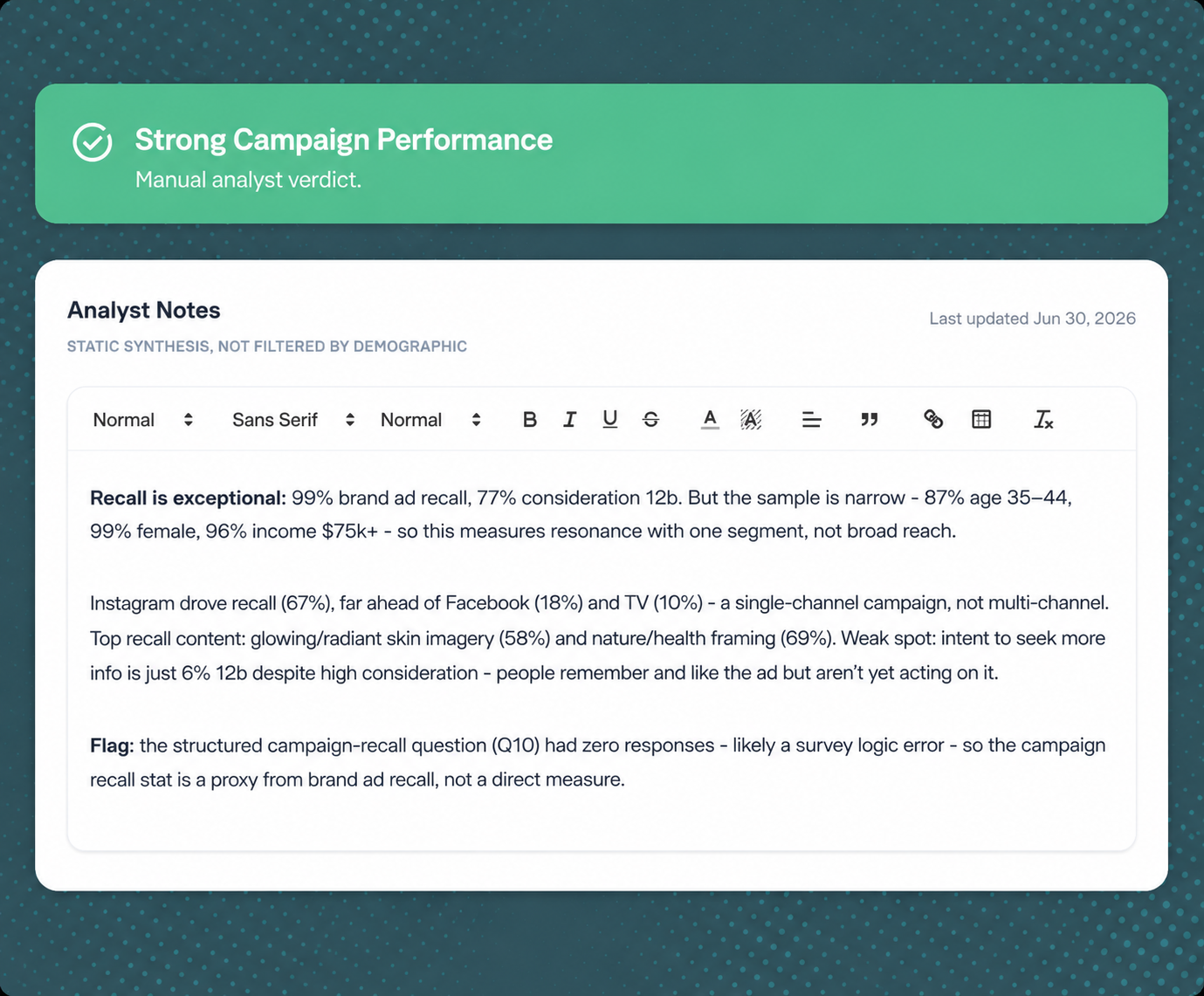
A written verdict, called by an analyst rather than a formula, because campaign performance depends on what you were trying to do.
Analyst notes with caution flags. Where the sample skews, where a number is a proxy rather than a direct measure, and where something in the data doesn't look right. If a survey question misfired, the notes say so rather than quietly reporting the number anyway.
Full Report Underneath
And the full report, if the answer raises another question.
Behind the dashboard sits the complete report - segment cross-tabs, personas, verbatim responses, market context, and every question exactly as it was answered. Plus a demographic filter across the whole dashboard, so you can re-run every figure for the audience the campaign was actually aimed at.
See what's in a full report →Campaign recall in three steps.
You tell us what ran and where. We ask real consumers what they remember, unprompted first. You get the honest version.
In just a few minutes.
- Name the campaign and category, and add any context worth knowing
- List the channels it ran on - TV, social, OOH, radio, whatever the plan included
- Name your brand and competitors, plus up to five image attributes. Leave them blank and we build them from your category
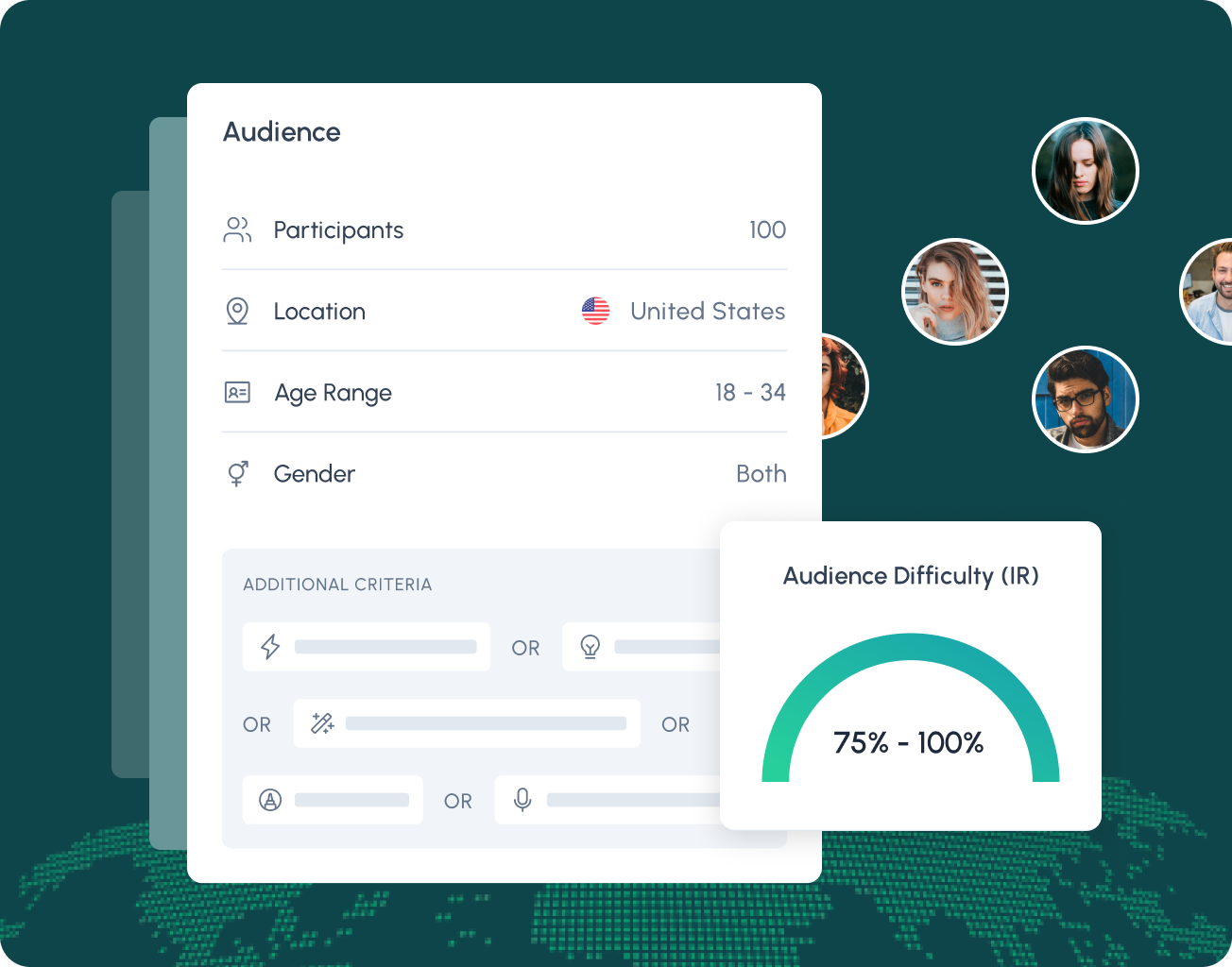
- You set it up yourself, in your own workspace - audience, criteria, add-ons - with the price updating as you go. No quote to wait for, no procurement step.


Why the verdict holds up.
Campaign recall is easy to run badly. Name the brand too early and everyone remembers seeing you. Ask only the people who engaged and the numbers look wonderful. The design is what makes the result worth anything.
Who answers
- 170M+ verified consumers across 130+ markets, from Kantar Profiles, Cint and Dynata
- Never synthetic. Every response comes from a verified human, not a model
- Drawn from the audience the campaign targeted, not from people who engaged with it
- Recallers and non-recallers both included - the people who missed it are half the finding
How it's asked
- Unaided before aided. We ask what they remember before showing your name, so recall isn't manufactured by the question
- Recall is verified, not assumed. Only respondents who confirm the campaign answer the message and intent questions — campaign recall figures rest on people who actually remember it
- Every figure carries its base, and the recaller base is always smaller than the total. That's shown, not hidden
- You get the sample you ordered. Order 300, receive 300 clean responses - removals are on us
How the verdict is reached
- Written by an analyst, not generated from a threshold. Campaign performance depends on what you were trying to do, and a formula doesn't know that
- The flags come with it. Where the sample skews, where a figure is a proxy, where the data looks off - stated in the notes
- False recall is reported, not buried. If people claim a channel you never bought, the notes explain what that usually means
- Base sizes on every cut, so you can see what a segment finding rests on
You're a good fit if
You're not a good fit if
Campaign recall questions, answered.
What is campaign recall?
A campaign recall study measures what a live or recently-finished campaign left behind: who remembers seeing it, whether they attached it to your brand, what message stuck, and whether it moved consideration or purchase intent. Respondents are asked unaided first, before your name appears, so recall isn't manufactured by the question. 300 respondents, 24 hours to 5 days, $2,790.
How much does a campaign recall study cost?
$2,790 per study, covering 300 respondents in any of 130+ markets, with analyst review and exports included. Audiences with an incidence rate under 30% need a custom quote. Narrow-reach campaigns may want a larger sample so the recaller base holds up — we'll flag that before you order.
How is this different from the numbers my media agency already gives me?
Impressions, reach and frequency describe delivery - how many times the ad was served. This describes what happened afterwards in someone's head: whether they remember it, whether they attached it to your brand, and whether it changed what they intend to do. A campaign can deliver perfectly and be forgotten completely.
What decides the verdict?
An analyst does, in writing. Unlike a concept test, there's no single threshold that makes a campaign a success - it depends on what you set out to achieve and what the category looks like. So a person reads the whole picture and calls it, and you can see their reasoning underneath.
How many respondents, and how many will actually remember the campaign?
300 by default. How many recall it depends entirely on your reach - that's the finding, not a flaw. But it does mean the recaller base is smaller than 300, and if your campaign was narrow you may want a bigger sample so the recaller cuts hold up. We'll tell you before you order.
Why does the report flag its own results?
Because a skewed sample makes a breakout directional rather than reliable, and a figure derived from a proxy isn't the same as a direct measure. If something in the data doesn't look right, the notes say so. We'd rather tell you than let you present a number that won't survive a question.
How soon after the campaign should I run it?
While it's live, or within a few weeks of it ending. Recall decays fast. Run it three months later and you're measuring forgetting rather than performance.
What if people say they saw the ad on a channel we never used?
It happens, and it's informative. The report flags it rather than quietly dropping those responses - claimed exposure on an unbought channel usually means someone is confusing you with a competitor, or that your category's advertising blurs together.
Can I compare it to a pre-launch test?
Yes, and it's the strongest way to use both. Before You Launch predicts what the creative will move. This measures what it actually moved. Running the pair turns a forecast into a track record.
Can I test outside the US?
Yes, across 130+ markets. Incidence rates below 30% need a custom quote rather than the standard price.
Ready to launch.
The fastest way to an answer.
Whatever you're deciding, there's a study designed for it.
Test concepts, messages, and creative before you commit budget.
See Concept Testing →Test the finished creative against a control group, before the media spend.
See Brand Lift →Measure what your campaign actually changed.
You're here - Campaign RecallTrack awareness, perception, and share against competitors.
See Brand Tracking →See the category landscape before you plan.
See Usage & Attitudes →Build real audience segments from real consumer data.
See Audience Profiling →Find out what it bought you.
Tell us what ran and where. Campaign recall runs from $2,790, and the verdict is back in 24 hours to 5 days.