Margin of Error Calculator

Determine the precision of your survey findings with this margin of error calculator. Enter key survey values below, and we will compute the margin of error.

Calculate Your Margin of Error

Margin of Error
Aim for 2–7%
Confidence interval: —
Next step: create your free Standard Insights account to design, launch, and analyze surveys in one place.

How does the margin of error calculator work?

The calculator estimates your survey’s margin of error based on your sample size, confidence level, and population size. Follow these three steps to see how precise your results are.

Flat icon of a stacked form with lines and a dropdown arrow, representing entering data.

1. Population Size

Enter the number of people in your target population (N). If unknown or very large, leave “Unknown” checked. We’ll apply the finite population correction automatically when n is a large share of N.

Two overlapping cards with text lines and a green cursor pointer, symbolizing selecting a setting or confidence level.

2. Sample Size

Enter how many completed responses you have (n). Bigger n reduces the margin of error, but with diminishing returns, about 4× the sample to halve MOE.

Two browser windows with a magnifying glass highlighting text, indicating reviewing results or insights.

3. Confidence Level

Choose your confidence level. 95% is standard (z = 1.96). Use 90% (z = 1.645) for exploratory work or 99% (z = 2.58) for maximum rigor.

What is a margin of error?

The margin of error (MOE) is the plus‑or‑minus range around a survey estimate that reflects sampling uncertainty. At a chosen confidence level (90%, 95%, or 99%), it shows how close your sample result is likely to be to the true population value.

Example: If 70% of respondents say “yes” with a ±4% margin of error at 95% confidence, the population percentage is likely between 66% and 74%.

Why it matters

Surveys use a sample to represent a larger population, so some error is inevitable. The margin of error quantifies that uncertainty and helps you judge result reliability. Lower margins of error indicate more precise results; increasing your sample size or using a lower confidence level reduces the margin of error.

How to interpret your margin of error?

The margin of error is a range of values below and above the actual results of a survey. For instance, a 70% “yes” response with a margin of error of 5% means that 65% and 75% of the general population think the answer is “yes.”

The more responses you get (or the larger your random sample), the smaller your margin of error will be, and the more confidence you will have in sample results that are reliable and representative.

On the other hand, a larger margin of error means your estimate can deviate more from the true value, reducing certainty.

Researchers often aim for a lower margin of error because it increases precision and strengthens quantitative conclusions.

Why should you track the margin of error?

There will always be the presence of uncertainty and imprecision since a sampling pool (your survey respondents) represents a larger population, while survey samples represent a chunk of your target population.

The existence of MOE, hence, is to calculate this inherent imprecision, which allows researchers to see how conclusive their survey results represent a particular population.

In addition to that, the MOE is also beneficial when you cannot record responses from every person you want to survey. For example, polling the entire population of Hong Kong is not feasible. However, you can pick out a set of people representative of that group and then base your survey results on them.

MOE helps you determine the accuracy of a value by expressing it in a range, which represents the answer in relation to the entire target population.

Generally speaking, the calculation of MOE will help specify the likelihood that your survey result is close to the result had the whole population been surveyed. Its value goes a long way in determining the accuracy level of your survey.

How to calculate the margin of error?

The Calculation Explained Step By Step:

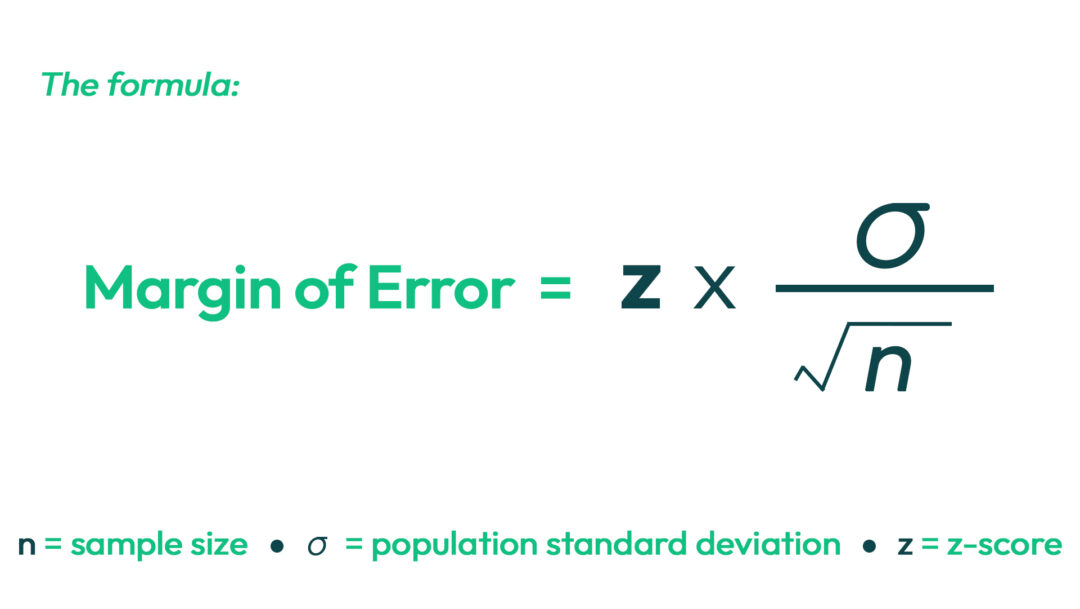
  1. Find the population standard deviation (σ) and determine your sample size (n).
  2. Get the square root of your sample size.
  3. Divide the population standard deviation (σ) by the result of the square root calculation.
  4. Multiply this result by the z-score that corresponds with your desired confidence level — not to be confused with the confidence interval (which is the margin of error).
Formula for margin of error in statistics: Margin of Error = Z × (σ ÷ √n), where n = sample size, σ = population standard deviation, Z = Zscore.

Most researchers who prefer statistically significant results look for a 5% or lower MOE. Feel free to play around with the margin of error calculator above. It can help you determine what sample size provides the MOE that best fits the needs of your unique project.

How the sample size affects the margin of error?

The relationship between the margin of error and sample size is inverse as the two move in opposite directions. When the sample size increases, the margin of error decreases, and vice versa.

Assume that the data were collected and handled correctly. The more information you get, the smaller your margin of error will be. In other words, your survey results will be more accurate.

Larger sample sizes decrease the margin of error but with diminishing returns. It means each time you poll one more person, the cost of your survey escalates accordingly.

How to increase your data’s reliability?

The correct choice of research methodology helps in determining the success and overall quality of your research study and its documentation.

Therefore, it is crucial to choose the appropriate research methodology to underpin your work and methods you use that likely enhance the data’s reliability.

A methodology that drives quality insights must:

  1. Execute questionnaires that ask the right questions. While good questions are the foundation of good market research, many people tend to overlook this step. – Check our principles of survey design
  2. Mix traditional and digital methodologies to come up with the best approaches that help identify the right individuals and put them in the right conditions to give honest answers.
  3. Incorporate layers of quality detecting and eliminating fraud and bias in order to collect relevant and trustworthy data in the end.

Explore the Standard Insights methodology to see how we meet all three of the key criteria above when you purchase survey respondents.

Explore Our Other Market Research Tools

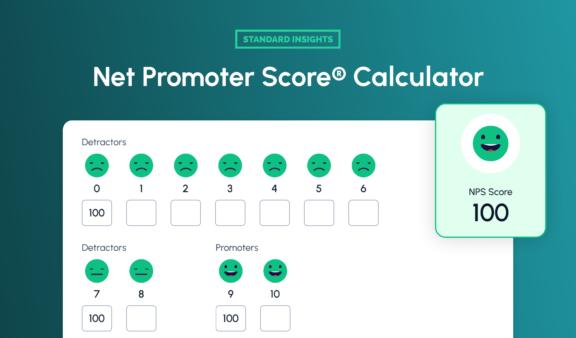
NPS calculator with score buckets 0–10 for detractors and promoters and a panel showing the calculated NPS score.

Calculate your Net Promoter Score instantly with our free NPS calculator. Measure customer loyalty, interpret results, and boost satisfaction.


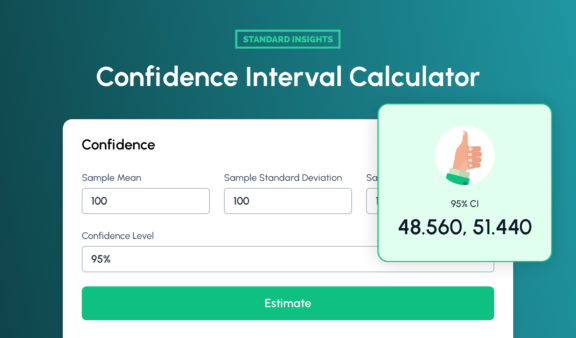
Confidence interval calculator with fields for sample mean, standard deviation, and size, showing a 95% CI result badge.

Use our Confidence Interval Calculator for quick, reliable estimates from your sample data. Ideal for data-driven decisions in research and analysis.
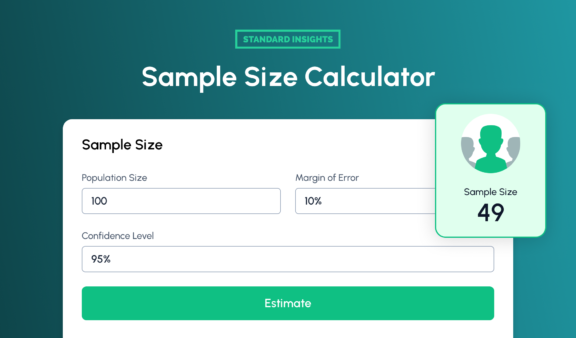
Sample size calculator with fields for population size, margin of error, and confidence level, displaying a sample size result badge.

Quickly calculate the ideal sample size for your study based on confidence level, margin of error, and population size.

Start your next consumer research

Create your free account, and use our set of tools to conduct your research easily.

Standard Insights dashboard showing navigation and cards to create surveys, visualize data, purchase audiences, and modules for brand health, brand lift, campaign recall, concept testing, audience profiling, and usage/attitude, plus recent projects.