Picture of By Standard Insights
By Standard Insights

Beauty & Skincare Dupe Economy — US Market Snapshot

The data behind who is actually winning the beauty aisle — and who is losing it to a $12 alternative.

Report Cover Dark

What's inside?

This report stress-tests the beauty dupe economy against 576 US consumers — nationally representative — to find out whether premium beauty brands are facing a recessionary trade-down or a structural renegotiation of the prestige contract. Based on a survey covering purchase behavior, brand perception, and a direct ingredient-parity scenario, the findings will change how senior marketers think about pricing power, brand equity, and where the real threat is coming from.

The Spending Shift

What is actually driving beauty purchase decisions right now — and whether price sensitivity, quality standards, or dupe behavior is the dominant force.

The Ingredient Parity Test

What happens when consumers are told a $12 drugstore product shares 80% of active ingredients with a $65 prestige equivalent. The answer is the verdict on emotional premium pricing.

The Brand Battlefield

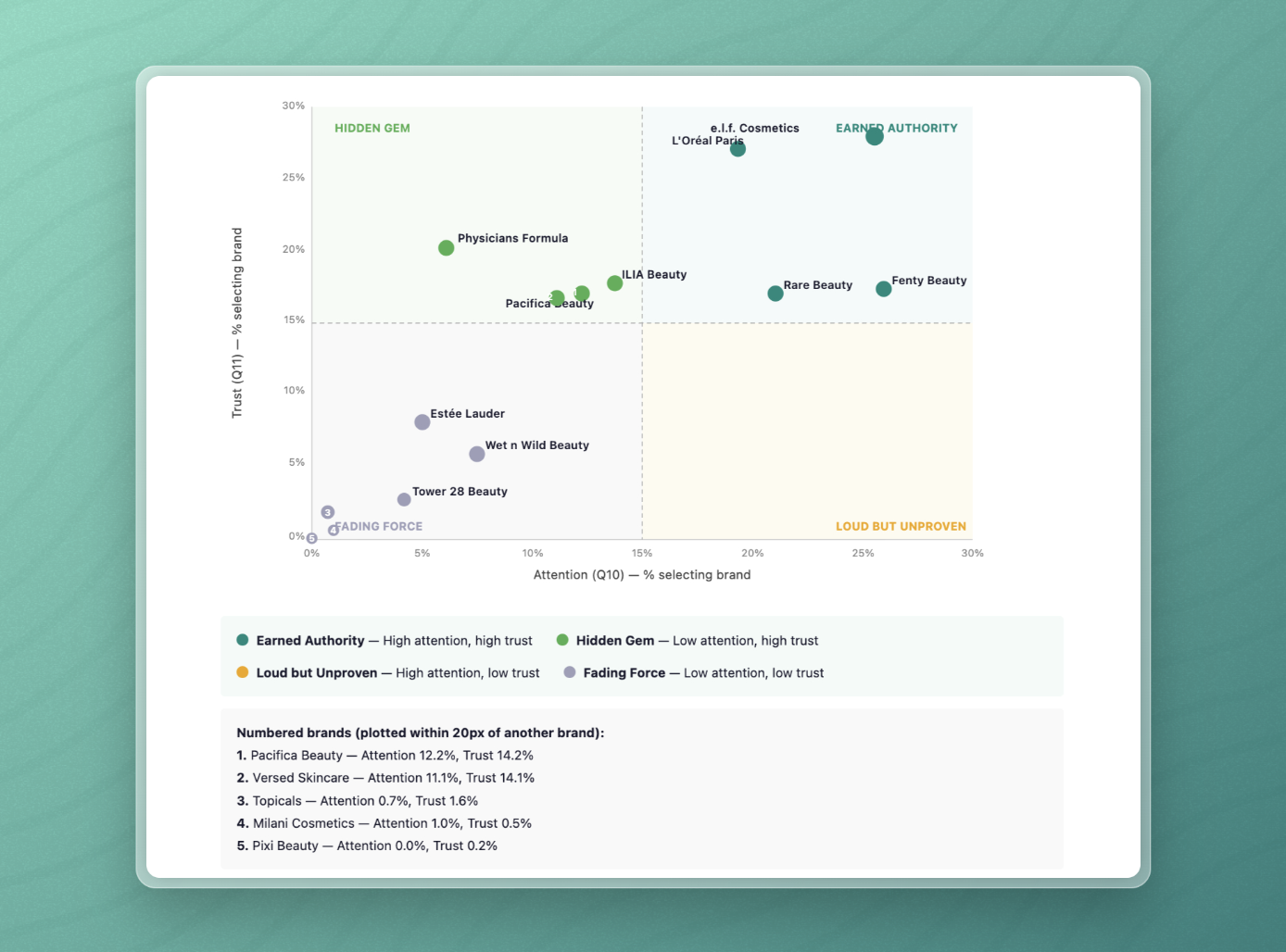
Attention vs. trust scores across 15 handpicked brands — from legacy giants like Estée Lauder and L'Oréal Paris to challengers like ILIA Beauty and e.l.f. Cosmetics — plotted across four quadrants: Earned Authority, Hidden Gem, Fading Force, and Loud But Unproven.

The Buyer Gap

How trade-down behavior differs between active buyers and non-buyers — and why the consumers doing the most damage to prestige pricing are the brands' own most frequent customers.

The Income and Age Signal

Why affluent consumers ($75,000+ household income) are replacing premium products at nearly the same rate as lower-income buyers — and what that means for who the real target of the dupe economy actually is.

The Five Consumer Personas

The archetypes that emerged from the data — each with a behavioral description, a relationship to the brand matrix, and a distinct implication for how brands should segment their response.

HOW TO GET THE MOST OUT OF THIS REPORT

This report is delivered as an interactive Standard Insights Executive Report — not a static PDF. Every finding is explorable, filterable, and exportable.

Here is what to use:

Frame 2087324520 1 1

Explore the brand map

The full 15-brand positioning matrix — attention vs. trust, plotted across four quadrants — is interactive. Hover over any brand to see its exact scores. The spread between Earned Authority and Fading Force tells you more about where prestige beauty is heading than a year of trade press coverage.

Frame 2087324520 11

Meet the five consumer personas

The data surfaces five distinct buyer archetypes — each with a behavioral description, a relationship to the brand matrix, and a clear implication for how brands should respond. From the formula-literate arbitrageur to the brand-loyal holdout, the personas tell you which consumer segment you are actually losing — and which one you can still win back.

About the data

In April 2026, Standard Insights surveyed 576 US adults — nationally representative by age, gender, and region — on their beauty and skincare purchase behavior, brand perceptions, and attitudes toward the dupe economy.

All respondents were 18 or older. The survey was fielded using Standard Insights’ nationally representative panel methodology — no opt-in convenience sample, no social media recruitment bias.

To ensure data quality, the survey included attention checks and consistency traps. Respondents who did not pass these checks were excluded from the final analysis.

The brand matrix covers 14 of the 15 brands listed in the survey instrument. Kinship received zero responses across all six brand dimension questions and is excluded from all brand analysis. Pixi Beauty received near-zero responses and is not discussed in brand archetypes.

For a custom study built around your specific brand, category, or strategic question, explore Standard Insights or contact the team directly.

ChatGPT Image Apr 30 2026 11 36 16 AM

More Reports