In 2022, Standard Insights and Digiboxes conducted a co-branded study on Myanmar’s social media ecosystem. The market survey was undertaken to track changes in social media users following the temporary suspension of several sites.
What Social Media Platforms Are Popular in Myanmar?
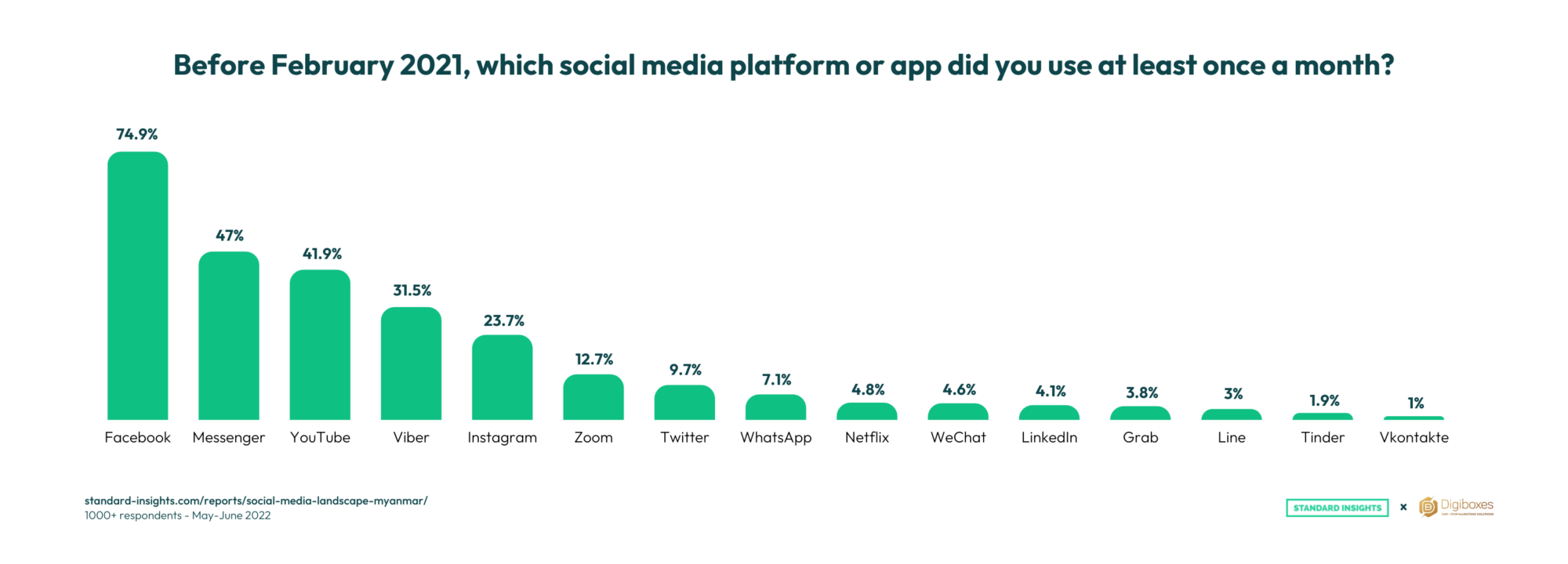
Among the different social media platforms, Facebook is the most popular in Myanmar, with 74.9% of respondents using it at least once a month before February 2021. Messenger is also preferred by many people living in Myanmar, with 47.0% of respondents using it once a month.
Other popular social media apps in Myanmar, as measured by the proportion of individuals who use them at least once a month before February 2021. They are YouTube (41.9%), Viber (31.5%), and Instagram (23.7%).
Zoom (12.7%), Twitter (9.7%), WhatsApp (7.1%), Netflix (4.8%), and WeChat round out the top 10 apps used by Burmese (4.6%).
How Burmese Reacted To Social Media Restrictions?
Myanmar’s internet penetration has been fast expanding. Specifically, the number of users increased by 3.5 million between 2019 and 2021, bringing the total to 23.65 million. As of January 2021, more than half of the Burmese population was active on Facebook. Such a quick adoption of social media in such a short period is bound to generate issues.
Among the most notable concerns have been:
- Voter suppression
- Hate speech
- Misinformation
- Lack of transparency
- Inappropriate political ads.
These issues are directly connected to the dearth of critical digital literacy (CDL). This fundamental skill goes beyond digital literacy to develop necessary thinking skills regarding technology adoption, including the credibility of content and how it should be consumed and shared.
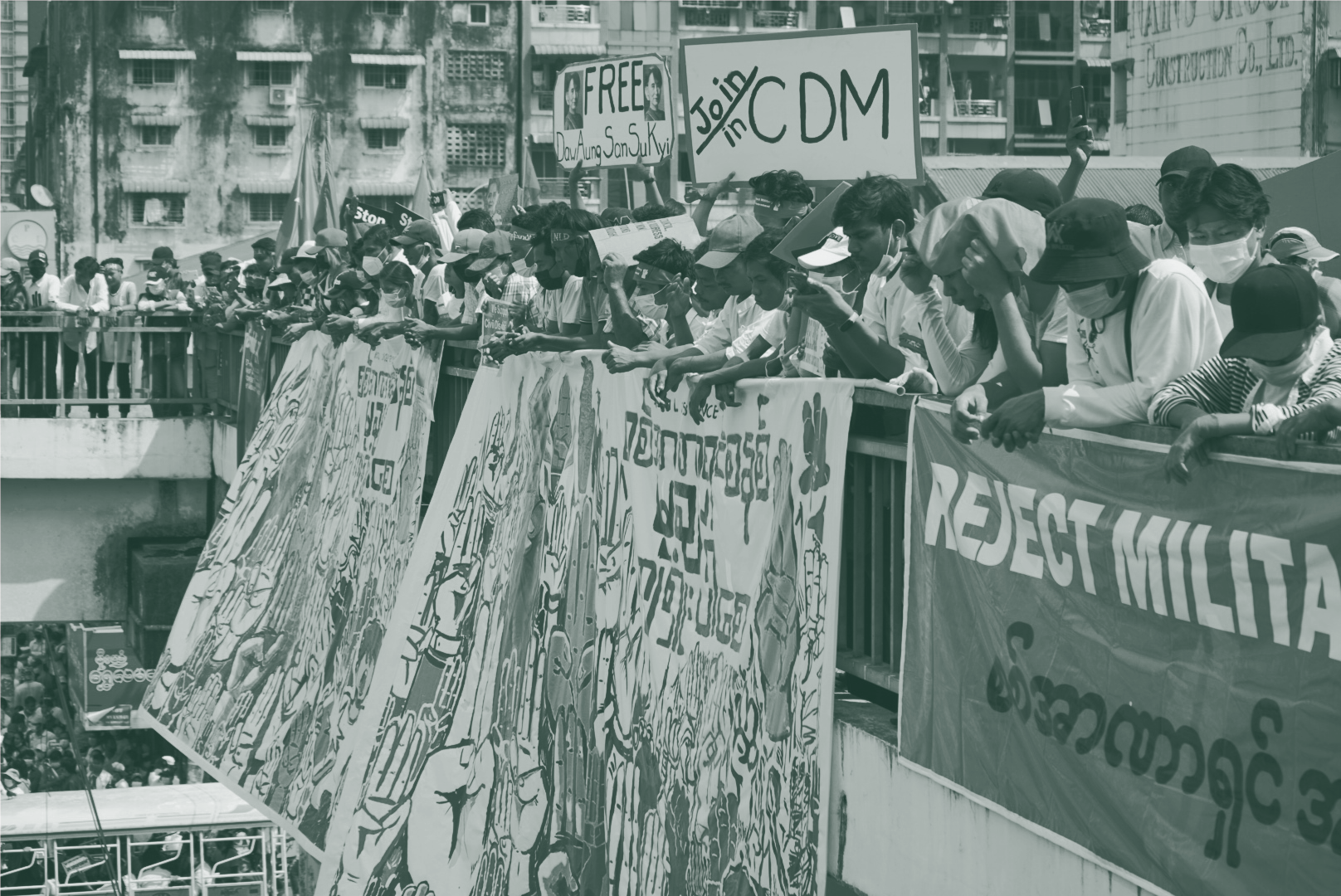
In Myanmar, the Internet connection triggered a citizen-led protest movement known as the Civil Disobedience Movement (CDM), which ushered in a new set of benefits and problems. Access to the platform enabled Burmese citizens to receive and exchange information freely, foster a sense of belonging and self-expression, and facilitate better political involvement between the people and the government.
After deposing the elected government on February 1, Myanmar’s military government continued to crack down on rebel groups and demonstrators. Simultaneously, they also attempted to seize control over information.
Authorities gradually curtailed access to social media and the internet. Specifically, Facebook, Messenger, and WhatsApp were blocked on February 4. The next day, citizens could not access Twitter or Instagram. Blocking Facebook was a critical step since around half of the country’s people used it as their primary news source.

The Impact of Social Media Restrictions in Myanmar
So what is the impact of the country’s regulations on Burmese social media consumption behaviors?
We noticed a significant shift in the social media habits of the majority of respondents in gaming, music-streaming, and social networking applications compared to the other sorts of social media. As can be seen, these three alternatives were also the top three most popular kinds of social media before the restriction. It indicates that the social media restriction has impacted people quite differently, with some able to maintain their previous social media activities. On the other hand, some have considerably reduced their social media usage on some sites.
The social media types that witnessed a decrease in usage among the majority of Burmese social media users include:
- Gaming apps (32.0%),
- Music streaming apps (23.6%),
- Movie & video streaming apps (21.0%),
- Travel & vacation (19.7%), and
- Learning & education (13.9%).
Meanwhile, social networks (33.6%), games (27.3%), music (26.6%), news & weather (20.7%), and learning and education (18.3%) are among the ones that increased in Burmese users’ social media consumption.

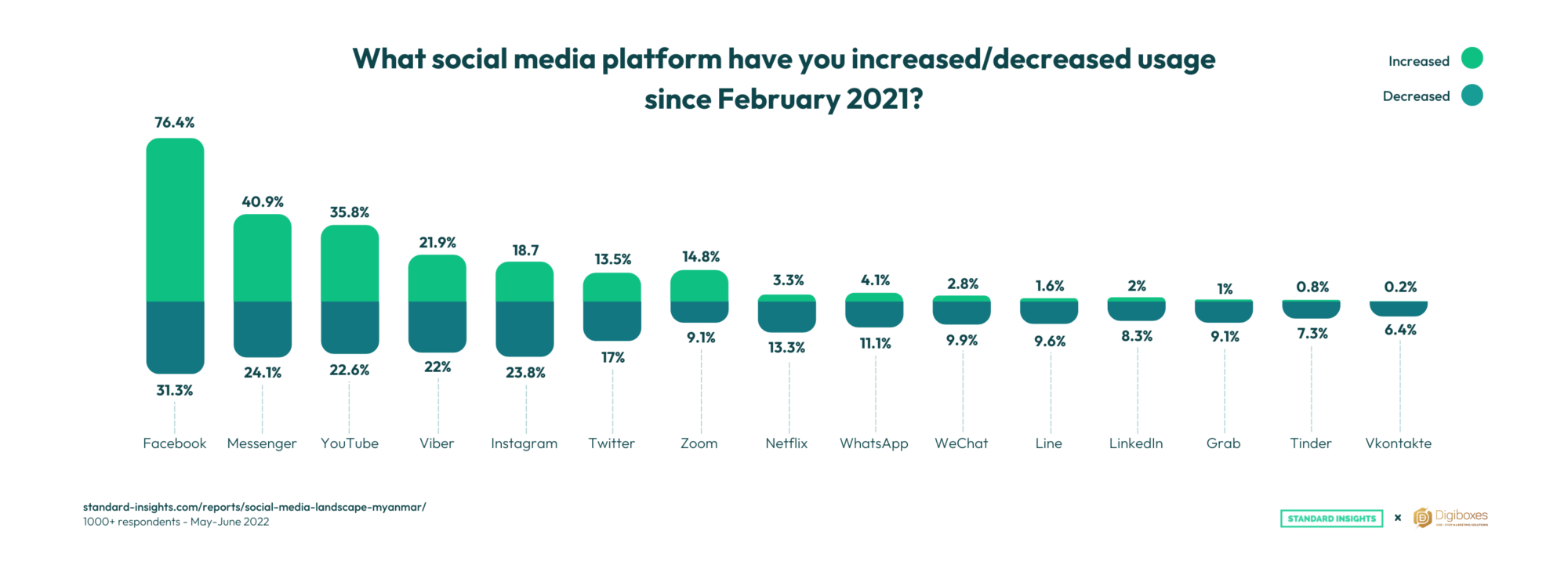
Amid the social media blackout in Myanmar, the number of individuals using Facebook and Messenger surged substantially after February 2021. The same is apparent for YouTube and Zoom because more users have noticed a rise in usage of these applications even after Myanmar’s social media restrictions. On the other hand, more users reported a drop in Viber, Instagram, Twitter, Netflix, and WhatsApp usage.
The Future of Social Media in Myanmar
Social media regulation benefits social networks, news and weather apps, and search engines. There are notably more respondents whose consumption of these social media platforms rose after February 2021.

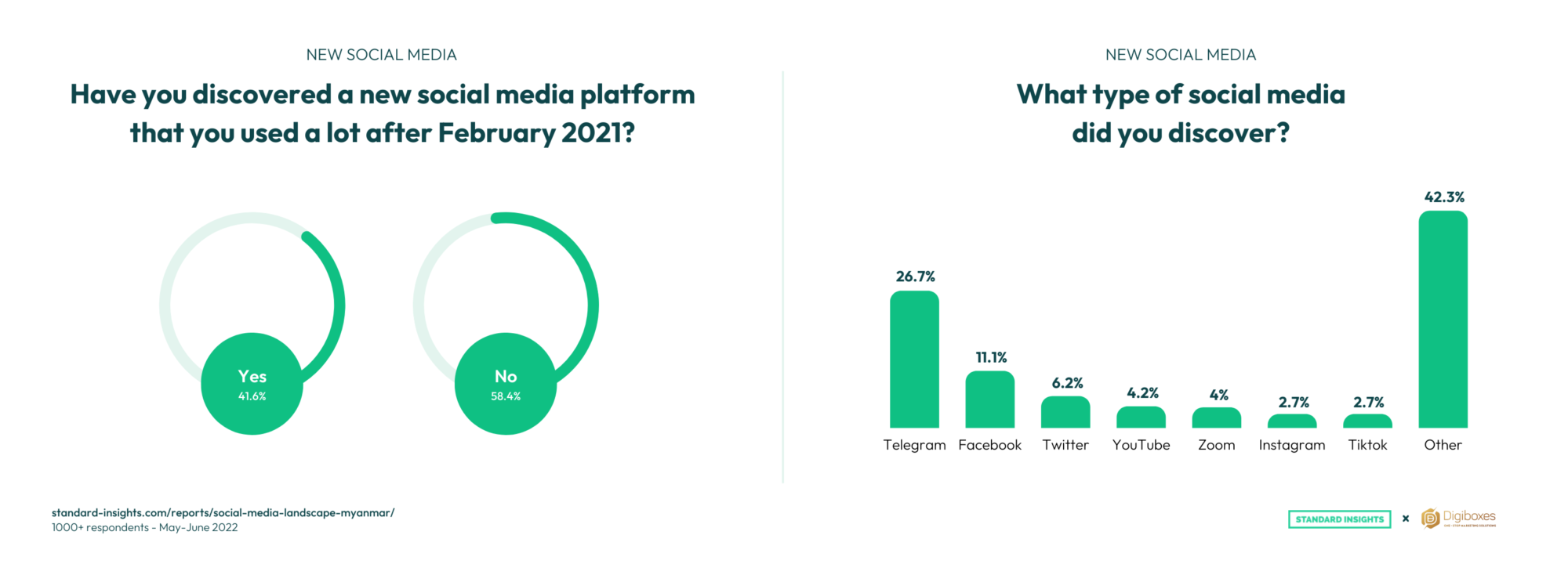
Not to mention, by February 2021, more than two out of every five respondents (41.6%) had discovered a new social media app. Telegram was the most popular social media app, favored by more than one in every four respondents (26.7%).
Other social media applications detected besides Telegram are Facebook (11.1%) and Twitter (6.2%). It indicates that, despite being widely utilized before February 2021, these social media apps are still gaining traction among Burmese. With this, it is clear that these social media apps are here to stay in Myanmar, despite the recent concerns caused by social media prohibitions.
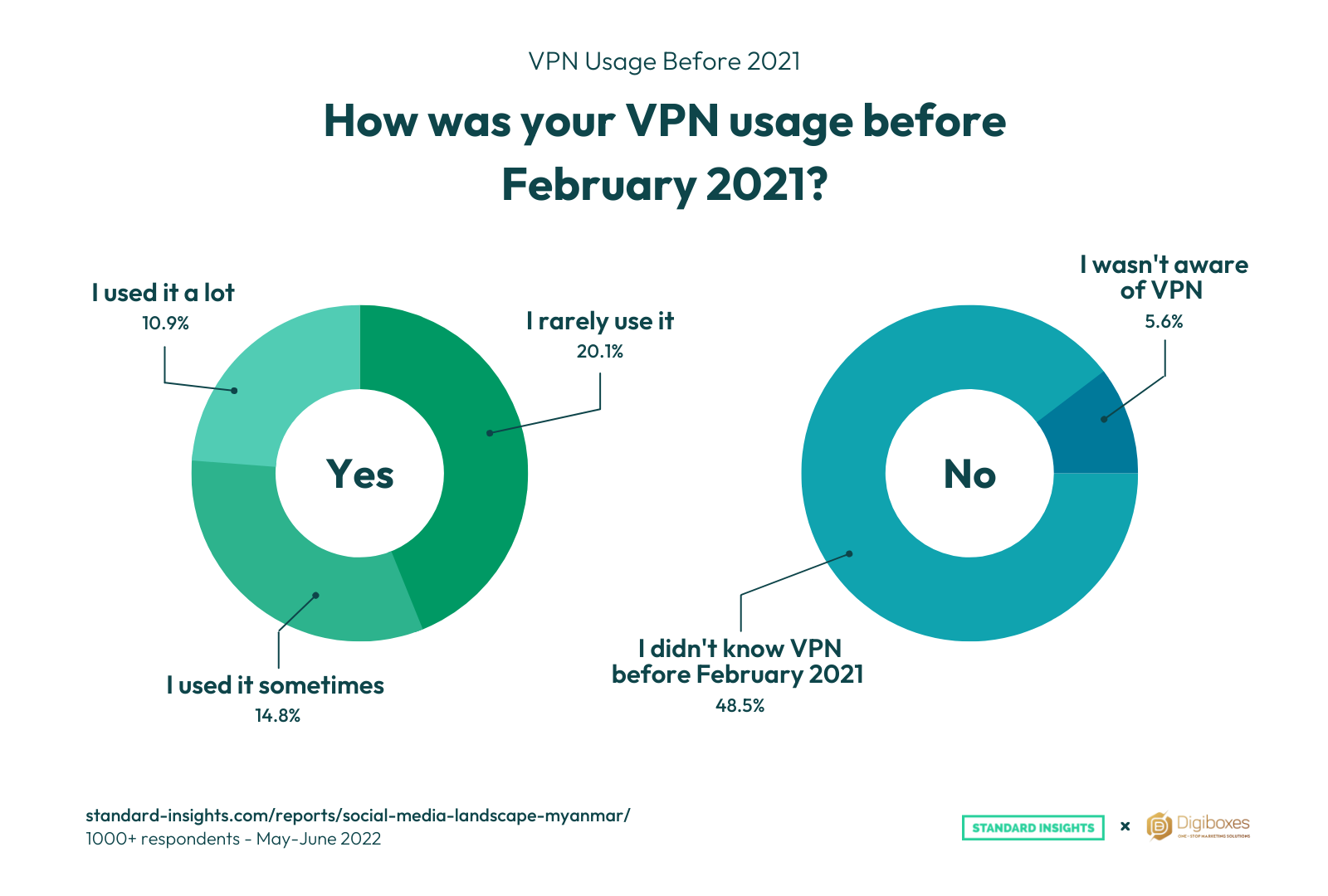
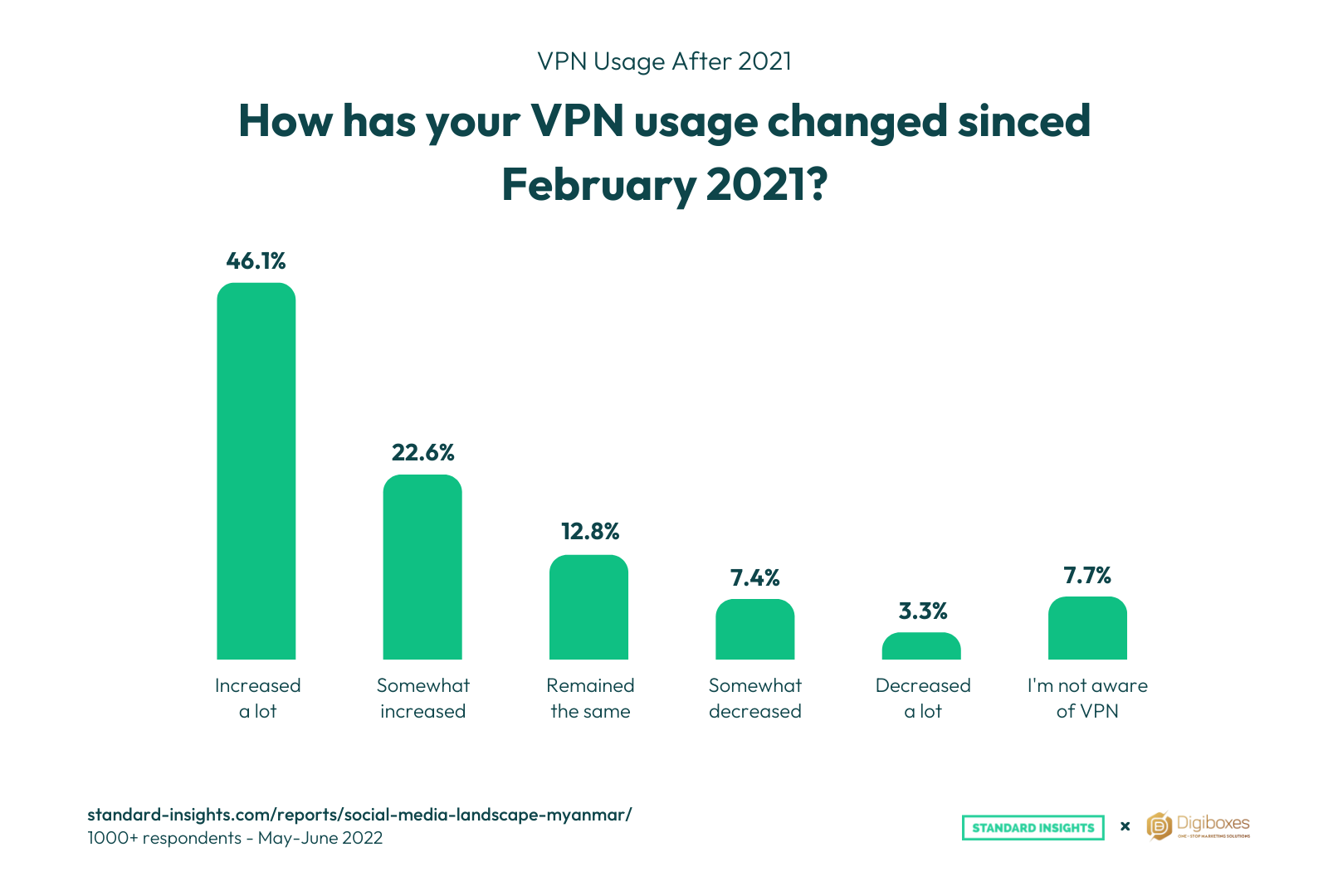
With the Myanmar government’s restriction on social media platforms, one specific activity that has changed Burmese people’s digital activities is Virtual Private Network (VPN) usage. Before February 2021, more than half of the respondents (54.1%) were unaware of VPNs. This amount has since been down by 7.7%. The data indicates that despite the official restrictions, 47.4% of social media users in Myanmar have found a way to continue their social media activity.
However, according to Statistics, 37.7% of Myanmar’s population was active on social media in 2022. This was a considerable reduction from the previous year, when 53.1% of Myanmar’s population was active on social media.
Understandably, Myanmar’s military government plans to prohibit the use of virtual private networks (VPNs) under a proposed new cybersecurity law, according to Nikkei Asia, to curtail internet access and prevent funding to pro-democracy parties.
Overall, the future of social media in Myanmar seems gloomier than ever, and no one can predict what is happening.
The Story Is Not Only About Social Media Regulations
The Myanmar government has done what many thought was impossible: enforced a VPN ban. The trick seems to declare an all-out war on the country’s internet users. Whether it will genuinely help the Tatmadaw retain power is yet to be seen.
Myanmar’s distinctive customs and celebrations offer unique insights into the local culture, presenting both challenges and opportunities for businesses looking to expand in the country. Decision-makers should acknowledge the significance of grasping these cultural nuances to formulate informed strategies that resonate with the market and honor local traditions.
In 2023, we surveyed over 600 Burmese individuals on Myanmar’s key celebrations, aiming to equip business leaders with information to better meet the needs and preferences of consumers in the country. Download our guide on “Myanmar’s Seasonal Marketing Calendar“ now!
What is the most popular social media in Myanmar?
Facebook remains dominant, but platforms like Messenger, YouTube, and Telegram are rising—especially after restrictions.
How do government restrictions affect Burmese social media use?
Many users switched to VPNs and discovered new apps like Telegram to get around blocks.
What should Myanmar marketers focus on now?
Monitor platform trends, invest in local research, and be ready to adapt to regulatory changes.