
Most brand personas were built in a workshop. Someone brought sticky notes. Someone else brought coffee. A senior stakeholder named the output "Millennial Maya" and the deck got filed three days after the presentation ended. Maya has not been consulted since.

This is not a cynical observation. It is the normal lifecycle of a persona built from assumption. And according to the Nielsen Norman Group, it describes the majority of personas in active use: what NN/G classifies as "proto-personas" - profiles based on a team's existing knowledge or best guesses, created with no new research - are the default output of most persona exercises, not the exception. The Group flags them explicitly as tools to use with caution, because they catalogue what the team already believes, not what consumers actually do.
The problem is not that brands are lazy about personas. It is that the standard persona-building process is structurally incapable of producing a tool that changes decisions. A persona built from assumption can describe a consumer. It cannot be interrogated. It cannot answer a question it was not built to answer. The moment the strategy moves - and strategy always moves - the persona has nothing left to say.
Meanwhile, the problem has been accelerating in a new direction. The availability of large language models has made persona generation trivially fast. Any strategist can produce a detailed consumer persona in under a minute. A 2025 review of 81 studies on LLM-generated personas identified a consistent pattern across the literature: these outputs skew positive, idealise their subjects, and reproduce stereotypes at scale. Researchers have named them "Potemkin personas" - staged to give an appearance of reality rather than truthfully representing real consumers. They are more detailed, more confident, and less grounded in reality than the sticky-note personas they replaced.
The persona problem is not a shortage of personas. It is a shortage of personas built from real data.
Why Most Personas Fail Before They're Finished
A persona is only as useful as the questions it can answer. That is the test. Not whether it has a name, a job title, a motivational quote, and a stock photo. Whether, when strategy changes and someone in the room says "what would our core customer think about this," the persona can give a real answer.
Workshop personas cannot pass this test. They were not built to. They were built to align a room - to give a team a shared vocabulary for a consumer they have not spoken to. That is a legitimate function, and NN/G acknowledges it: proto-personas are useful for making implicit assumptions explicit, for giving a team a shared direction when no research exists. The problem is that brands treat the workshop output as a research output. The description becomes the asset. The assumption becomes the finding.
Once that happens, the persona is static by design. It reflects the team's consensus at a fixed point in time, in response to a specific set of strategic questions. When the brief changes - when a new pricing tier needs testing, when a new channel is under consideration, when a competitor launches something unexpected - the persona has no new information to offer. It can be referred to. It cannot be questioned.
A persona that cannot be interrogated is not a strategic tool. It is a description.
The specific moment most strategists recognise: the persona deck gets presented, it gets praised, it gets filed. The strategy team references "Maya" in the next three briefs and then stops mentioning her. Not because she was wrong, but because she was finished. She could not grow with the strategy. So the strategy grew without her.
The structural fix requires changing what a persona is made of - not how it is formatted or how much detail it contains. The difference between a persona that gets filed and a persona that changes decisions is the difference between a document and a dataset.
What a Data-Driven Persona Can Do That a Workshop Persona Can't
A persona built from real consumer data has three capabilities a workshop persona cannot replicate. Each does distinct strategic work.
It reflects actual behaviour, not inferred behaviour. When a persona is generated by filtering a nationally representative survey dataset - female respondents aged 25–44 who purchase skincare products at least monthly, for example, the segment that emerges exists. It is not constructed from consensus. It is not averaged from demographic inference. It is a real subset of real consumers who answered real questions. The profile that emerges describes what that group actually said, not what the team assumed they would say. In categories where the assumed core customer and the actual core customer diverge, and they diverge more often than most strategy teams expect, this distinction is the difference between a brief that targets the right segment and one that doesn't.
It is interrogable. When strategy changes, a data-driven persona can be asked new questions. A grocery brand builds a persona of frequent shoppers from a survey focused on price sensitivity. Six months later, the brand is considering a premium private label launch. The workshop persona has nothing to say - the question was never asked. The data-driven persona can be interrogated against that new question because the consumers who answered the original survey already provided the data.
It is comparable. When multiple personas are built from the same dataset, the differences between them are real. A beauty brand that builds personas for their loyal monthly purchasers, their occasional buyers, and their lapsed customers - all from a single 500-person nationally representative survey - is not constructing fictional distinctions between fictional people. They are measuring real differences between real segments. When those personas are placed side by side, the gaps are evidence. The loyal customer values ingredient transparency. The lapsed customer values convenience. That finding does not come from a workshop. It comes from the data. And it changes the brief.
Real differences between real segments are the only basis for a positioning decision that holds up.
How Standard Insights Builds Personas From Your Survey Data
Every paid Standard Insights survey project produces more than a report. It produces a filterable dataset that the personas feature turns into named, comparable consumer segments.
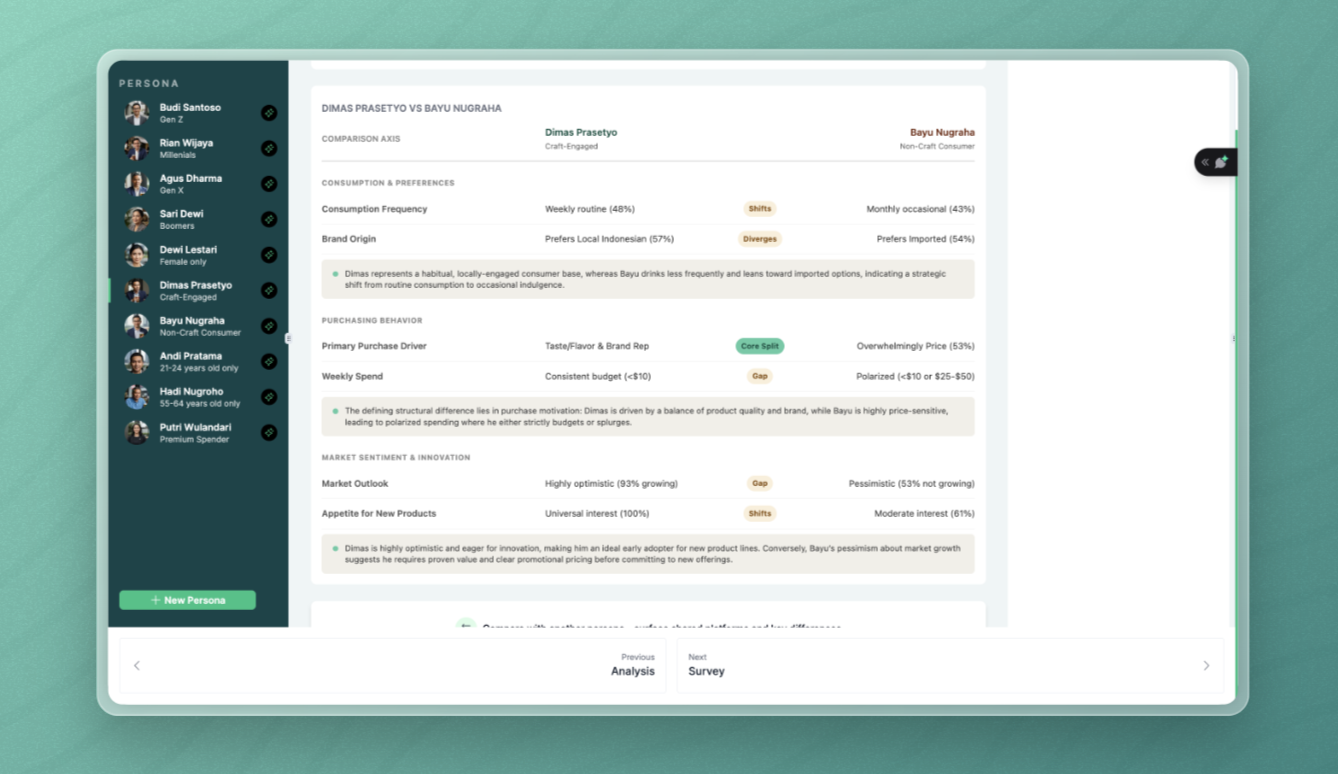
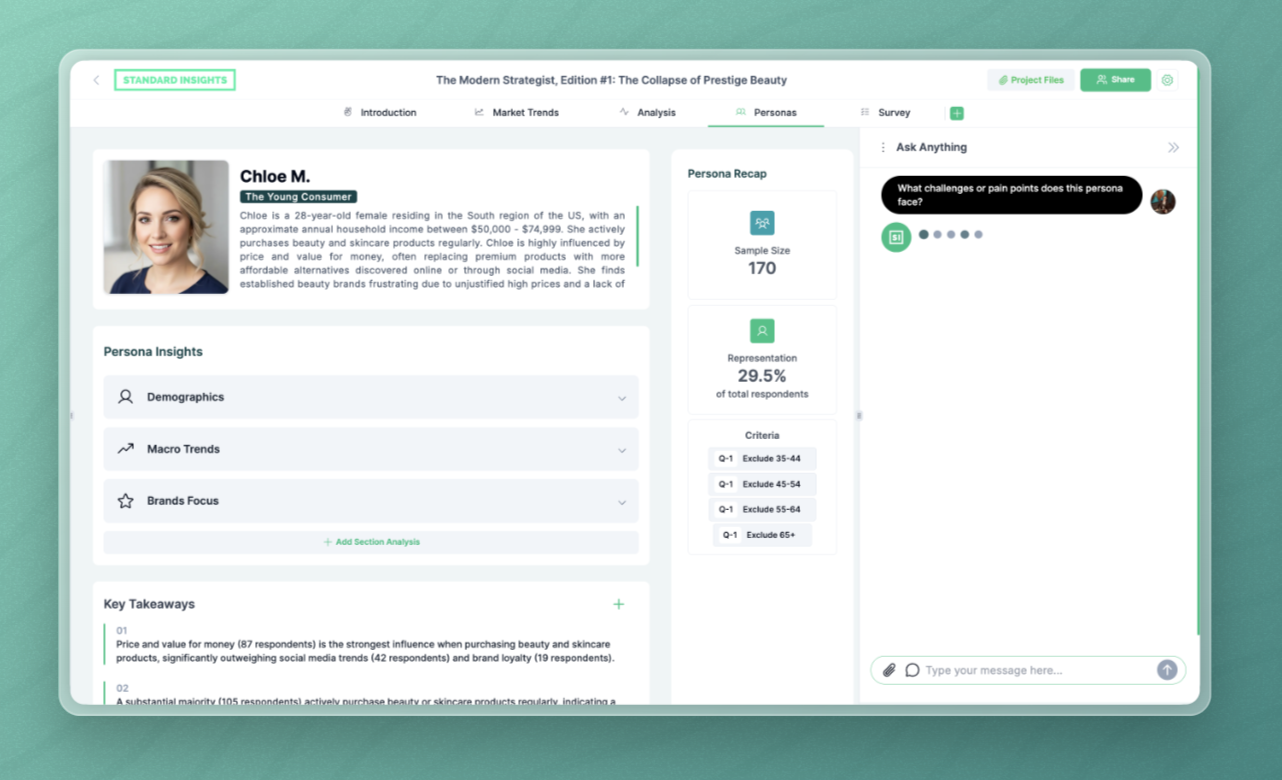
Once a survey report is delivered, the user opens the personas view and applies a filter to the dataset - by demographic variable, by behavioural variable, or by any answer combination in the survey. Female respondents only. Respondents aged 18–34 who purchase in the category monthly. Respondents who rated brand trust as their primary purchase driver. The platform generates a full analysis of that filtered segment as a named persona: a profile of who they are, what they said, how they differ from the broader sample, and what the data reveals about their decision-making.
Multiple personas can be created from the same dataset and placed in direct comparison. The differences the platform surfaces are real - they are measured differences in what distinct segments said, not constructed distinctions between imagined consumers. A brand running a single 500-person nationally representative survey can emerge with a loyal-customer persona, a lapsed-customer persona, and an untapped-segment persona, all built from the same fieldwork, all comparable against each other.
The AI chat capability extends this further. Rather than treating the persona as a finished document, the user can engage with the underlying dataset through a conversational interface - asking new questions, testing new ideas, exploring patterns that were not in the original survey brief. A campaign concept that did not exist when the survey was fielded can be tested against the persona's dataset before commissioning new research. The persona does not just describe the segment. It stays useful as the strategy evolves.
Access is included in every paid project. Any user who receives a paid Standard Insights report can create personas from that report's dataset. Enterprise users can access the personas feature at the point of report creation.
The survey does not end at the report. The report is where the strategic work begins.
The Recycled Data Advantage - One Study, Multiple Strategic Questions
A 500-person nationally representative survey costs a fixed amount and takes 24 hours to field. That is the cost of access to a nationally representative sample of real consumers. How much strategic value you extract from that access is a function of how many questions you can ask of the data — not how many studies you run.
This is the calculation most brands are not making explicitly. The default mental model treats a survey as an answer to one question. Brief in, finding out, study closed. The Standard Insights personas feature changes that model. A single survey, filtered into three or four distinct consumer segments, interrogated with new questions over time through the AI chat interface, does not produce one strategic asset. It produces a durable one.
The use cases are concrete. A CPG brand uses purchase frequency as the filter variable, splitting their dataset into heavy, medium, and light buyers. The heavy-buyer persona and the light-buyer persona sit side by side. The gap between them — what they value differently, what they distrust, what would change their behaviour — is the positioning brief. An agency filters a client's dataset by demographic to identify which segment is most underserved by the current brand positioning, and brings that comparison into the pitch rather than a slide deck built on category inference. An insights team at a retailer uses the AI chat to test a new loyalty programme concept against their existing persona data before deciding whether to commission a dedicated study. The concept either maps onto what the loyal segment already said they want, or it doesn't. That answer takes minutes, not weeks.
None of these applications require a new survey. They require a single well-designed survey and a tool that lets the data keep answering questions after the original report is filed.
The cost of a survey is not the cost of one answer. It is the cost of access to a segment. The return on that access compounds with every question you ask.
The Persona That Can Be Questioned Is the Only One Worth Building
The value of a persona is not in its description. It is in its utility under pressure - when the brief changes, when the budget shifts, when a competitor launches something the strategy did not anticipate.
A workshop persona, however well-crafted, was built to answer the questions the workshop was designed to address. When the questions change, it has nothing new to offer. It becomes a historical document — a record of what the team assumed at a fixed point in time. Brands do not stop referencing it. They stop trusting it. And without a credible alternative, strategy defaults to gut.
An LLM-generated persona accelerates this problem. It is faster to produce, more detailed in presentation, and less grounded in reality than anything a workshop produces. The research literature's term for it — Potemkin persona — is precise: it is a facade constructed to look like insight. It validates whatever the prompter was already inclined to believe, with enough surface plausibility to make the assumption feel like a finding.
The alternative is not more rigorous workshops or better prompt engineering. It is data. A persona built from filtered survey responses, comparable across segments, interrogable with new questions as strategy evolves — that is a decision-support tool, not a document. It does not just describe the consumer. It stays in the conversation.
The brands that will extract the most from their research budgets in the next three years are not the ones that commission the most studies. They are the ones that ask the most questions of each study they run.
If your personas cannot answer a question you have not asked yet, they are not personas. They are portraits.
About the data: No Standard Insights survey data is cited in this article. The personas feature described is part of Standard Insights' standard paid project offering. Standard Insights conducts nationally representative surveys across its 170M+ global panel.