Quick answer. Before asking “what does ChatGPT say about my brand?”, look at what shoppers do with the answer: in Standard Insights’ September 2026 survey of 500 US adults, AI assistants mostly helped them work out what to look for, and only 10% of those who’d used one for a purchase said the AI’s assessment was what mostly decided the brand. What ChatGPT says about your brand is worth reading, across many answers and next to your competitors, but whether buyers know you and would consider you is still the number that decides.
A third of the US adults we surveyed asked AI for help with a purchase
In Standard Insights’ September 2026 survey of 500 US adults, 33% said they’d asked an AI assistant for help with a purchase in the past three months. The Shopping With AI article and the AI Shopping Behavior report have the full results.
Traffic data points the same way. Adobe recorded a 693.4% rise in traffic from generative AI tools to US retail sites over the 2025 holiday season. But traffic only shows the click at the end, not the conversation that came before it.
Shoppers want help, not someone to decide for them. In a Gartner survey of 322 US consumers in January 2026, 11% said they’d be willing to let AI make purchase decisions.
AI shapes what shoppers look for more than which brand they pick
Among the 164 people in our survey who used AI for a purchase:
- 60% used it to work out what to look for;
- 34% used it to confirm their final choice;
- 25% used it only at the start.
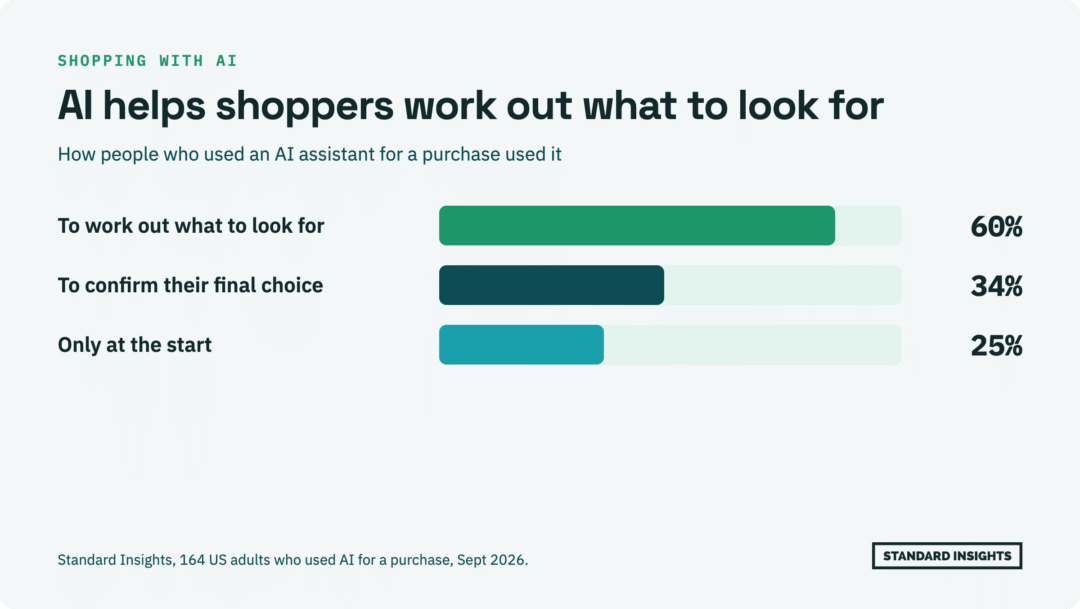
It changed the search for many of them: 43% said it changed what they were looking for, and 58% that it helped them find something better suited.
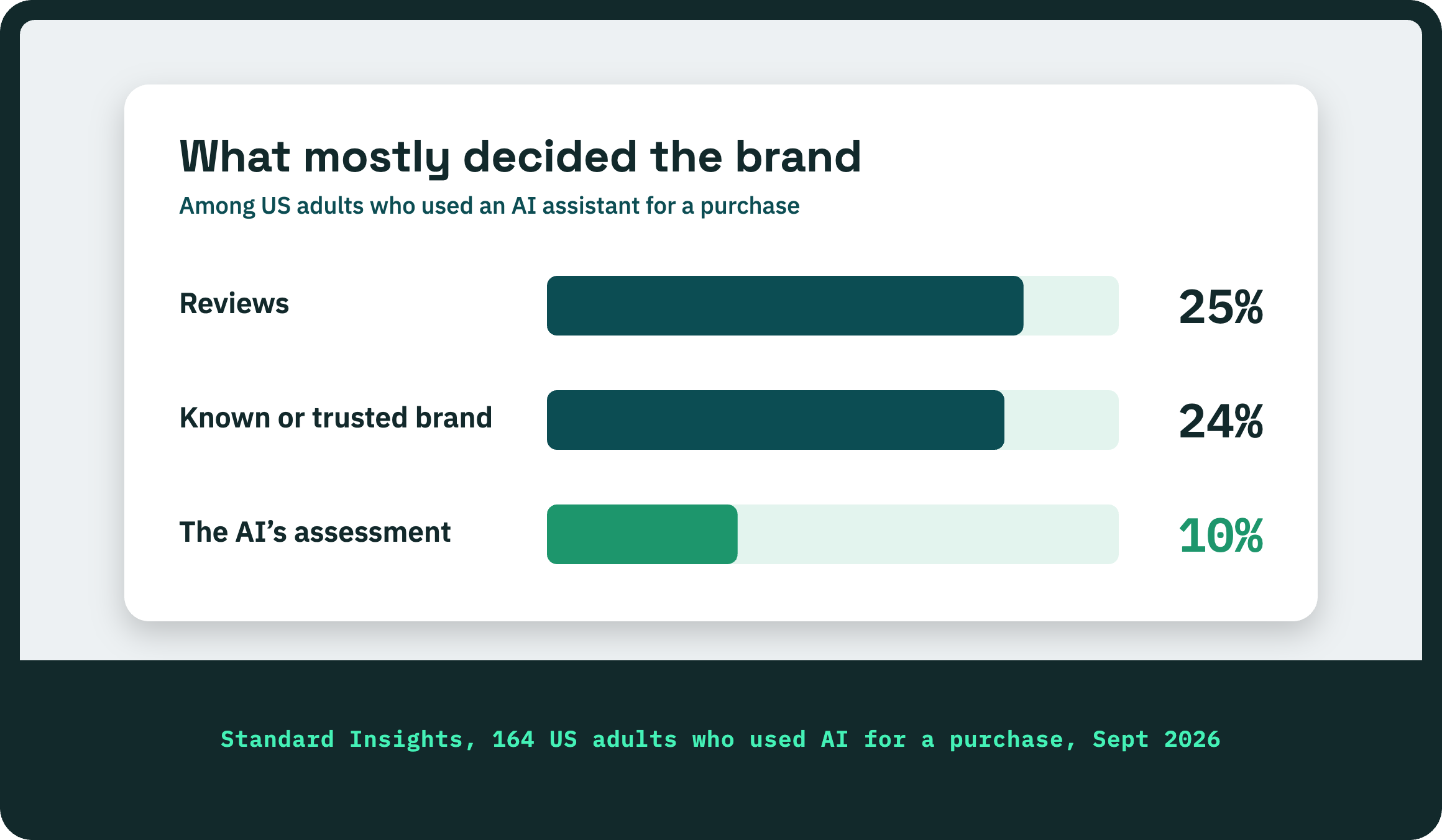
The brand, though, was mostly decided elsewhere. Reviews came first (25%), then already knowing or trusting the brand (24%). The AI’s own assessment came well behind, at 10%.
So a brand can be judged against criteria set in a conversation it never saw. In this survey, AI’s influence shows up more in what a good choice looks like than in which brand gets picked.
One ChatGPT answer is not a measure of your brand
Ask “what does ChatGPT say about my brand?” twice and you’ll often get a different list. SparkToro and Gumshoe, a company that tracks AI answers, ran 2,961 prompts on ChatGPT, Claude and Google’s AI features in November and December 2025. The same list of brands came back less than 1% of the time, and the same list in the same order less than 0.1%. The study isn’t peer-reviewed.
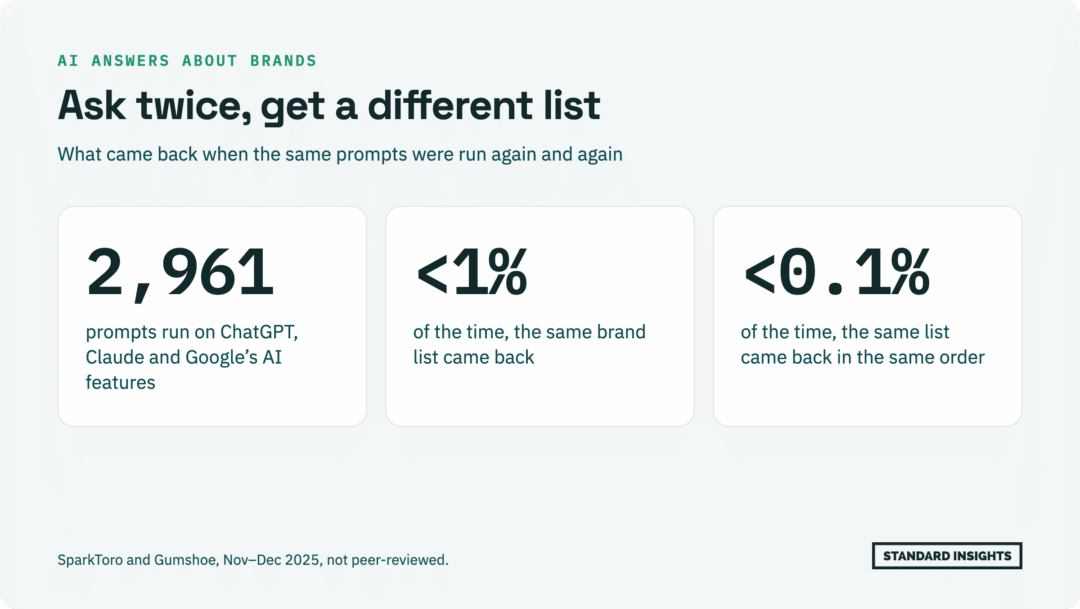
The same study found something steadier: how often a brand showed up across many runs held better than where it appeared in any one answer.
So the useful reading is repeated: the same prompts each time, many answers, your competitors alongside, and a neutral shopper profile next to your buyers’ profiles. Inside a brand tracker, this reading sits next to the survey results on each page, never merged into one score. For a first look at what assistants say about your brand today, try the AI Brand Check. One check is a snapshot; repeated readings are the measure.
Why what buyers think stays the reference
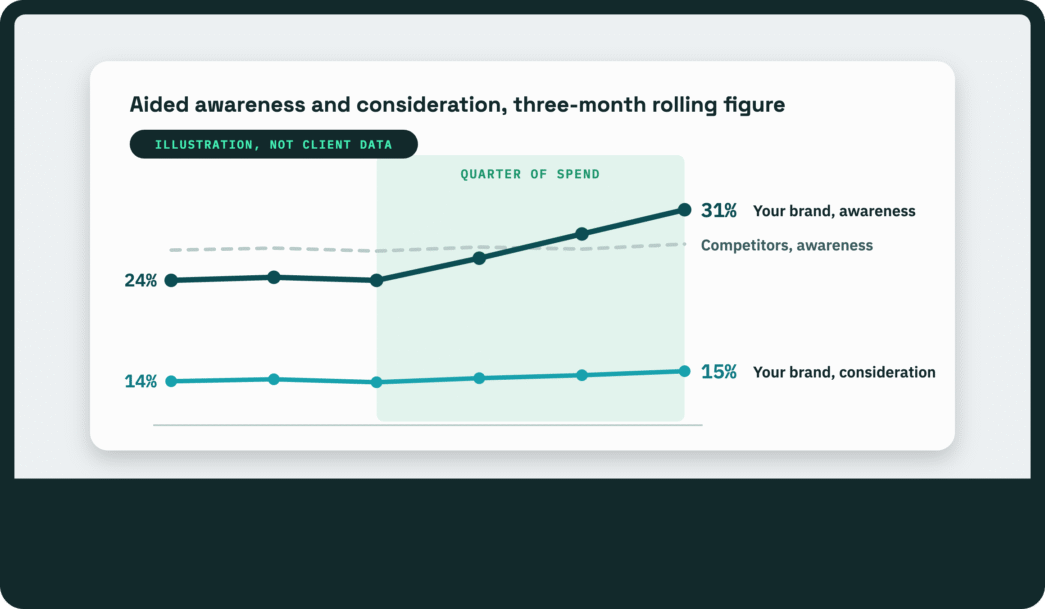
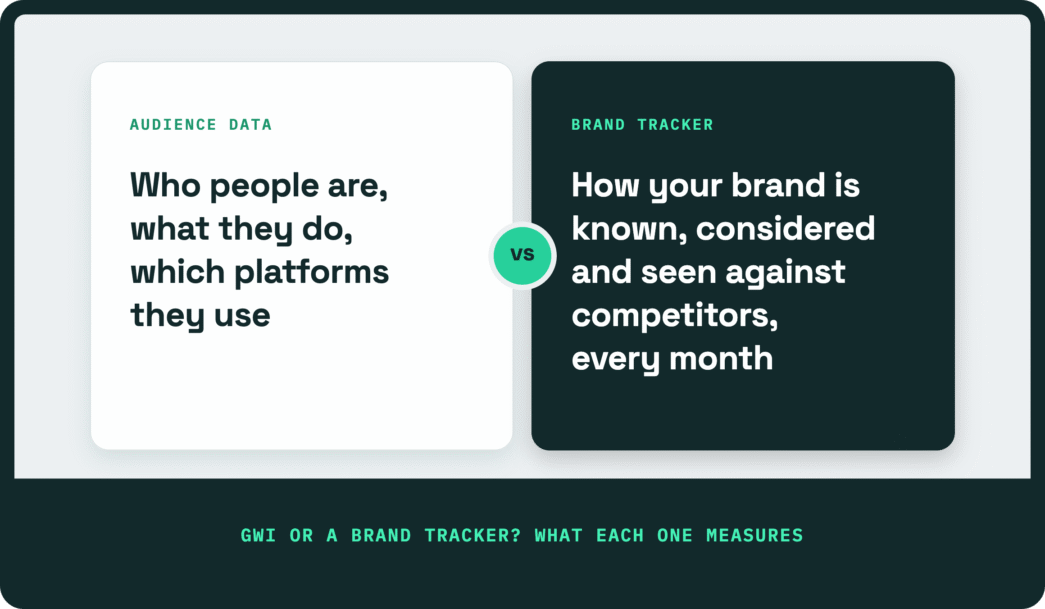
An AI answer tells you what a model says. A survey tells you what buyers know and would consider. Only the second is your market.
So read the two together, side by side. If AI answers keep leaving you out of a category where buyers already consider you, that’s worth noting. If buyers don’t consider you, the survey shows it, whatever the AI answers say.
For how brand tracking measures what buyers think over time, see What is brand tracking? How it works and who does it.
FAQ
What does ChatGPT say about my brand?
It depends on the run: ask the same question twice and you may get a different list. Read it across many answers, next to your competitors, rather than from one reply.
Do shoppers trust AI to choose a brand?
Few do. In our survey, 10% of the 164 people who used AI for a purchase said its assessment was what mostly decided the brand. Gartner found 11% of US consumers willing to let AI make purchase decisions.
Can I change what ChatGPT says about my brand?
This article doesn’t give optimisation advice. What it shows is that shoppers still mostly pick the brand on reviews and on knowing and trusting it, so what buyers know and would consider is what to measure first.
How do I track what AI assistants say about my brand?
With the same prompts, repeated, across several assistants, with your competitors and a neutral profile alongside. Read the results next to survey data on the same brands.
Method note
Standard Insights survey of 500 US adults, online, unweighted, 25 to 27 September 2026. Margin of error about ±4.4 points on the full sample, and about ±7.5 points on the 60% figure among the 164 people who used AI for a purchase (95% confidence, simple random sample). The Gartner figure is from 322 US consumers surveyed in January 2026. The SparkToro and Gumshoe study isn’t peer-reviewed.
Sources
- Adobe, 2025 holiday shopping season (7 Jan 2026): https://news.adobe.com/news/2026/01/adobe-holiday-shopping-season
- Gartner, “Consumers want AI shopping help but not AI purchase decisions” (27 May 2026): https://www.gartner.com/en/newsroom/press-releases/2026-05-27-gartner-survey-finds-consumers-want-ai-shopping-help-but-not-ai-purchase-decisions
- Search Engine Journal, SparkToro study on AI recommendations (30 Jan 2026): https://www.searchenginejournal.com/ai-recommendations-change-with-nearly-every-query-sparktoro/566242
Standard Insights’ tracker does both readings every month: what buyers know, consider and think of your brand against your competitors, and, with AI Brand Tracking, what AI assistants tell shoppers about it, on the same report page, never merged into one score. It also asks buyers where they get information when they choose a brand, so you see how much AI weighs in your category. See Brand Tracking. For a monthly read on brands and consumers, subscribe to Brands & Consumers.