We wanted to know at which point Americans bring an AI assistant into a purchase, and whether it ends up choosing the brand. We surveyed 500 US adults in September 2026 about shopping with AI. Of the 33% who say they asked an AI assistant for help with a purchase in the past three months, 60% say they used it to work out what to look for, and 10% say its assessment mostly decided the brand they bought.
Key figures
- 33% of the 500 Americans we surveyed say they asked an AI assistant for help with something they were thinking of buying in the past three months.
- 60% of them say they used it to work out what to look for, and 34% to confirm their final choice.
- 10% of them say the AI’s assessment is what mostly decided the brand.
What we wanted to find out
Retail traffic data already shows that Americans are shopping with AI. Adobe reports that visits to US retail sites from generative AI tools rose 693% year on year over the 2025 holiday season. Traffic data records the click that follows a conversation with an assistant. It does not record what the person asked before clicking.
The timing of that conversation matters to a brand. An assistant consulted early helps a shopper define what they need, before they draw up a list of brands. An assistant consulted late helps them choose between brands they are already considering. We set out to measure which of the two Americans describe, and how often they credit the AI with the final choice.
How we went about it
We surveyed 500 adults in the United States from September 25 to 27, 2026, with six questions plus demographics. Everyone was asked whether they had used an assistant such as ChatGPT, Gemini, Copilot or Meta AI to help with something they were thinking of buying. Those who had were then asked at which steps they used it and what difference it made.
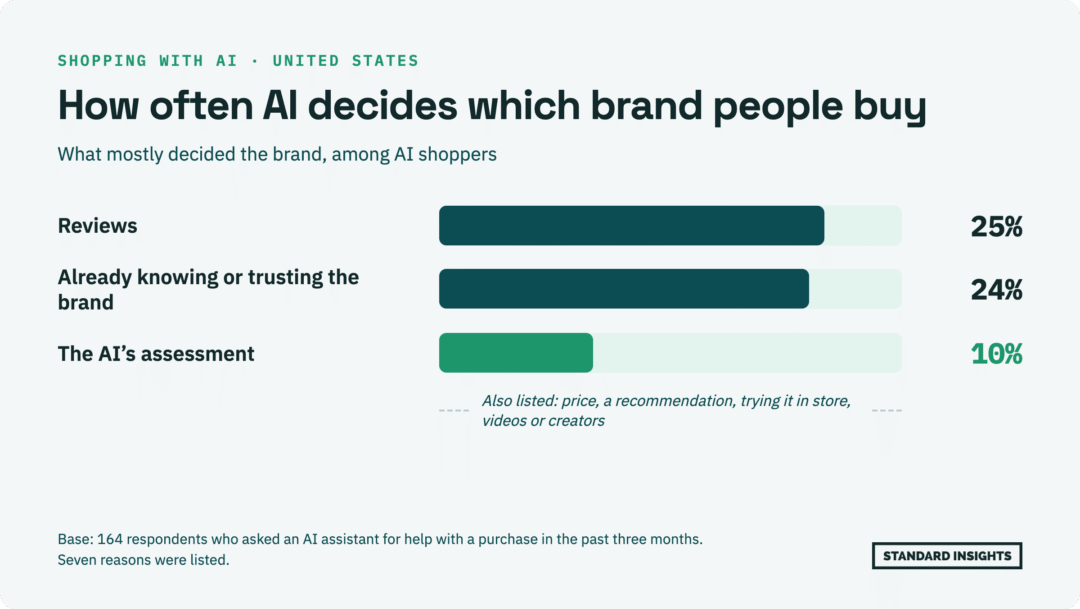
The AI was never asked about on its own in the brand question. Everyone was asked what mostly decided the brand in the last purchase they had to research, and the AI’s assessment was one of seven listed reasons. The others were already knowing the brand, reviews, price, a recommendation, trying it in store, and videos or creators.
Shopping with AI happens mostly at the start of a purchase
From here on, “AI shoppers” means the 164 people who say they asked an AI assistant for help with a purchase. We asked them to think of the last purchase they had to look into, and to say at which steps they used the assistant. Working out what to look for was the most common answer, given by 60%. Understanding the problem came next. Confirming the final choice came last, at 34%.
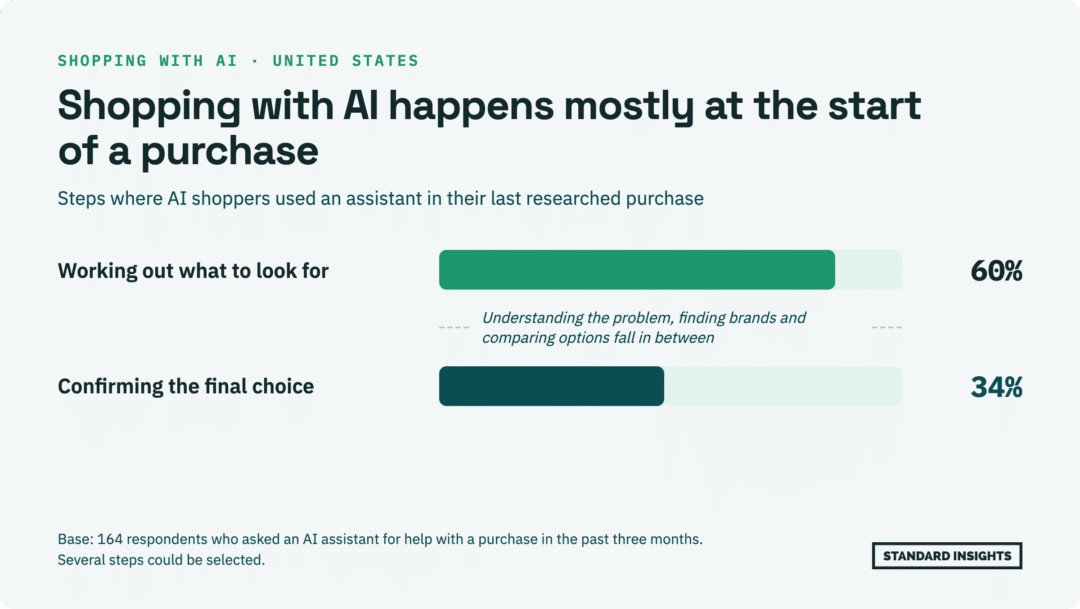
Finding brands and comparing options fall between those two ends. A quarter of AI shoppers (25%) say they used the assistant only at the first steps, understanding the problem or working out what to look for, and at none of the later ones. The next question was how much the assistant counts once a brand has to be chosen.
How often AI decides which brand people buy
Among AI shoppers, 10% say the AI’s assessment is what mostly decided the brand they bought. Reviews were named by 25% and already knowing or trusting the brand by 24%. Each was named more than twice as often as the assistant.
The people who brought AI into the early steps of a purchase mostly credit something else for the brand they picked. We then asked them what difference using AI had made compared with buying without it.
How shopping with AI changes what people look for
Six in ten AI shoppers (58%) say it helped them find something better suited to their needs. Four in ten (43%) say it changed what they were looking for. Only 8% say it made no difference to their purchase.
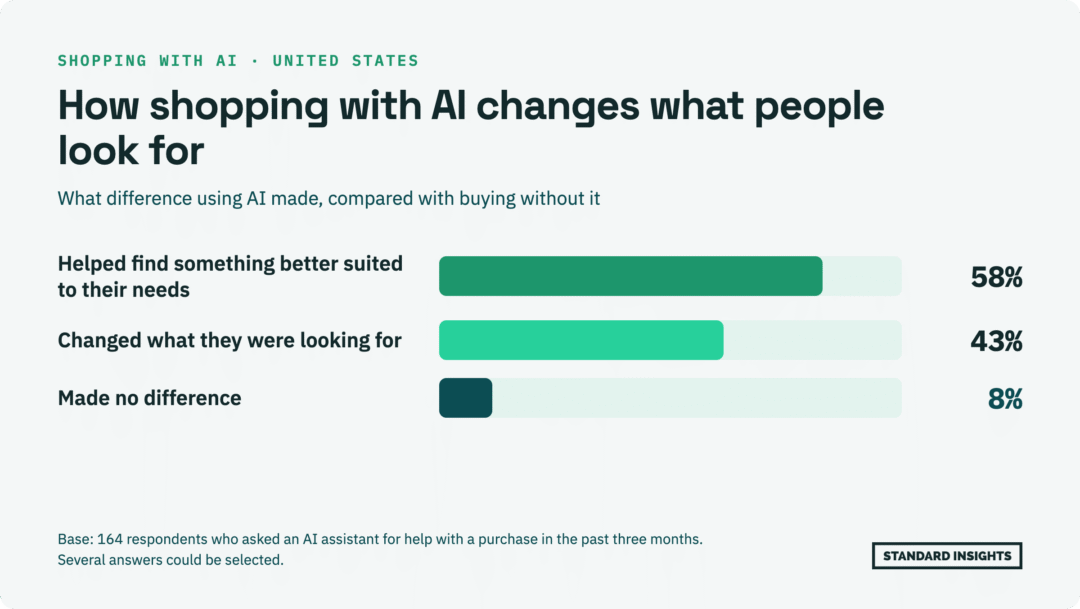
Both answers concern what the shopper wanted from the product, which matches the step most of them say they used the assistant for. As people recall it, the assistant’s role sits mainly in setting their criteria and much less in the final pick of brand. A brand can meet requirements at the comparison stage that were set in a conversation it never saw.
What this means for a brand
Ask an AI assistant what to look for when buying in your category. 60% of AI shoppers say they used it for that step. Its answer shows one version of the criteria they may arrive with.
Check how your reviews read against those criteria. Reviews (25%) and an already known brand (24%) were the two reasons AI shoppers named most often for picking a brand.
Check what your attribution model records before the final click. A quarter of AI shoppers (25%) say they used an assistant only at the first steps of a purchase. A model that credits the last touch does not record those conversations.
What the study doesn’t tell us
The 500 people were not adjusted to match the US population, so the percentages describe the people we surveyed rather than all American adults. The answers are recalled and concern a single recent purchase. AI shoppers described a purchase where they used AI, so their answers on brand choice can’t be compared directly with other shoppers’. The 164 AI shoppers are too few to split reliably by age, gender or how often they use AI.
Going further
The full report is on our platform. The figures here describe shopping with AI across purchases in general. For a specific brand, that is what Brand Health and Brand Tracking measure.
Methodology
Market: United States. Base: 500 adults, online survey, unweighted. Fieldwork: September 25–27, 2026.
Questions covered: AI use for purchases in the past three months; categories where people would ask AI for help; steps where AI was used in the last researched purchase; what mostly decided the brand; what difference AI made; whether AI helped people buy something they would otherwise have put off. Demographics: age, gender, region, household income, employment.
Base composition: 164 respondents say they used an AI assistant for a purchase in the past three months (32.8%), 128 use AI for other things (25.6%), 208 don’t use AI assistants (41.6%). Questions on AI steps and AI impact were asked only of the 164.