Quick answer. Brand consideration is the share of people in your category who would consider buying from you next time they shop it. Divide it by awareness and you get the number to watch: of the people who know your brand, how many see it as an option, which you read against your competitors and month after month rather than against a universal benchmark.
Brand consideration is the share of buyers who would consider you next time
The usual survey question is simple: “Which of these brands would you consider the next time you buy [category]?” People pick from a list that includes your brand and your competitors.
Consideration sits between awareness and purchase. To be bought, a brand first has to be known, then make the shortlist.
That shortlist is short. In McKinsey’s 2009 study of the consumer decision journey, the brands people started with averaged 1.7 for PCs and 3.8 for cars, and brands on that first list were up to three times more likely to end up bought.
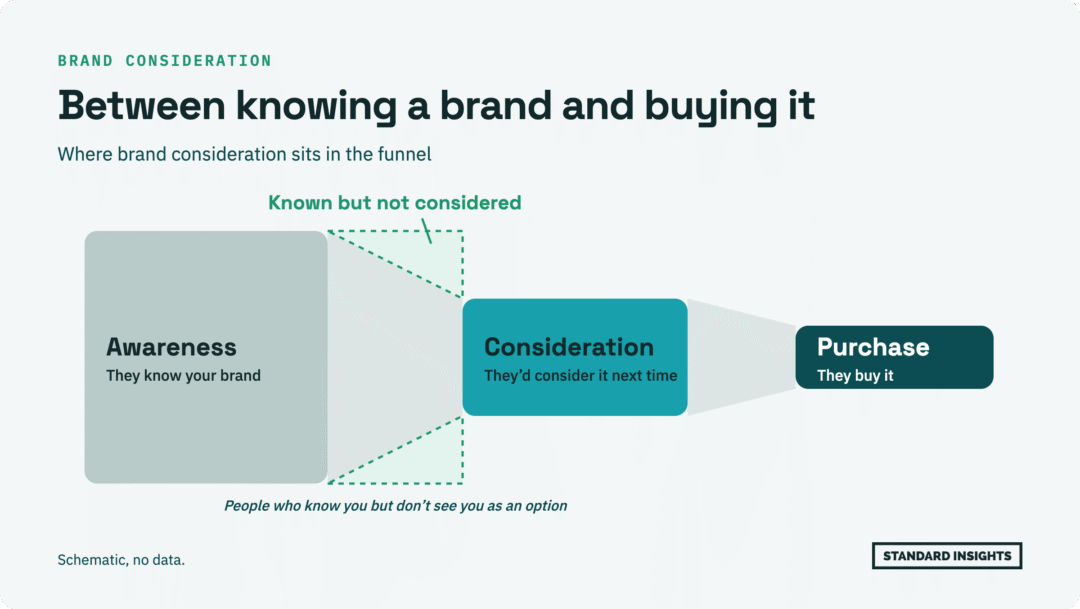
Awareness alone hides the problem: read consideration as a share of awareness
On its own, consideration mixes two things: how many people know you, and how many of those would pick you. To separate them, divide consideration by awareness. YouGov uses the same method in its funnel charts, dividing each stage by the one above it.
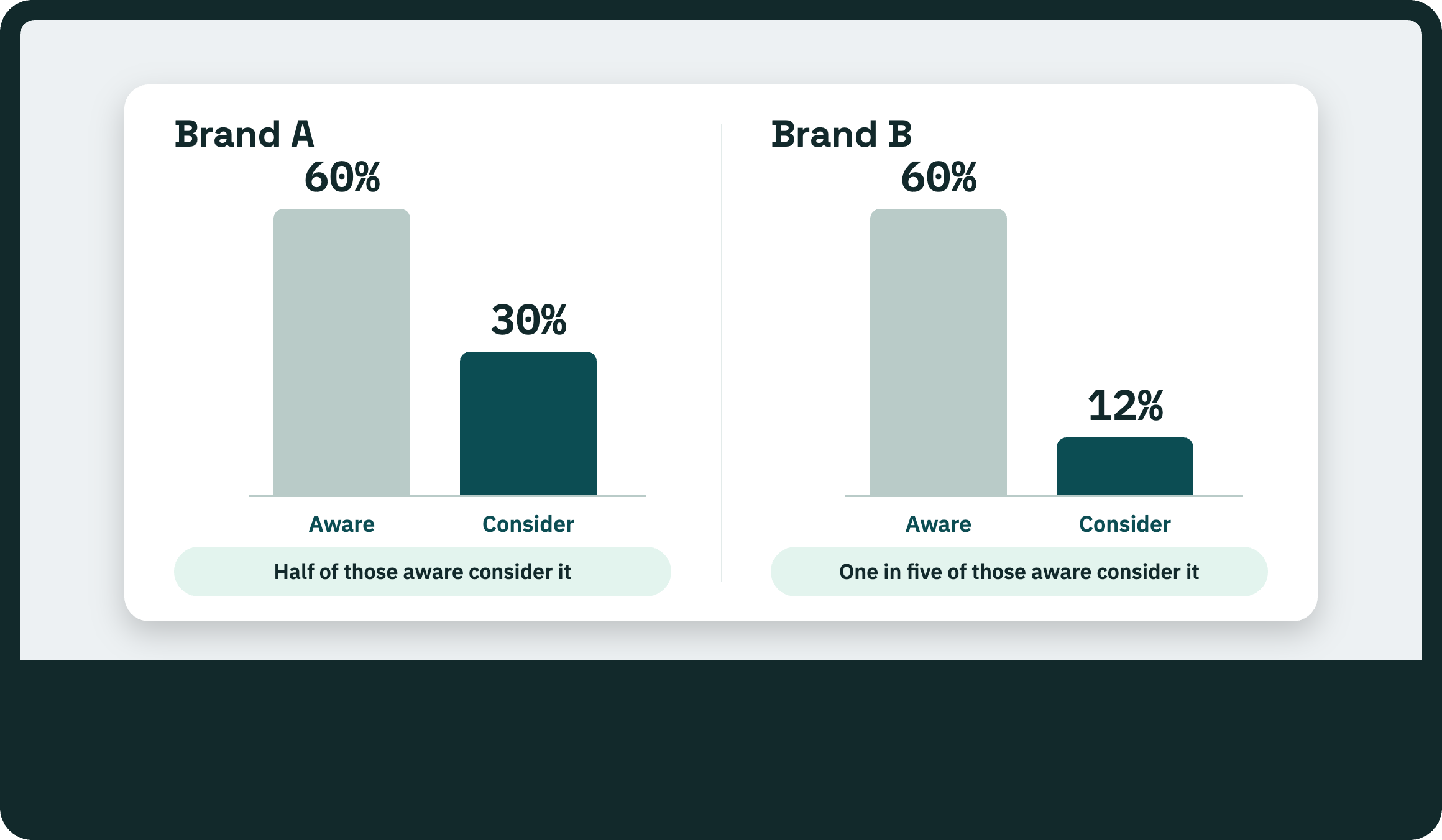
Here’s an illustration with round numbers, not real data. Two brands are both known by 60% of category buyers. Brand A is considered by 30%: half the people who know it would consider it. Brand B is considered by 12%: only one in five would. Same awareness, very different brands. One is known and chosen from; the other is known and passed over.
That gap is “known but not considered”: people you’ve already paid to reach, who don’t see you as an option.
One thing to watch: the ratio rests on a smaller base than the headline. If 60% of 300 people know you, the conversion is read on 180 people, with a margin of error of about ±7.3 points.
What’s a good consideration rate? It depends on your competitors
There isn’t a universal good rate. It depends on the category: how many brands people keep in mind, and how often they buy. McKinsey’s figures already show the shortlist changing size from PCs to cars.
The useful comparison is your conversion against the median of your competitors, measured with the same questions and the same audience. If your competitors convert half their aware buyers and you convert a fifth, that’s your number to watch.
Consideration moves faster than awareness, and for real reasons
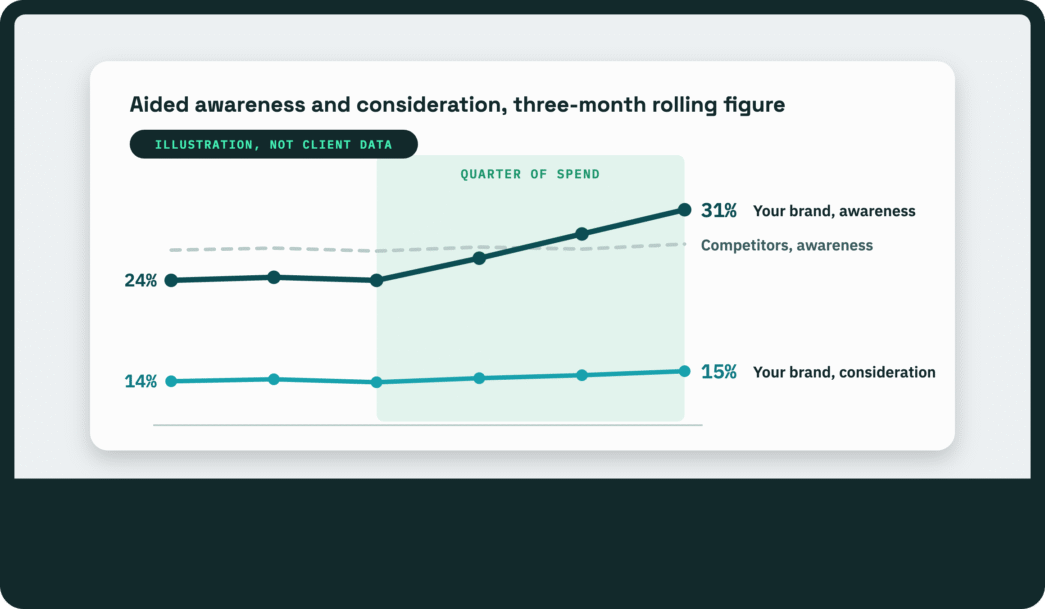
Awareness is memory, and memory fades slowly: aided awareness rarely falls. Consideration can fall quickly, and when it does, it’s often real: a price change, a stock-out, a crisis, a competitor’s move.
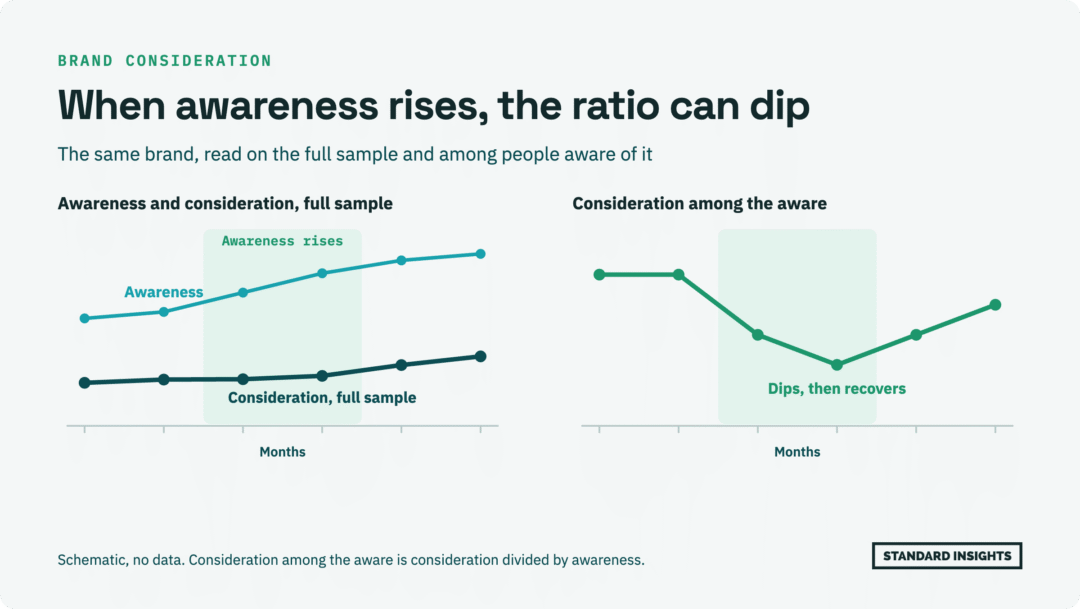
There’s one trap. When awareness rises, the people who’ve just heard of you are less likely to consider you yet, so the conversion rate can fall even while awareness grows as planned. Check consideration on the full sample before calling it a decline.
Read it monthly, as a rolling figure, with the margin stated. On 300 people, one month carries about ±5.7 points; a three-month rolling figure brings that down to about ±3.3. The margin of error article covers how big a change has to be to count.
And when three or more brands’ consideration moves together, that’s usually a real category event, not noise.
What the number doesn’t tell you: why
Consideration shows that people know you and pass you over. It doesn’t tell you why. A price perception, a missing feature and a bad review all leave the same gap in the funnel. The number shows where to look, not the cause.
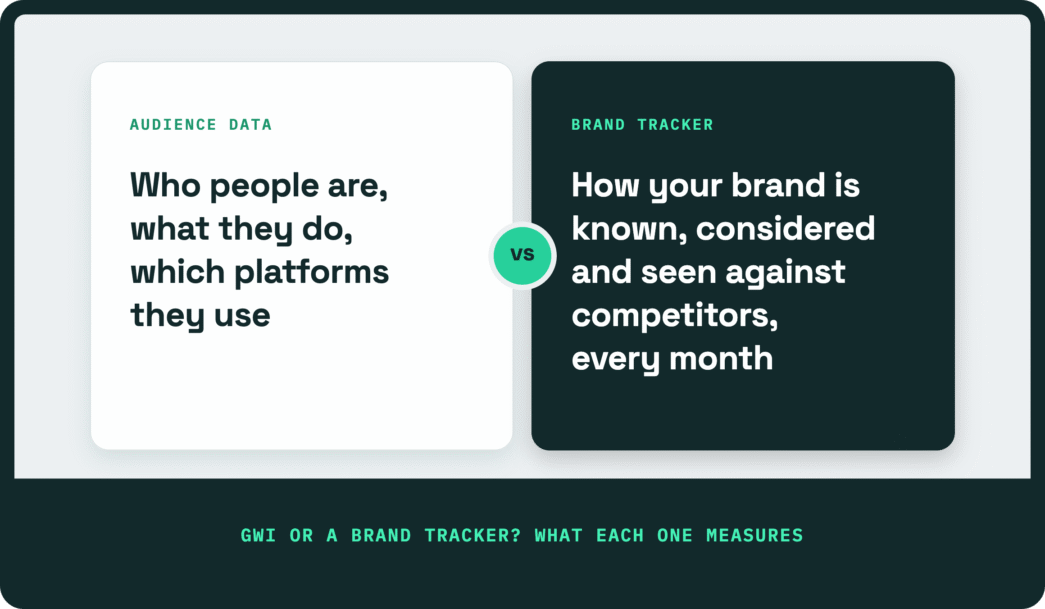
For how consideration fits with the other brand metrics, see What is brand tracking? How it works and who does it.
FAQ
What is brand consideration?
It’s the share of people in a category who would consider buying from a brand the next time they shop it. It sits between awareness and purchase in the funnel.
How do you measure brand consideration?
With a survey question asked the same way each time, to the same audience, with your competitors in the list. Divide it by awareness to see how many of the people who know you would consider you.
What is a good consideration rate?
There isn’t a universal one, because it depends on the category. Compare your conversion from awareness with the median of your competitors, measured the same way.
How do you increase brand consideration?
Start by seeing where it’s lost. If many people know you and few consider you, the gap sits after awareness, in how the brand is seen. The number shows where to look, not the cause.
Why did consideration fall after our campaign?
Often because awareness rose: people who’ve just heard of you consider you less at first. Check consideration on the full sample before calling it a decline.
Method note
Margins of error are computed with the standard formula: 95% confidence, simple random sample, for a result around 50%. The two-brand example is an illustration with round numbers, not survey data.
Sources
- Court, Elzinga, Mulder and Vetvik, “The consumer decision journey”, McKinsey Quarterly, 2009, No. 3: https://www.mckinsey.com/~/media/McKinsey/Business Functions/Marketing and Sales/Our Insights/The consumer decision journey/The consumer decision journey.pdf
- YouGov, brand funnel chart (method illustration): https://datawrapper.dwcdn.net/5o4kN/3
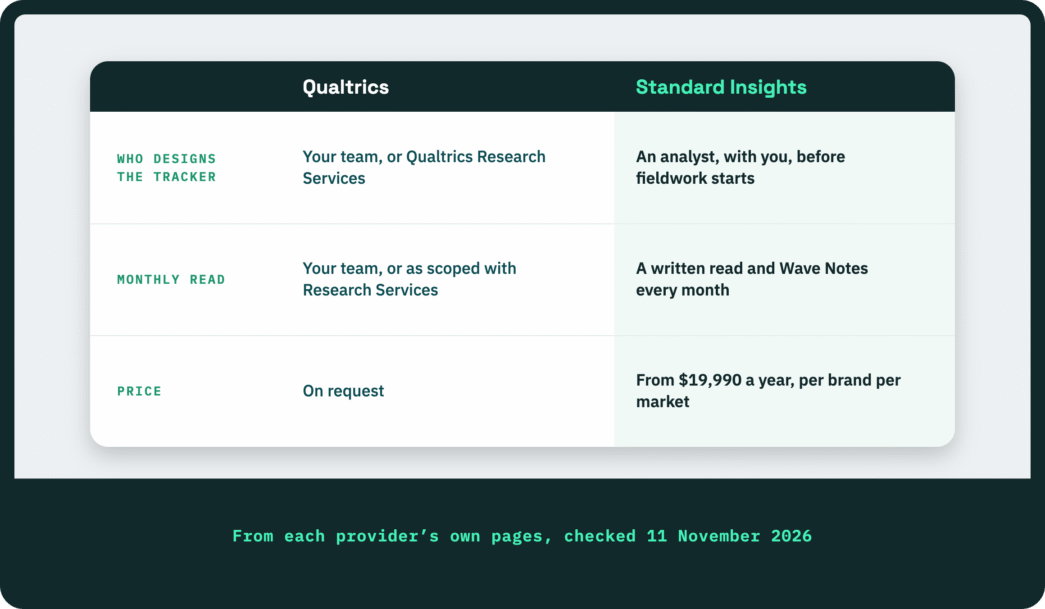
Standard Insights’ tracker measures that gap every month, and asks each buyer why they would or wouldn’t consider your brand and each competitor, so the number comes with its reasons. See Brand Tracking. For a monthly read on brands and consumers, subscribe to Brands & Consumers.