Quick answer. With 300 people surveyed each month, the brand tracking margin of error is about ±5.7 points on any single number, and a change between two months needs about 8 points before you can tell it from noise. So a brand going from 32% to 35% in one month hasn’t shown a real change yet; it counts if it holds for several months.
Every survey number comes with a margin of error
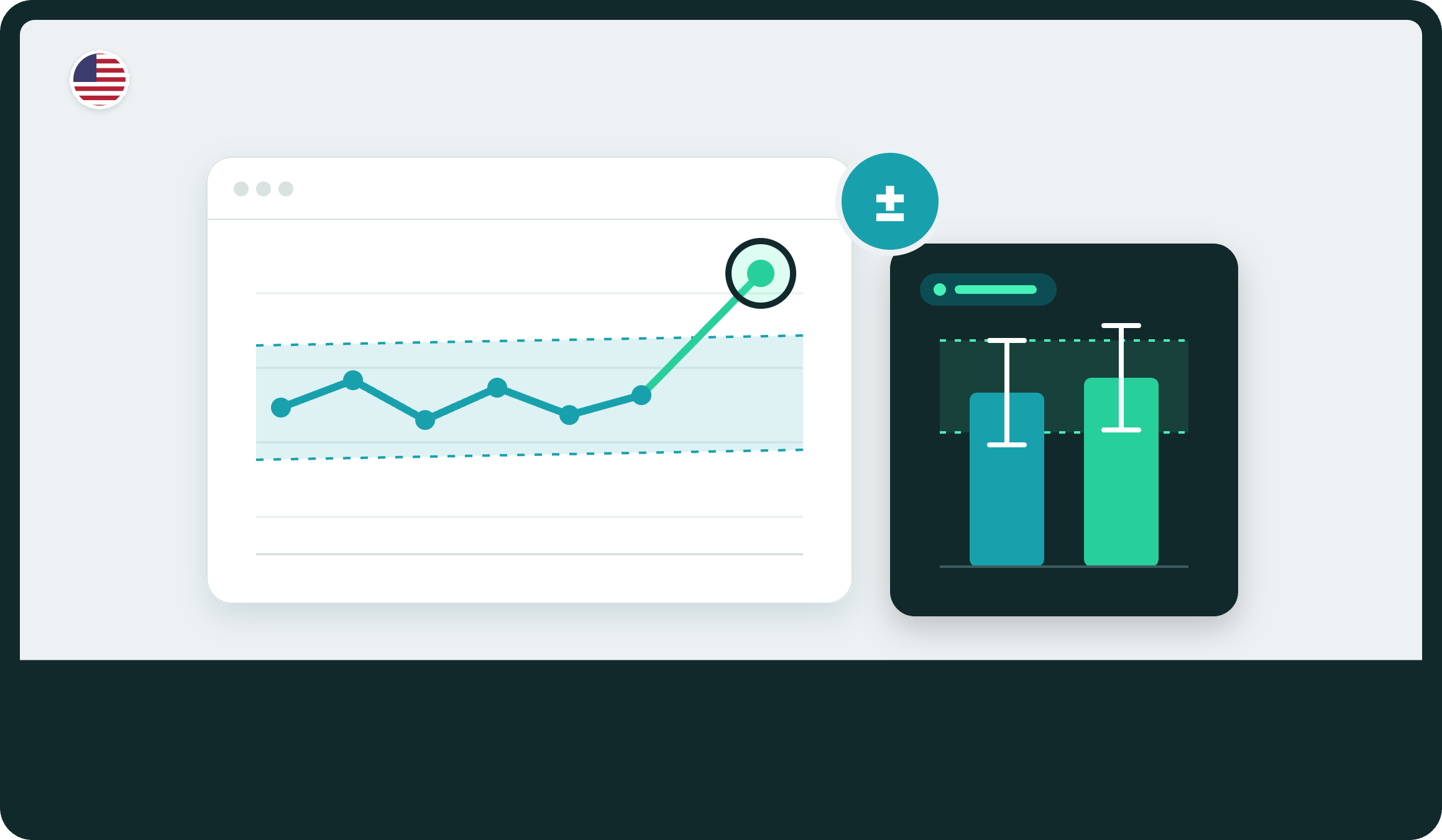
A tracker asks 300 people, not everyone in your market. Ask a different 300 and you’d get a slightly different number. The margin of error tells you how far the true figure could be from the one you got.
Say your awareness is 32% with 300 people. The true figure is most likely somewhere between about 27% and 37%. By convention, researchers use 95% confidence: if you ran the same survey 100 times, about 95 of those ranges would contain the true figure.
The figures on this page are for a result around 50%. Between 30% and 70% they change by less than a point, and closer to 0% or 100% the margin gets smaller. The brand tracking margin of error only covers the luck of who answered. It doesn’t include weighting, or the fact that people on online panels chose to join, so read it as a minimum.
Brand tracking margin of error: a change between two months needs about 8 points at 300 people
When you compare two months, both numbers carry their own margin. So the change between them has to be bigger than either one: about 1.4 times the margin on a single month. Pew Research Center applies the same rule when it compares two polls.
| People surveyed each month | Margin on one number | Change needed between two months |
|---|---|---|
| 300 | ±5.7 points | about 8 points |
| 500 | ±4.4 points | about 6 points |
| 1,000 | ±3.1 points | about 4.4 points |
Take a brand going from 32% to 35% with 300 people each month. That’s a 3-point move against a bar of about 8 points, so you can’t tell it from noise. That doesn’t mean nothing happened. It means the data doesn’t show it yet.
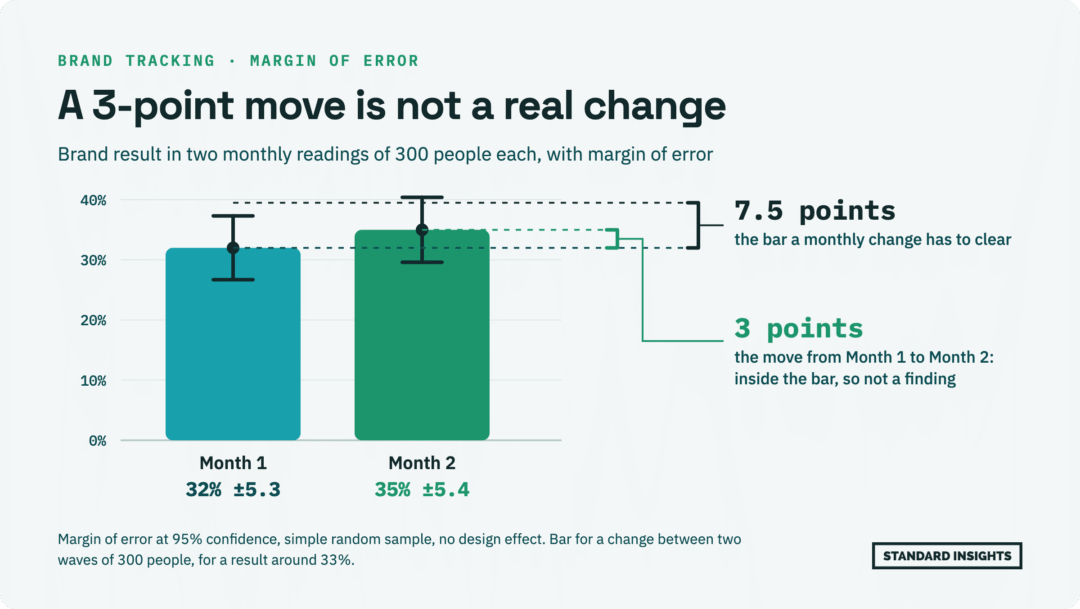
More people narrow the margin, but slowly. Spotting a 3-point move between two months would take about 2,100 people a month.
Averaging three months steadies the number, but a real change takes two or three months to show
Many trackers report a rolling average of the last three months. Standard Insights’ tracker, for example, does so from month three. Three months of 300 people work like one survey of 900, so the margin on the number drops to about ±3.3 points.
The trade-off is speed. Say your awareness truly jumps 6 points in one month and stays there. The rolling figure rises about 2 points a month, for three months, before it shows the full jump.
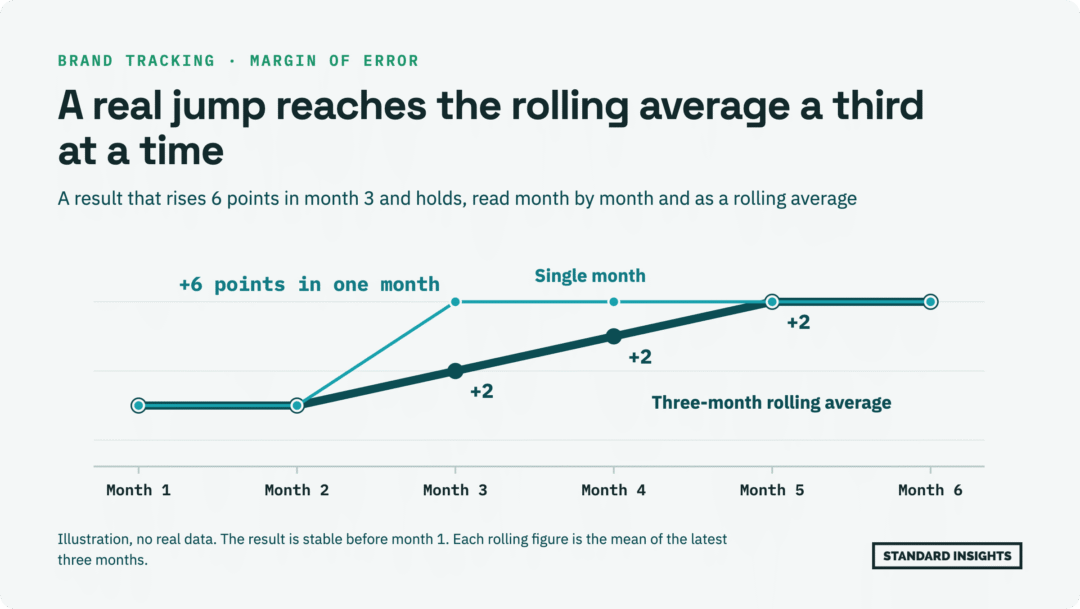
To compare two separate three-month periods (900 people each), the gap needs to be about 4.6 points. A move that keeps going in the same direction month after month is the clearest sign of a real change.
Numbers based on fewer people move more: consideration and audience segments
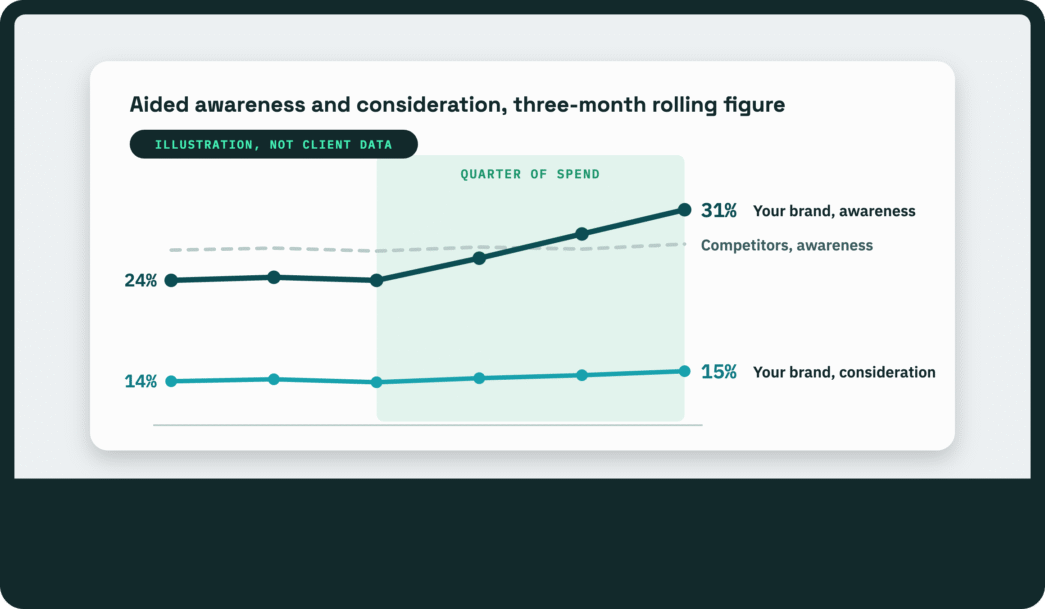
Some figures in a tracker rest on fewer people than the headline sample. Consideration is often asked only of people who know your brand. If 30% of 300 people are aware of you, consideration rests on 90 people. Its margin is about ±10 points, and a change between two months needs about 15.
The same goes for audience segments. A segment of 100 people carries a margin of about ±10 points. Below about 10% awareness, consideration rests on 30 people or fewer, with a margin of around ±18 points: too wide to read on its own.
Three checks before a number goes in the deck
- Is the move bigger than the bar? Check how many people the number rests on, then compare the move with the table above, or with the wider margin for a smaller group.
- Did it hold? A real change keeps showing for two or three months. A tracker with 5 brands and 10 metrics produces 50 numbers a month, so a few will cross the bar by chance alone.
- Did something else change? Seasons can move a brand every year, so compare the move with the whole category. A new questionnaire, a new competitor list or a change in who’s surveyed also moves the numbers. Aided awareness rarely falls fast, so a sudden drop is a reason to check the measurement first.
FAQ
Is a 3-point change in brand awareness significant?
Not at 300, 500 or even 1,000 people a month. With 1,000 people each month, a change still needs about 4.4 points. Spotting a 3-point move takes about 2,100 people a month. A 3-point move becomes credible if it holds for several months.
How many respondents do I need for a 5% margin of error?
About 385, at 95% confidence, for one reading of a result around 50%. To read a change between two months to within 5 points, you need about 770 people each month.
Why does my brand’s consideration jump around more than its awareness?
Consideration is usually asked only of people who know your brand, so it rests on fewer people. At 30% awareness out of 300 people, that’s 90 people, with a margin of about ±10 points.
Can I compare two brands in the same month?
Yes, but test the gap between them, not each brand’s margin separately. When people can pick only one brand, Pew notes that the margin on the gap is about twice the margin on each brand. When they can pick several, it depends on how many picked both.
Method note
Every brand tracking margin of error on this page is computed with the standard formula, margin = 1.96 × √(p × (1 − p) ÷ n), at 95% confidence, for a simple random sample with no weighting, in a large population. None is taken from a Standard Insights survey.
Sources
- Pew Research Center, “Understanding the margin of error in election polls” (Sep 2016): https://www.pewresearch.org/methods/2016/09/08/understanding-the-margin-of-error/
A tracker shows that a number moved and when, not why. When a change holds and a campaign ran in the same period, a campaign recall study shows whether people remember it and what stuck.
For how brand tracking works overall, see What is brand tracking? To see how a monthly tracker reports its numbers, see Brand Tracking. For a monthly read on brands and consumers, subscribe to Brands & Consumers.