Quick answer. Brand tracking means measuring how your brand is doing over time against competitors, either by monitoring what people post and search online or by surveying consumers. Survey-based tracking asks a similar group of consumers the same questions every month or quarter, which shows how many people know, consider and buy your brand, including the many who never post about it.
Brand tracking covers two different things: watching what people post, and asking consumers directly
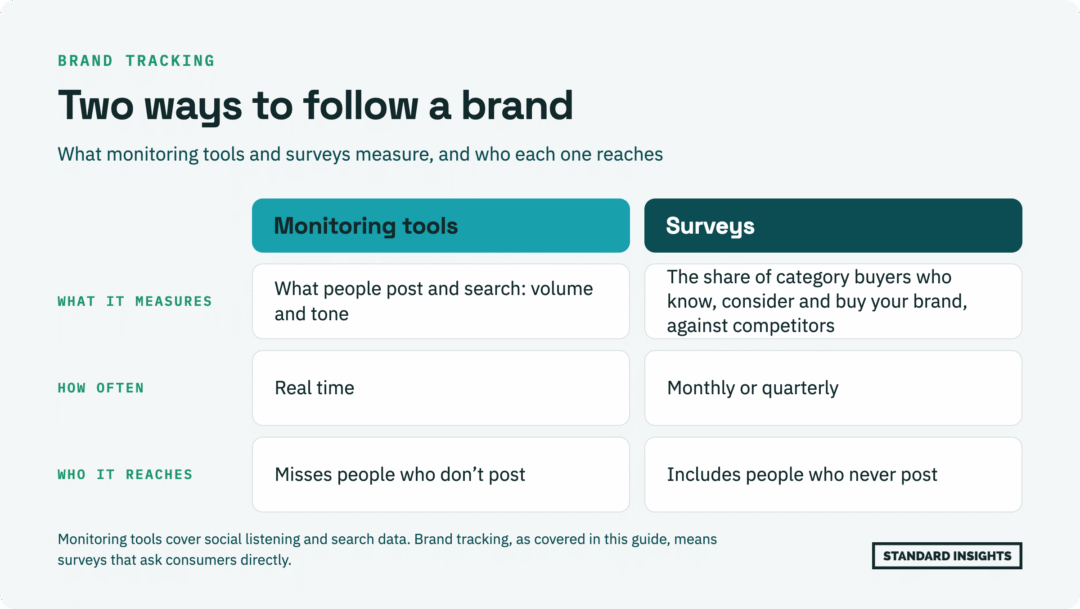
When people talk about brand tracking, they can mean two kinds of tools.
Monitoring tools collect what people already publish or search: social listening, media monitoring, reviews, search trends. They show how often your brand is mentioned, in what tone, on which topics, and your share of voice against competitors. They work in near real time, across large volumes of public posts.
Their limit is who they hear. In Standard Insights’ July 2025 survey of 500 US adults, over 90% said they don’t actively engage with brands online beyond liking posts. Monitoring can’t tell you what share of your category’s buyers know your brand, would consider it, or bought it last month.
Survey-based tracking asks a sample of category buyers directly, with the same questions each time. It reaches people who never post, and gives you shares you can compare with your competitors. In return, it updates monthly or quarterly, and every number comes with a margin of error.
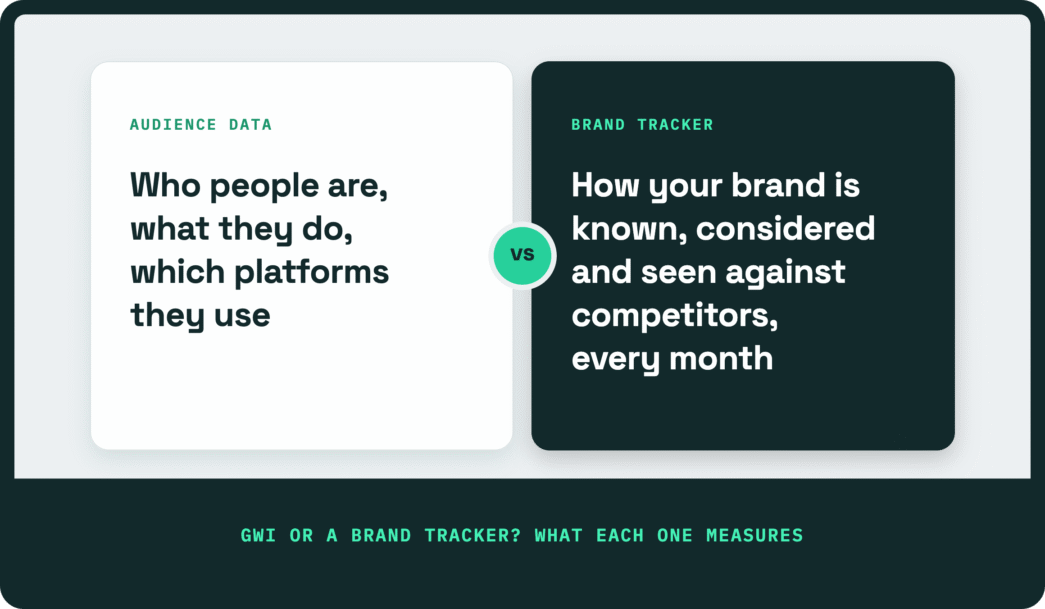
The two answer different questions: monitoring shows what people are saying, surveys show whether your market has moved. Many brands use both. The rest of this page covers survey-based tracking: what it measures, how it works and who sells it.
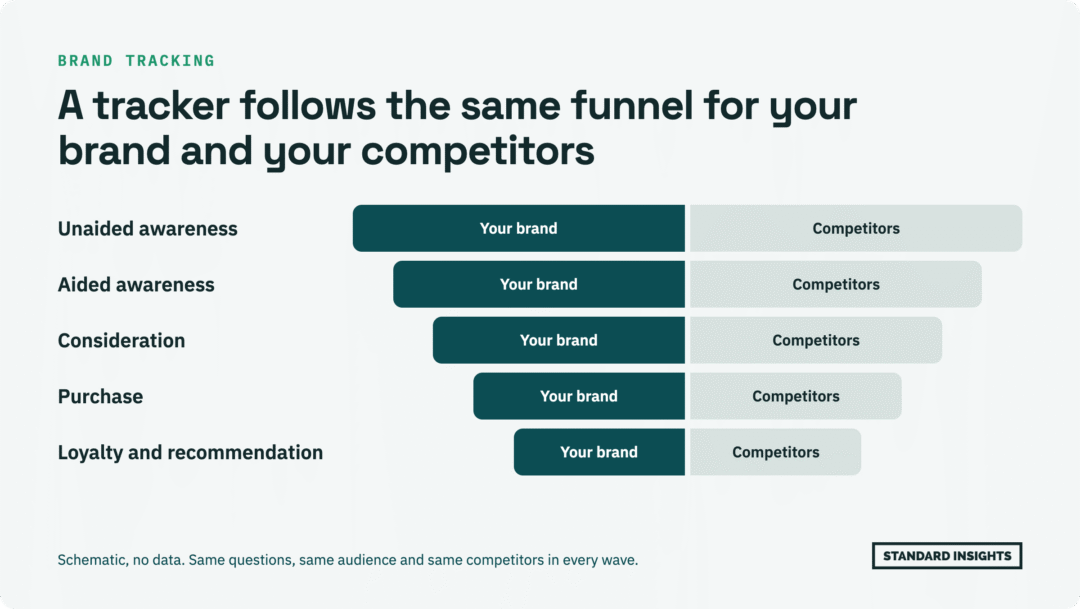
What a brand tracker measures: awareness, consideration, purchase and perceptions, against the same competitors
A brand tracker asks people who buy in your category the same questions about your brand and a fixed list of competitors. The questions cover four areas:
- The funnel: whether people name your brand without a prompt (unaided awareness), recognize it from a list (aided awareness), would consider it, have bought it, prefer it, stay loyal and recommend it.
- Perceptions: what people associate with each brand, and how they rate its price and quality.
- Reasons: why people would or wouldn’t consider each brand.
- Context: whether people remember your ads and where they saw you, and how often and where they buy in the category.
Most providers measure the same basic funnel. YouGov BrandIndex, for example, tracks 16 metrics, including awareness, ad awareness, consideration, purchase intent, satisfaction, value, reputation and recommendation. Providers differ in how many questions they ask on perceptions and reasons. Some combine several metrics into one score or framework; each of these is specific to its provider, not an industry standard.
All results are compared with the same competitors. A 40% awareness score means little until you know whether your competitors are at 20% or 70%.
Why a tracker has to keep the same questions, audience, and competitors every time
A tracker compares your brand with itself over time. If something other than the market changes between two surveys (researchers call each survey a wave), the numbers move for that reason, not because your brand changed. Brand tracking methods vary by provider, but they share one requirement: the survey stays the same from one wave to the next.
Four things stay the same for the whole series: the questions and their order, who you survey, the competitor list, and how the sample is built. The sample has to match from one survey to the next: either a cross-section of all adults, or category buyers selected with the same screening questions. quantilope’s guide to brand tracking says the same and recommends identical quotas and screening every time.
The competitor list is the change people overlook. If you add one competitor, every respondent sees a longer list, so every brand’s consideration score can shift for a reason unrelated to the market. A new competitor list effectively starts a new series.
How often you survey should match how often people buy in your category, as quantilope also recommends. Attest notes that quarterly tracking is common and that fast-moving or high-spending brands often track monthly. With monthly surveys, you can also average several months together, as the next section explains.
How to tell if your brand really moved, and three changes that aren’t real
Because a survey asks a sample rather than everyone, every number has a range of uncertainty: the margin of error. It depends mainly on how many people you ask. For a result around 50%, at 95% confidence, it’s about ±5.7 points with 300 people, ±4.4 with 500 and ±3.3 with 900. When you compare two surveys, both carry their own uncertainty, so the change between them has to be bigger still: about 8 points at 300 people. How to tell a real change from noise.
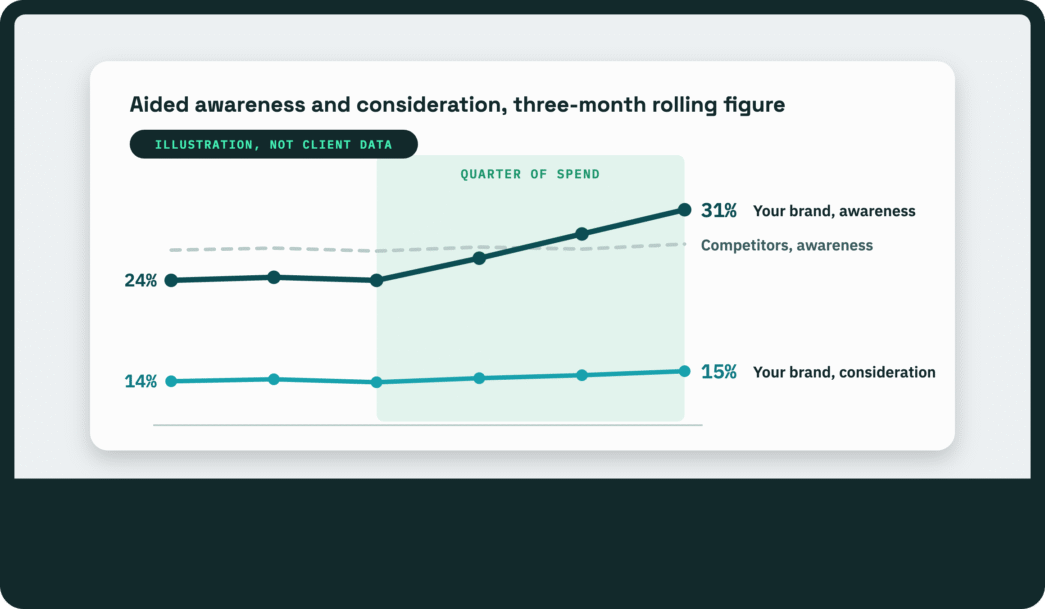
Averaging several months makes the numbers steadier; this is a rolling average. A common setup shows only your position in months one and two. From month three, the headline figures average the last three months, which works like a sample of 900 and brings the margin on the number down to about ±3.3 points. The downside is speed: a real change shows up gradually, over three months.
Three patterns look like movement when nothing has changed in the brand:
- Seasons. A brand can rise every year in its peak season. Compare the change with the whole category, not just with your own past results.
- Awareness going up, consideration going down. When more people know your brand, the share of them who’d consider it often falls, because people who’ve just heard of you are less likely to consider you. This is the dilution effect. The fall comes from the bigger base, so it doesn’t signal a weaker brand.
- A sudden drop in recognition. Aided awareness rarely falls fast. If it drops suddenly, check how it was measured before reading it as a market signal.
A tracker shows what changed and when. It doesn’t show why. To explain a change, you need another study, for example on the campaign, the audience or the concept involved.
Brand health study vs brand tracker: where you stand today vs whether you’re going up or down
“Brand health tracking” often means the same thing as brand tracking. On this page, a one-off brand health study means a single survey: where your brand stands with your audience, against your competitors, at one point in time. A tracker repeats that survey to show whether your brand is going up or down.
The first surveys of a tracker only show your position. You need at least three to see a trend. A one-off study that uses the same questions, audience and competitors as the tracker can become the tracker’s first data point.
Who sells brand tracking: research institutes, daily trackers, survey platforms and monthly trackers
Brand tracking, as covered here, means surveys that ask consumers directly. Social listening and media monitoring count what people post publicly. Both are useful, but listening only hears people who post. In Standard Insights’ July 2025 survey of 500 US adults, over 90% said they don’t actively engage with brands online beyond liking posts.
Research institutes: Kantar, Ipsos
- Kantar builds its brand work on its MDS framework, which measures whether a brand is meaningful, different and salient (comes to mind easily); the Marketing Accountability Standards Board has validated it. Kantar’s BrandDynamics gives daily brand performance indicators against competitors.
- Ipsos sells Brand Health Essentials, a ready-made tracker in nearly 30 markets. You can add your own questions, and results come as a strategic report built around its Brand Desire metric.
- Strength: detailed frameworks and enterprise scale. Limit: built for enterprise budgets, and neither publishes prices.
Daily trackers covering thousands of brands: YouGov BrandIndex, Morning Consult
Also called syndicated trackers.
- YouGov BrandIndex tracks 27,000+ brands daily in 56 markets, from a 30M+ panel.
- Morning Consult Intelligence runs 30,000+ interviews a day across 45+ countries and reports on 4,000+ brands.
- Strength: daily data and comparisons across many brands. Limit: the provider chooses the brand list and the questions, not you.
Survey platforms: Attest, Qualtrics
- Attest builds custom trackers with AI tools, with a dedicated research manager, drawing on 150M+ people across 59 countries.
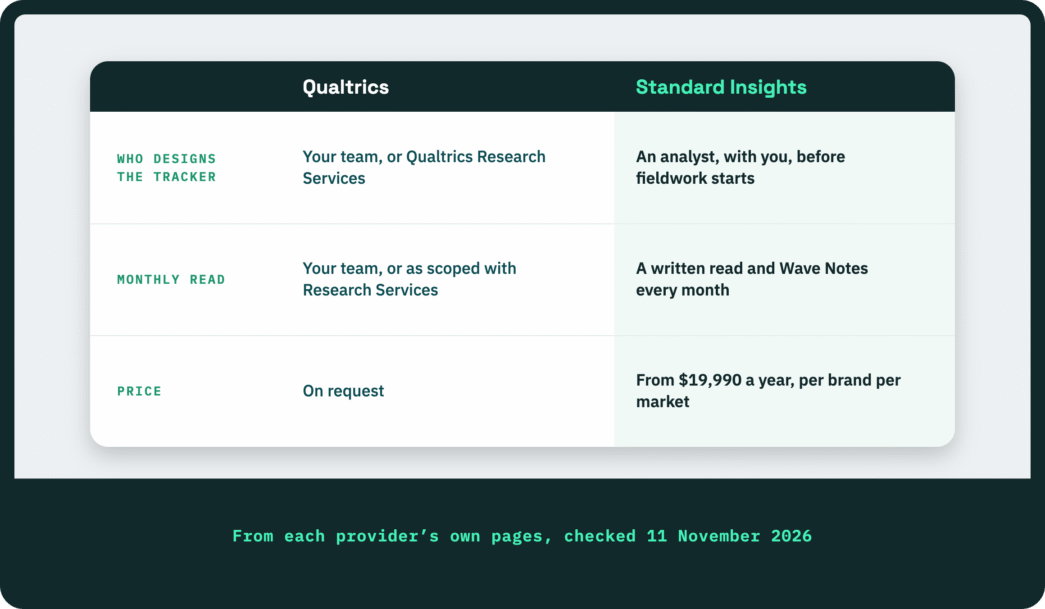
- Qualtrics Brand XM is software: you can use ready-made setups built by brand experts or design your own tracker, and research services are available.
- Strength: flexibility on questions and audience. Limit: your team does more of the design and analysis.
Monthly trackers: Tracksuit, Latana, Standard Insights
- Tracksuit tracks continuously with monthly updates and gives a first benchmark in 30 days.
- Latana updates monthly, with prices per market.
- Standard Insights runs an always-on tracker, updated monthly, with a written analysis of each month’s results. To understand a change or go further, you can run a ready-made study (concept test, campaign recall, audience profile) or your own survey on the same platform.
- Strength: you choose the competitors, the format is ready-made, and all three publish a starting price. Limit: a set format, with less room for custom design than an institute or a platform.
Five questions to ask a brand tracking provider
- Who chooses the competitors and the audience: you, or the provider?
- How many people are surveyed each month, and what’s the margin of error?
- Are changes reported month by month or as a rolling average, and are changes within the margin filtered out?
- What do you get each month: raw data, a dashboard, or a written analysis?
- What can you do when a number changes and you need to know why?
These answers tell you more about what a tracker can show you than its dashboard does.
FAQ
What is brand tracking?
It’s measuring how your brand does over time against competitors. Monitoring tools track what people post and search online; survey-based tracking asks a sample of consumers the same questions every month or quarter, which also covers people who never post.
Is social listening a form of brand tracking?
Yes, in the broad sense: it tracks what people say about your brand in public posts. It can’t measure what share of your market knows or considers your brand, because most people never post about brands. Survey-based tracking measures that.
How often should you run a brand tracker?
Match it to how often people buy in your category. Monthly suits frequently bought categories and brands that advertise year-round; quarterly suits slower categories. Monthly updates also let you average several months, which steadies results from smaller samples.
How many respondents do you need for brand tracking?
It depends on the smallest change you need to detect. At 95% confidence on a 50% result, the margin of error is about ±5.7 points with 300 people, ±4.4 with 500 and ±3.3 with 900. Averaging three months of 300 gives the same margin as 900.
Which companies offer brand tracking?
For survey-based tracking, four types: research institutes (Kantar, Ipsos), daily trackers covering thousands of brands (YouGov BrandIndex, Morning Consult), survey platforms (Attest, Qualtrics) and monthly trackers (Tracksuit, Latana, Standard Insights). They differ on who picks the competitors, how the sample is built and what you receive each month.
How much does brand tracking cost?
Few providers publish prices. Latana starts at €7,900 per market a year, Tracksuit at $19,500 a year and Standard Insights at $19,990 a year per brand per market. Institutes, daily trackers and survey platforms quote on request.
Method note
Standard Insights Consumer Report United States 2025: 500 US adults, July 2025. Margin of error about ±2.6 points at 95% confidence on a result near 90%. Other margins on this page are for a 50% result at 95% confidence. Provider descriptions come from their own pages, checked 1 November 2026.
Sources
- quantilope, guide to brand tracking (1 Dec 2025): https://www.quantilope.com/resources/guide-to-brand-tracking
- Kantar, Brand Guidance: https://www.kantar.com/Solutions/Brand-Guidance
- Kantar, BrandDynamics: https://kantar.com/north-america/campaigns/branddynamics-md
- Ipsos, Brand Health Essentials: https://www.ipsos.com/en-uk/brand-health-essentials
- YouGov, BrandIndex: https://yougov.com/en-us/business/products/brandindex
- Morning Consult, Intelligence: https://morningconsult.com/products/intelligence
- Attest, brand tracker: https://www.askattest.com/brand-tracker
- Qualtrics, Brand XM: https://qualtrics.com/brand-experience/
- Tracksuit, product page: https://www.gotracksuit.com/au/product
- Tracksuit blog, market research tools: https://www.gotracksuit.com/blog/posts/market-research-tools
- Latana, pricing: https://www.latana.com/pricing
- Standard Insights, Consumer Report United States 2025: https://standard-insights.com/consumer-report-united-states-2025/
To see how a monthly tracker and its report work, see Brand Tracking. For a monthly read on brands and consumers, subscribe to Brands & Consumers.