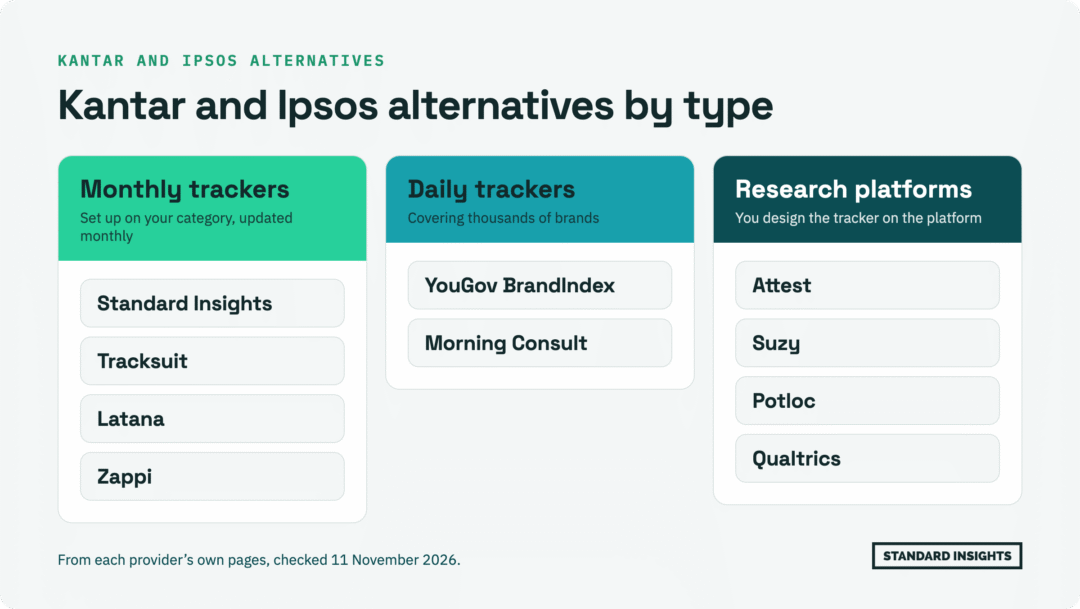
Quick answer. Kantar and Ipsos build brand tracking on their own frameworks, from always-on trackers to custom programs, mostly for large companies with an insights team, and neither publishes a price. The main Kantar brand tracking alternatives are monthly trackers with a published starting price (Standard Insights from $19,990 a year, Tracksuit, Latana, Zappi), which suit a marketing team that needs its category measured and read every month.
What Kantar and Ipsos do well
Research institutes bring depth that few others can match: work across many markets at once, programs designed around a company’s own questions, and weight with boards.
Kantar builds its brand work on its Meaningful, Different, Salient framework (MDS), which it describes as independently validated. Its range covers BrandHealth, a tracking program designed for “your brand, your category, your market”; BrandDynamics, an always-on tracker with daily signals and forecasts; BrandDigital, a monthly tracker; and BrandSnapshot, free to explore, with 10,000+ brands across 42 markets.
Ipsos sells Brand Health Tracking in several forms, from a survey-only approach built for speed and simplicity to surveys combined with other data and the management of global KPIs. It introduced Brand Health Essentials in August 2025.
If you run brands in many markets, or want a brand equity model built around your business, an institute is designed for that.
Six reasons marketing teams choose Standard Insights over an institute tracker
1. A starting price published before the first call
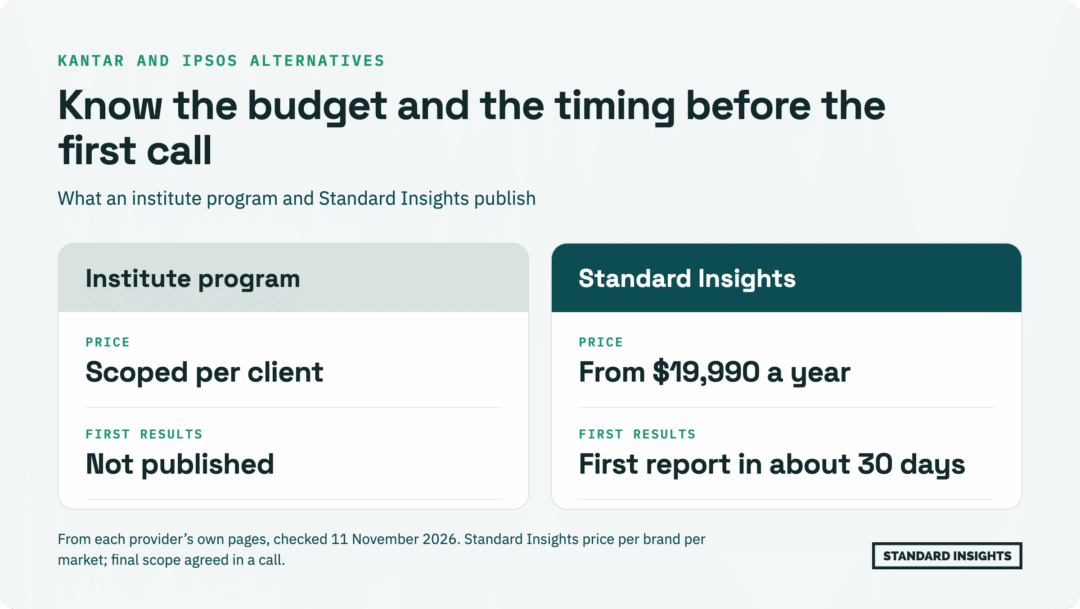
Standard Insights Brand Tracking starts at $19,990 a year per brand and per market. Neither Kantar nor Ipsos publishes a price on its brand tracking pages: both send you to their team. You know the budget range before the conversation starts; the final scope (competitors, audience) is agreed in a call.
2. Your first report about 30 days after signing
An analyst sets up the tracker with you before fieldwork starts: your brand and four competitors, your category buyers, five attributes that matter in your market. The first report arrives about 30 days after signing, and the setup then stays the same for the year, so every month compares like with like.
3. A written read of every month, by our analysts, without an insights team on your side
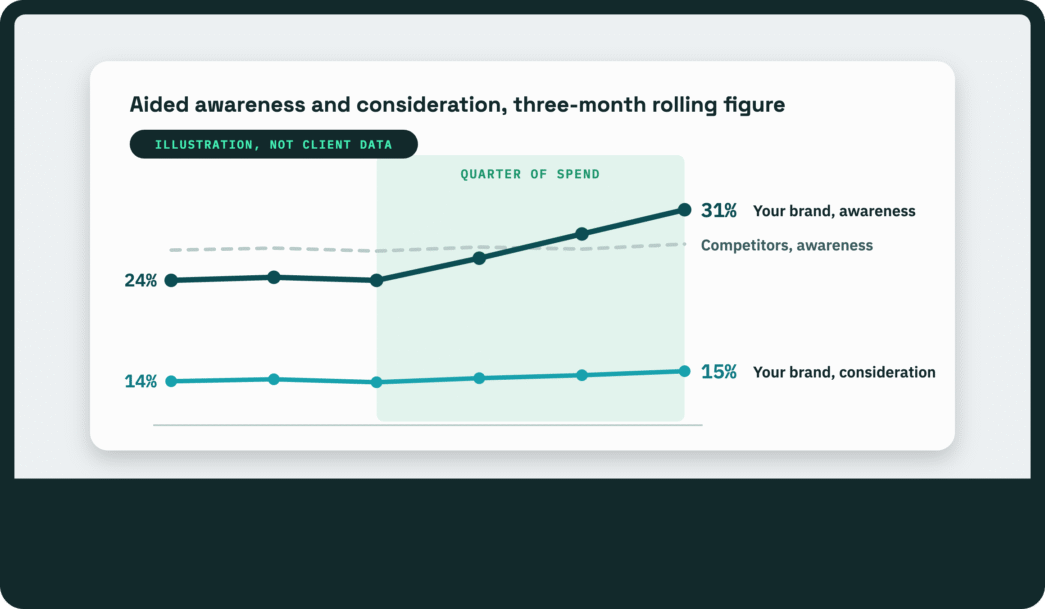
Each month’s results arrive with a written read and a Wave Notes tab: what moved, what held, what to watch next month, and an answer to last month’s watchlist. From month three, each move is labeled confirmed (it held), reverted (it came back) or emerging (it’s starting to show). A marketing team without research staff gets the month already read.
4. You see why buyers pass on your brand
For each brand, the tracker asks why people would or wouldn’t consider it, ranks what matters most when they choose in your category, and measures how they rate price and quality. When consideration drops, you read the reasons next to the number, for your brand and for each competitor.
5. You see what AI assistants tell shoppers about your brand, next to what buyers think
With AI Brand Tracking, available with the tracker, each report page shows what AI assistants answer about your brand, right below the survey results, never merged into one score. The tracker also asks buyers where they get information when they choose a brand, AI assistants included.
6. When a number moves, the next step is on the same platform
The question after a move is usually a decision: test a new concept, check whether people remember a campaign, understand an audience you’re losing. On Standard Insights, you run that study on the same platform, with the same audience and competitors already set up.
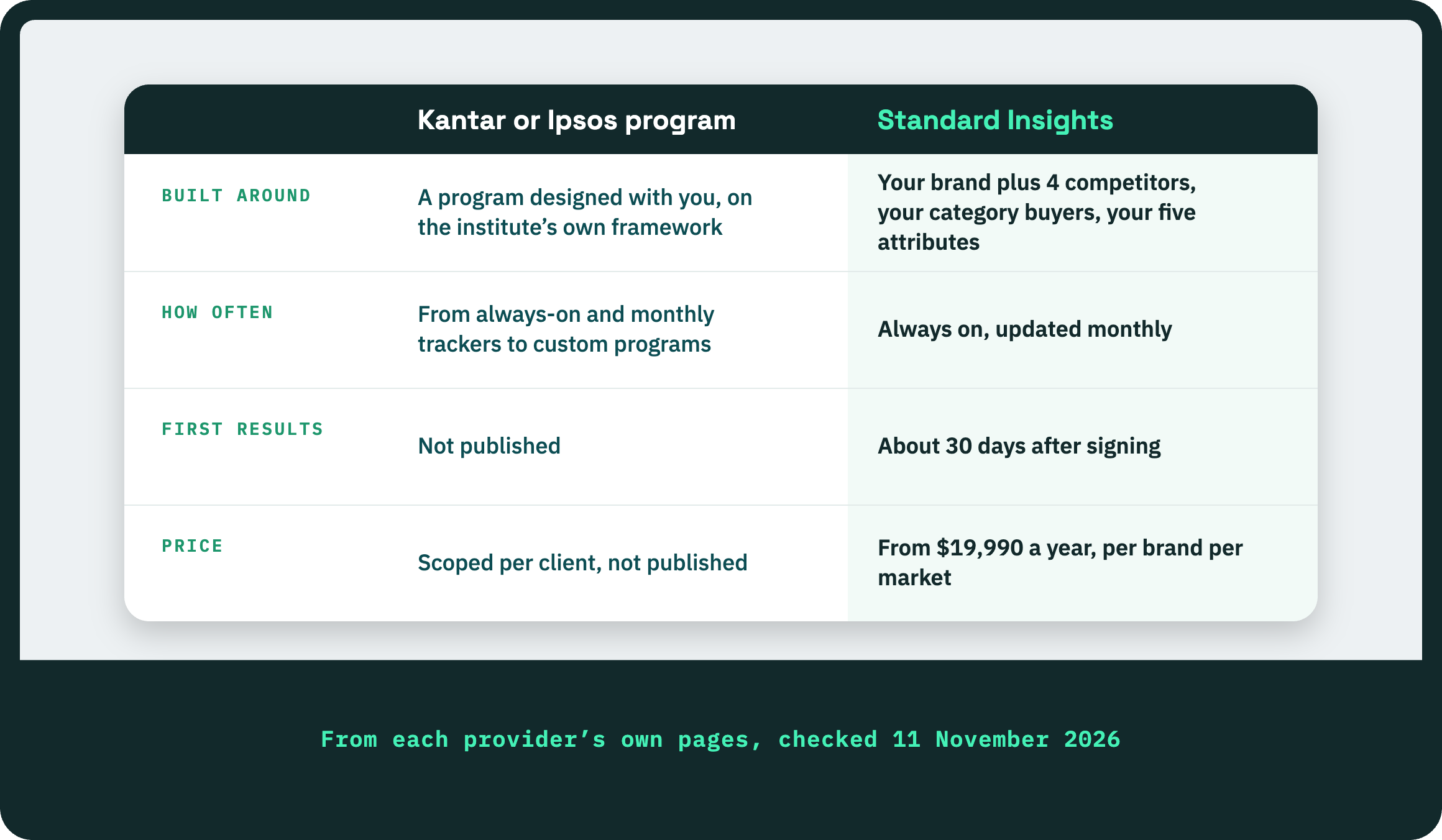
Institute tracker vs Standard Insights, side by side
| Kantar or Ipsos program | Standard Insights | |
|---|---|---|
| Built around | A program designed with you, on the institute’s own framework (MDS for Kantar) | Your brand plus 4 competitors, your category buyers, your five attributes |
| How often | From always-on and monthly trackers to custom programs | Always on, updated monthly; three-month rolling figure from month three |
| What’s measured | Set by the program and the framework | Funnel from unaided awareness to NPS; why people consider each brand or not; ranked purchase drivers; price and quality perception; ad recall; where buyers get information, AI assistants included |
| What you get each month | Set by the program | A report with a written read and Wave Notes; personas; AI chat on your own data; exports |
| First results | Not published | About 30 days after signing |
| Price | Scoped per client, not published | From $19,990 a year, per brand per market |
Other Kantar and Ipsos alternatives
- Tracksuit: monthly, from $19,500 a year for one category, your brand plus five competitors.
- Latana: monthly, from €7,900 (Essential) or €18,900 (Pro) per market a year.
- Zappi Brand Health Tracker: 12 monthly waves of about 400 responses, listed at $25,500.
- YouGov BrandIndex and Morning Consult Intelligence: daily trackers covering thousands of brands; YouGov quotes per client, Morning Consult publishes no price.
- Attest, Suzy and Potloc: research platforms with a service team, where you design the tracker with their support.
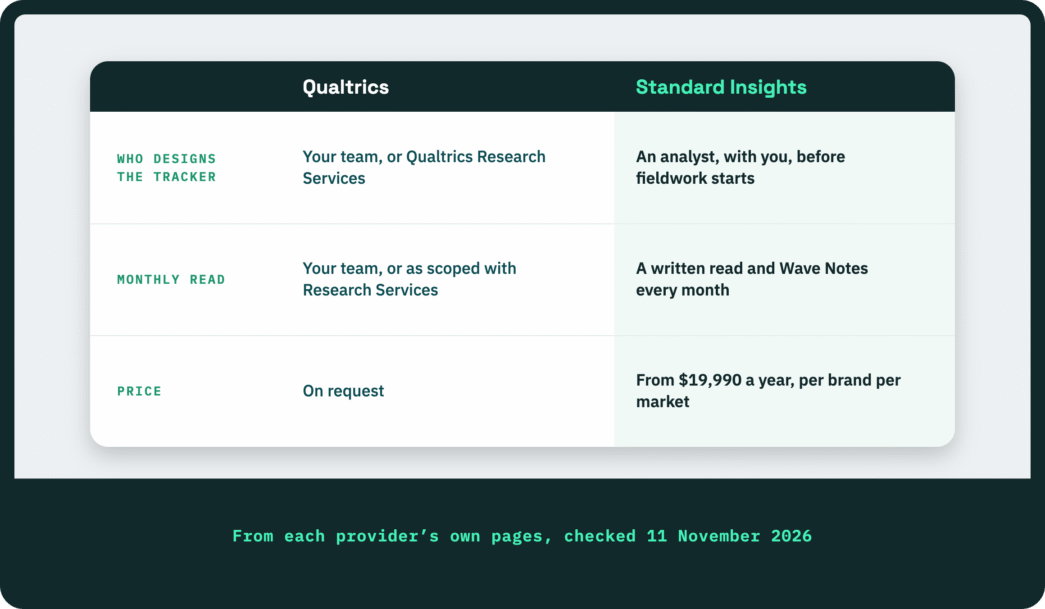
- Qualtrics: for teams that already run their research on Qualtrics.
When an institute is still the better fit
- You need many markets at once, run as one program.
- You want a custom brand equity model built around your business.
- You link brand data to econometrics or other models across your marketing.
FAQ
How much does a Kantar or Ipsos brand tracker cost?
Neither publishes a price; both scope each program with the client.
Are there cheaper Kantar brand tracking alternatives?
Several trackers publish a starting price: Standard Insights from $19,990 a year per brand per market, Tracksuit from $19,500 for one category, Latana from €7,900 per market. Each covers something different, so compare what’s included, not only the price. Ipsos doesn’t publish a price either.
What’s the difference between an institute tracker and a monthly tracker?
An institute designs a program around you, often across many markets, at a price scoped per client. A monthly tracker like Standard Insights is set up on your category and competitors, with a published starting price and a written read every month.
Does Kantar have an always-on tracker?
Yes. BrandDynamics is an always-on tracker with daily signals and forecasts, and BrandDigital is a monthly tracker.
Why switch from Kantar or Ipsos to Standard Insights?
For a published starting price, a first report about 30 days after signing, and a written read of every month without needing an insights team, plus why buyers pass on your brand, what AI assistants tell shoppers about it, and the next step on the same platform.
About this comparison
Information about Kantar, Ipsos and the other trackers comes from their own public pages, checked on 11 November 2026. Prices are published starting prices, before extras or negotiated terms. We review this page every six months.
Sources
- Kantar, Brand Guidance: https://www.kantar.com/solutions/brand-guidance
- Ipsos, Brand Health Tracking: https://www.ipsos.com/en-us/solutions/brand-health-tracking/brand-activation-tracking
- Ipsos, Introducing Brand Health Essentials (25 Aug 2025): https://www.ipsos.com/en-us/introducing-brand-health-essentials
- Tracksuit blog, market research tools (22 Apr 2026): https://www.gotracksuit.com/blog/posts/market-research-tools
- Latana, pricing: https://www.latana.com/pricing
- Zappi, choosing the right brand health solution: https://learn.zappi.io/article/270-choosing-the-right-brand-health-solution-for-you
- YouGov, Best brand tracking tools for 2026 (11 Dec 2025): https://yougov.com/en-us/guides/53712-best-brand-tracking-tools-for-2026
- Morning Consult, Intelligence: https://morningconsult.com/products/intelligence
For how brand tracking works overall, see What is brand tracking? To see the tracker and a sample report, see Brand Tracking.